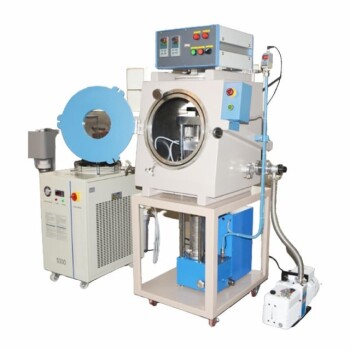
The definitive answer to "what conditions are needed?" is clear: hot-pressing h-BN ceramics demands a furnace capable of simultaneously delivering temperatures up to 1900°C, a controlled nitrogen atmosphere, and uniaxial pressure around 50 MPa. A sintering additive like boron oxide (B₂O₃) is typically required to kickstart liquid-phase sintering, enabling the powder to rearrange and densify into a solid component.
The entire process hinges on preventing oxidation while forcing the intrinsically difficult-to-sinter h-BN powder into a dense bulk. A nitrogen environment protects the material up to its pressing temperature, while the combination of heat and uniaxial pressure overcomes the natural resistance of its plate-like crystal structure to achieve 81%–96% of theoretical density.
Why Standard Sintering Fails for h-BN
Hexagonal boron nitride has a strong, covalent, plate-like crystal structure. This makes full densification virtually impossible through simple, pressureless sintering in a conventional furnace. The plates resist packing together tightly without an external driving force.
The Necessity of Simultaneous Heat and Pressure
To turn loose h-BN powder into a solid, usable component, you must apply uniaxial mechanical pressure while the material is at peak temperature. This simultaneous action is what defines the hot-pressing process.
- It promotes grain alignment: The pressure encourages the plate-like grains to orient themselves, improving properties like thermal conductivity in the pressing direction.
- It enables plastic deformation: At high temperature, the material becomes more malleable, and the constant force causes the plates to slide, creep, and close porosity.
- It drives diffusion: The combination of heat and stress accelerates bulk diffusion, which is the primary mechanism for eliminating the last pockets of porosity.
The Critical Role of Thermal Atmosphere
The atmosphere inside the furnace is not a secondary detail; it is the primary factor that determines whether the h-BN densifies successfully or catastrophically degrades. h-BN’s stability is fundamentally tied to its environment.
Nitrogen: The Primary Processing Shield
The primary reference and all supporting data point to a controlled nitrogen (N₂) atmosphere as the standard for hot-pressing at 1900°C. This is non-negotiable.
- Prevents Degradation: In inert or reducing environments without nitrogen, the material can begin to decompose at extreme temperatures. A nitrogen overpressure counteracts this.
- Extends Operational Limits: While h-BN melts near 2600°C, its maximum stable service temperature in a nitrogen atmosphere is up to 2400°C, providing a wide safety margin for a 1900°C processing step.
Atmosphere-Dependent Stability: A Deeper Look
The choice of environment has a dramatic effect on how much heat the material can withstand before it fails. This is crucial for understanding both the processing step and the final component’s application limits.
- In oxidizing air: Stability is limited to just 1,000°C. Even a trace of oxygen during hot-pressing would instantly lead to surface oxidation and component failure.
- In inert argon: Stability extends up to 2,200°C. While possible, nitrogen is preferred for processing to actively suppress decomposition.
- In nitrogen: Stability is maximized at 2,400°C, making it the ideal protective gas for the entire 1,900°C hot-pressing cycle.
Step-by-Step Breakdown of the Hot-Pressing Cycle
The 1900°C target is the peak temperature, but the process relies on a sequence of events triggered by temperature, pressure, and a critical additive.
The Role of Sintering Additives (B₂O₃)
Pure h-BN powder will not densify well even with heat and pressure. A low-melting additive, most commonly boron oxide (B₂O₃) , is essential.
- Liquid-Phase Formation: As the furnace heats up, the B₂O₃ begins to melt around 550°C.
- Facilitating Rearrangement: This intergranular liquid phase lubricates the h-BN plates, allowing them to slide and rearrange under the applied pressure long before the peak temperature is reached.
- Enhancing Diffusion: The liquid phase provides a fast diffusion path, which is critical for achieving final densities between 81% and 96%.
A Typical Consolidation Recipe
To achieve a dense h-BN ceramic, the following parameters are all brought together in a single furnace cycle:
- Peak Temperature: Up to 1,900°C.
- Uniaxial Pressure: Typically 50 MPa.
- Hold Time: Often around 60 minutes to allow diffusion and pore closure to reach completion.
- Atmosphere: A continuous flow or positive pressure of high-purity nitrogen.
Understanding the Trade-offs
No process is perfect, and hot-pressing h-BN involves specific compromises that must be understood.
The Density Ceiling
You will not achieve 100% theoretical density. The final product typically falls in the range of 81%–96%. This inherent residual porosity is a trade-off for the material's excellent machinability and thermal shock resistance. Attempting to force full density can lead to grain growth and property degradation.
Vacuum Processing for Composites
The required atmosphere can change if you are creating a composite. For example, consolidating h-BN with a reactive phase like titanium diboride (TiB₂) is often best performed under vacuum up to 1900°C with a pressure of 30 MPa. This prevents the oxidation of the non-oxide second phase, which would be a risk even in a nominally inert nitrogen environment.
The Additive’s Double-Edged Sword
The B₂O₃ sintering aid is mandatory, but it remains as a secondary glassy phase at grain boundaries. This can be a limiting factor if the final part is used in applications with very high moisture sensitivity or corrosive environments, where the additive could leach out, weakening the component.
Making the Right Choice for Your Goal
The precise operating conditions you select should be tailored to your final application’s requirements. A single parameter shift can significantly alter properties.
- If your primary focus is highest density and mechanical strength: Use a nitrogen atmosphere, 1900°C peak temperature, 50 MPa uniaxial pressure, and a B₂O₃ additive, ensuring a sufficient one-hour hold time.
- If your primary focus is maximum purity and high-temperature stability: Investigate advanced additive systems that yield less residual grain-boundary phase, or precisely control the B₂O₃ content to the minimum needed for densification, staying within the nitrogen atmosphere limits.
- If your primary focus is a complex composite part: Evaluate whether a vacuum atmosphere is more appropriate than nitrogen to protect the secondary phase from reaction, and adjust the pressure profile accordingly.
- If your primary focus is component service life in air: Remember the 1,000°C hard limit. You may need to consider a protective coating applied after pressing, as the hot-pressing process itself cannot solve the inherent oxidation weakness of h-BN.
The art is in the integration: a 1900°C furnace, a pure nitrogen shield, 50 MPa of uniaxial force, and the correct use of a liquid-phase sintering additive are the essential pillars that transform loose h-BN powder into a high-performance ceramic.
Summary Table:
| Parameter / Condition | Recommended Value | Primary Purpose / Role |
|---|---|---|
| Peak Temperature | Up to 1900°C | Enables grain plasticity and bulk diffusion |
| Uniaxial Pressure | ~50 MPa | Forces rearrangement, grain alignment & pore closure |
| Thermal Atmosphere | High-Purity Nitrogen (N₂) | Prevents thermal degradation & oxidation (stable up to 2400°C) |
| Sintering Additive | Boron Oxide (B₂O₃) | Melts at ~550°C to provide liquid-phase densification |
| Hold Time | ~60 minutes | Ensures complete diffusion and structural consolidation |
| Target Density | 81% – 96% Theoretical | Balances mechanical strength and exceptional machinability |
Upgrade Your Advanced Ceramic Processing with KINTEK
Achieving precise atmosphere control, uniform mechanical force, and extreme temperatures up to 1900°C requires dependable processing equipment. KINTEK specializes in advanced laboratory equipment and consumables, offering a comprehensive range of high-temperature furnaces—including atmosphere, vacuum, hot-press, muffle, and customizable furnace solutions tailored to your unique material synthesis needs.
Whether you are refining h-BN densification parameters or developing next-generation composite ceramics, our tailored systems give your lab the thermal accuracy and reliability it demands. Contact KINTEK today to consult with our high-temp furnace experts!
Related Products
- Dental Porcelain Zirconia Sintering Ceramic Vacuum Press Furnace
- 1700℃ Controlled Inert Nitrogen Atmosphere Furnace
- 1400℃ Controlled Inert Nitrogen Atmosphere Furnace
- Laboratory Muffle Oven Furnace with Bottom Lifting
- 2200 ℃ Graphite Vacuum Heat Treat Furnace
People Also Ask
- What factors determine the quality of sintered zirconia restorations? Master Material, Equipment, and Technique
- How do conventional vs rapid sintering in dental furnaces affect zirconia? Optimize Efficiency Without Sacrificing Strength
- What is the purpose of dental sintering furnaces? Transform Zirconia into Durable, High-Quality Dental Restorations
- What precautions should be taken when sintering zirconia in the Fast Slow Dental Sintering Furnace? Master Key Steps for Perfect Results
- What temperature range is used for sintering zirconia ceramics? Achieve Optimal Strength and Translucency