
A high-temperature muffle furnace provides a stable, 550°C oxidative environment essential for the analysis of fruit powder.
This specific thermal condition facilitates the complete oxidative decomposition of all organic substances within the sample. By maintaining this constant extreme temperature, the furnace ensures that only pure inorganic mineral residues remain, which is a prerequisite for accurately measuring the total ash proportion.
The muffle furnace acts as a critical separator, utilizing sustained, high-intensity heat to drive the transition from organic matter to inorganic residue. This process eliminates carbon-based components entirely, leaving behind a pure mineral sample necessary for precise quantitative analysis.
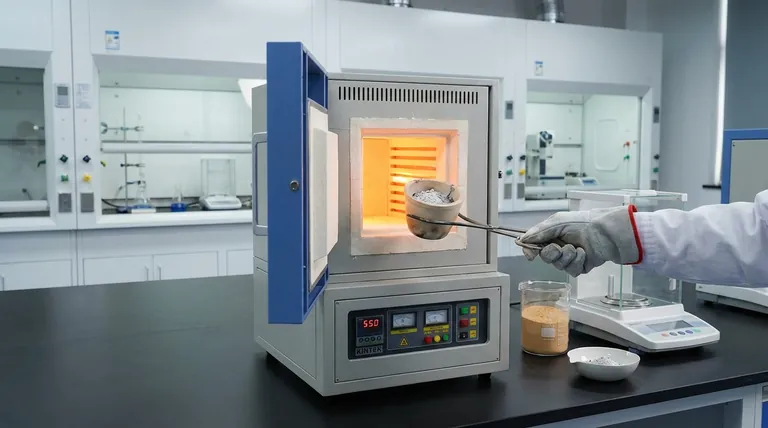
Creating the Necessary Thermal Environment
Stability at 550°C
For fruit powders, the furnace must maintain a rigorous temperature setting of 550°C.
This specific temperature is the "sweet spot" identified for this material. It is high enough to induce combustion but controlled enough to be the standard for fruit-based matrices.
The "Extreme" Prerequisite
The environment provided is described as "extreme" because it must force a chemical change, not just a physical one.
Mere drying is insufficient; the furnace provides the intense energy required to break down complex organic structures found in fruit.
Consistent Heat Distribution
The "muffle" design ensures that the heat is applied uniformly around the sample.
This stability prevents hot spots or cold spots, ensuring that the entire sample undergoes decomposition at the same rate.
The Mechanism of Oxidative Decomposition
Eliminating Organic Matter
The primary function of this process condition is the removal of organic substances (carbon, hydrogen, nitrogen).
Fruit powders are rich in organics; the furnace uses heat and oxygen to convert these into gases (volatilization), removing them from the crucible.
Dry Ashing
This process is technically referred to as dry ashing.
It relies on the complete combustion of the sample in air, without the addition of liquid reagents, to isolate the mineral content.
Achieving Complete Oxidation
The process is only considered successful if "complete oxidative decomposition" occurs.
If the environment is not maintained correctly, black carbon residues may remain, leading to inaccurate, elevated weight measurements.
The Result: Isolating Inorganic Residues
Defining "Pure Ash"
The goal of these process conditions is to obtain pure ash.
In the context of fruit powder, pure ash consists exclusively of inorganic mineral residues.
Evaluating Purity
This residue serves as a proxy for the mineral quality and purity of the raw material.
By stripping away the organic framework, the furnace reveals the baseline mineral content hidden within the fruit structure.
Preparation for Further Analysis
While the primary goal is determining total ash proportion, this process is also foundational for downstream tasks.
Obtaining a clean, carbon-free ash is often a prerequisite for subsequent trace element analysis.
Understanding the Precision Trade-offs
The Risk of Incomplete Combustion
If the furnace fails to maintain the stable 550°C environment, oxidation may be incomplete.
This results in "black ash" containing unburned carbon, which artificially inflates the ash content reading and renders the data invalid.
Temperature Specificity
While other materials (like biomass briquettes) may require temperatures up to 900°C, fruit powders require the specific 550°C standard.
Deviating to higher temperatures unnecessarily risks the volatilization (loss) of certain volatile minerals, while lower temperatures fail to burn off the organics.
Making the Right Choice for Your Goal
To ensure accurate ash content analysis of fruit powders, ensure your equipment capabilities align with your analytical objectives:
- If your primary focus is Total Ash Quantification: Ensure your furnace can maintain a strictly stable 550°C to guarantee the weight of the residue reflects only inorganic minerals.
- If your primary focus is Trace Element Analysis: Verify that the oxidation is visibly complete (white/grey ash) to ensure no organic carbon interferes with subsequent chemical testing.
Ultimately, the reliability of your data depends entirely on the furnace's ability to sustain a stable environment for complete oxidative decomposition.
Summary Table:
| Process Condition | Requirement for Fruit Powder | Purpose/Outcome |
|---|---|---|
| Temperature Setting | 550°C (Stable) | Standardizes combustion for fruit matrices |
| Atmospheric State | Oxidative Environment | Ensures complete decomposition of organic matter |
| Heating Method | Uniform Muffle Design | Prevents hot/cold spots for consistent results |
| Key Mechanism | Dry Ashing | Converts carbon/organics into volatile gases |
| End Product | Pure Inorganic Residue | Isolate minerals for quantitative analysis |
Elevate Your Laboratory Precision with KINTEK
Ensure absolute accuracy in your ash content analysis with KINTEK’s high-performance laboratory solutions. Backed by expert R&D and manufacturing, KINTEK offers a wide range of Muffle, Tube, Rotary, Vacuum, and CVD systems, all fully customizable to meet your unique temperature and atmospheric needs.
Whether you are analyzing fruit powders at 550°C or conducting advanced trace element research, our high-temperature furnaces provide the thermal stability and uniform heat distribution your data depends on.
Ready to optimize your heat treatment processes? Contact us today to discuss your custom furnace solution.
References
- Recep Güneş. A Study on Quality Properties of Blackthorn (<i>Prunus spinosa</i> L.) Fruit Powder Obtained by Different Drying Treatments. DOI: 10.1051/bioconf/20248501011
This article is also based on technical information from Kintek Furnace Knowledge Base .
Related Products
- 1700℃ High Temperature Muffle Oven Furnace for Laboratory
- 1800℃ High Temperature Muffle Oven Furnace for Laboratory
- 1200℃ Muffle Oven Furnace for Laboratory
- 1400℃ Muffle Oven Furnace for Laboratory
- High Temperature Muffle Oven Furnace for Laboratory Debinding and Pre Sintering
People Also Ask
- What is the primary function of a high-temperature laboratory muffle furnace in chemical synthesis? Achieve Precision.
- How does a high-temperature laboratory muffle furnace affect material properties? Transform Anodic Oxide Films Fast
- What role does a muffle furnace play in BCZY712 electrolyte powder production? Achieve Perfect Phase Purity
- How does a muffle furnace impact Ni/MgAl2O4 catalysts? Optimize Stability and Catalytic Performance
- What is the role of a high-temperature muffle furnace in guava leaf carbonization? Master Precise Pyrolysis Control

















