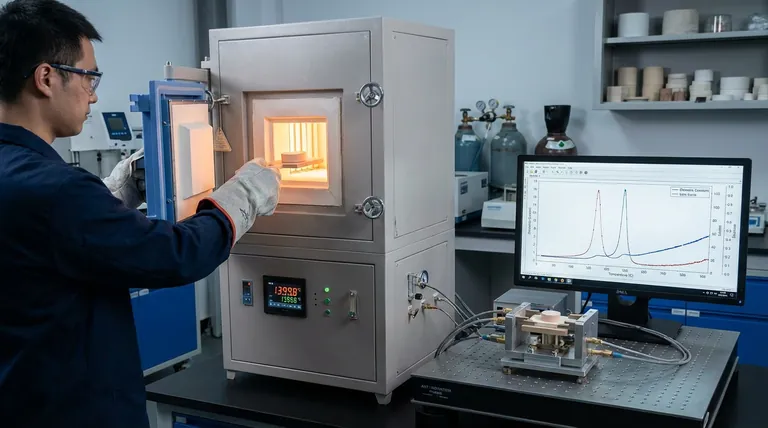
Precision is the cornerstone of material characterization. Integrating digital PID temperature controllers into high-temperature furnaces actively suppresses thermal fluctuations, ensuring that measurements of dielectric constants and loss curves are both accurate and highly repeatable across various frequencies.
By eliminating temperature instability, digital PID controllers enable the precise identification of critical material properties, specifically the Curie temperature and diffuse phase transition characteristics.
Enhancing Measurement Integrity
Suppressing Thermal Fluctuations
The primary technical value of a digital PID controller in this context is the active suppression of temperature fluctuations.
In a high-temperature furnace, natural thermal drift can introduce significant noise into data. The PID algorithm continuously corrects the heat output to maintain a strictly stable environment.
Ensuring Repeatability
Dielectric property testing often involves measuring responses across a wide spectrum of frequencies.
To trust these measurements, the thermal conditions must remain constant during the entire test cycle. The controller ensures high repeatability, guaranteeing that data variations are caused by the material, not the environment.
Identifying Critical Phase Transitions
Pinpointing the Curie Temperature
Ceramic materials undergo significant physical changes at specific thermal points, most notably the Curie temperature.
Precise thermal control allows researchers to identify exactly where these shifts occur. This accuracy is vital for defining the operational limits of the ceramic material.
Characterizing Diffuse Phase Transitions
Not all material changes are sudden; some appear as diffuse phase transitions.
These are gradual shifts that can easily be obscured by thermal noise. The high level of control provided by digital PID systems preserves the fidelity of the dielectric constant curves, allowing these subtle characteristics to be mapped accurately.
The Risk of Inadequate Control
The Cost of Thermal Drift
While PID controllers are essential tools, understanding the consequence of their absence highlights their value.
Without active suppression, even minor temperature fluctuations will distort dielectric loss curves. This results in data that is statistically unreliable and impossible to reproduce.
Masking Material Behavior
The specific nuance of a diffuse phase transition requires a "clean" thermal signal.
If the controller fails to maintain extreme precision, the gradual curve of the transition becomes indistinguishable from background noise. This leads to a fundamental misinterpretation of the ceramic's physical properties.
Applying Precision to Your Analysis
To maximize the reliability of your dielectric temperature spectrum testing, align your control strategy with your analytical goals:
- If your primary focus is defining phase boundaries: Prioritize the controller's ability to hold a specific setpoint to identify the exact Curie temperature.
- If your primary focus is broad spectrum data: Ensure the controller offers stability over time to guarantee repeatable loss curves across all frequencies.
Precise thermal control is not merely a feature of the furnace; it is the prerequisite for valid ceramic material science.
Summary Table:
| Feature | Technical Value in Dielectric Testing | Impact on Research |
|---|---|---|
| Fluctuation Suppression | Eliminates thermal drift and background noise | High data integrity and signal clarity |
| Phase Identification | Pinpoints exact Curie temperatures | Accurate definition of operational limits |
| Stability Control | Maintains constant environment across frequencies | High repeatability for broad spectrum data |
| Signal Fidelity | Preserves subtle diffuse phase transitions | Deep insight into material behavior |
Elevate Your Material Characterization with KINTEK
Precision is the prerequisite for valid material science. At KINTEK, we understand that even minor thermal drift can compromise your dielectric research. Backed by expert R&D and manufacturing, we offer a comprehensive range of Muffle, Tube, Rotary, Vacuum, and CVD systems, all equipped with high-precision control technology and customizable for your unique laboratory needs.
Don't let inadequate thermal control mask your material's true behavior. Contact KINTEK today to discuss your high-temperature furnace requirements and ensure your measurements are both accurate and repeatable.
References
- Novel high-<i>T</i>C piezo-/ferroelectric ceramics based on a medium-entropy morphotropic phase boundary design strategy. DOI: 10.1063/5.0244768
This article is also based on technical information from Kintek Furnace Knowledge Base .
Related Products
- Multi Heating Zones CVD Tube Furnace Machine for Chemical Vapor Deposition Equipment
- 1400℃ Muffle Oven Furnace for Laboratory
- High Temperature Muffle Oven Furnace for Laboratory Debinding and Pre Sintering
- Multi Zone Laboratory Quartz Tube Furnace Tubular Furnace
- Laboratory Quartz Tube Furnace RTP Heating Tubular Furnace
People Also Ask
- What is the function of a multi-zone tube furnace in CVD synthesis? Master 2D In2Se3 Nanosheet Precision
- What temperature-related capabilities make multi zone tube furnaces valuable for research? Unlock Precision Thermal Control
- Why are multi zone tube furnaces particularly useful for nanomaterial research? Unlock Precise Thermal Control for Advanced Synthesis
- What role do multi zone tube furnaces play in new energy research? Unlock Precise Thermal Control for Innovation
- What environmental protection applications utilize multi zone tube furnaces? Unlock Precision in Waste Treatment and Green Tech