Knowledge Why is firing cotton used as a cushion between the ceramic sample and the tray during sintering? Prevent Distortion
Author avatar

Tech Team · Kintek Furnace

Updated 3 hours ago

Why is firing cotton used as a cushion between the ceramic sample and the tray during sintering? Prevent Distortion


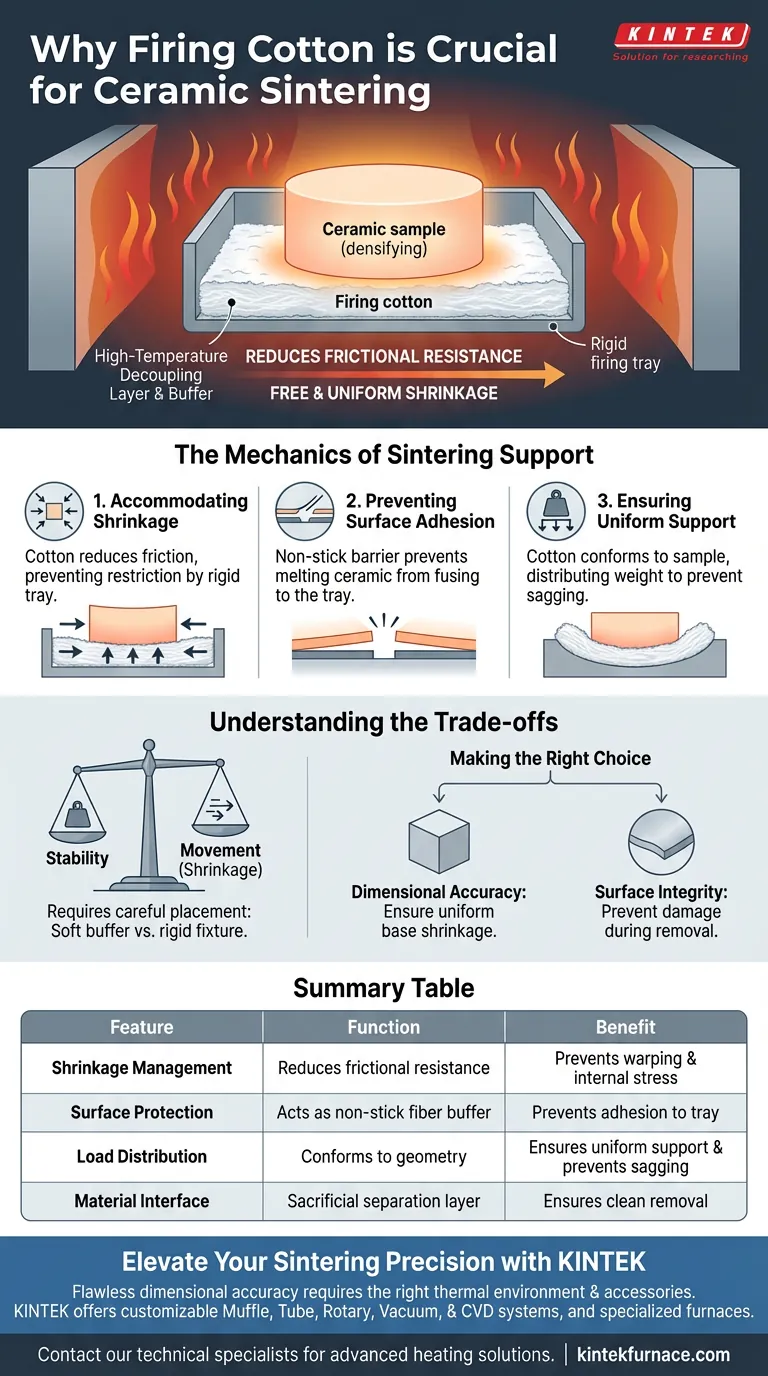
Firing cotton functions as a high-temperature decoupling layer. It creates a soft, fibrous buffer between the delicate ceramic sample and the rigid firing tray during the sintering process. This separation is essential to prevent the ceramic from sticking to the tray while ensuring the material is supported evenly across its base.

The central role of firing cotton is to reduce frictional resistance. By allowing the ceramic to shrink freely and uniformly as it densifies, the cotton prevents the structural distortion and stress that occur when a sample is restricted by a rigid surface.

The Mechanics of Sintering Support

Accommodating Physical Shrinkage

Ceramics undergo significant physical shrinkage as they are fired. If the sample rests directly on a rigid tray, the friction between the two surfaces can restrict this movement.

Firing cotton reduces this frictional resistance at the base of the sample. This allows the veneered ceramic to contract naturally and freely. Without this "floating" effect, the material could experience tension, leading to warping or internal stress.

Preventing Surface Adhesion

At elevated temperatures, ceramic materials can become reactive or sticky. Direct contact with the firing tray risks the sample adhering or fusing to the tray surface.

The cotton serves as a high-temperature resistant fiber buffer. It acts as a sacrificial interface that physically separates the melting ceramic from the tray, ensuring the sample can be removed cleanly after cooling.

Ensuring Uniform Support

rigid firing trays provide a flat, unforgiving surface. Complex ceramic shapes may not make perfect contact with the tray, creating pressure points.

Firing cotton conforms to the geometry of the sample. It offers uniform support, distributing the weight of the ceramic evenly to prevent sagging or deformation during the high-heat phase.

Understanding the Trade-offs

Stability vs. Movement

While the primary goal of firing cotton is to allow movement (shrinkage), this introduces a variable in stability.

Because the material is a soft buffer rather than a rigid fixture, it requires careful placement. The cotton must be sufficient to cushion the sample but stable enough to prevent the object from shifting or tipping over as the fibers compress under heat.

Making the Right Choice for Your Goal

To ensure the integrity of your ceramic samples, consider the specific function the cotton serves relative to your outcome.

  • If your primary focus is Dimensional Accuracy: Use firing cotton to ensure the base of the sample shrinks at the same rate as the body, preventing distortion.
  • If your primary focus is Surface Integrity: Rely on the cotton to act as a non-stick barrier, preventing damage to the bottom of the ceramic during removal.

By neutralizing friction, firing cotton transforms the sintering tray from a rigid constraint into a supportive platform.

Summary Table:

Feature Function of Firing Cotton Benefit for Ceramics
Shrinkage Management Reduces frictional resistance Prevents warping and internal stress
Surface Protection Acts as a non-stick fiber buffer Prevents adhesion to the firing tray
Load Distribution Conforms to sample geometry Ensures uniform support and prevents sagging
Material Interface Sacrificial separation layer Ensures clean removal after cooling

Elevate Your Sintering Precision with KINTEK

Achieving flawless dimensional accuracy requires the right thermal environment and accessories. Backed by expert R&D and manufacturing, KINTEK offers a comprehensive range of Muffle, Tube, Rotary, Vacuum, and CVD systems, along with specialized lab high-temp furnaces—all fully customizable to your unique sintering needs.

Don't let friction or uneven heating compromise your ceramic integrity. Contact our technical specialists today to discover how our advanced heating solutions can optimize your laboratory results.

Visual Guide
Why is firing cotton used as a cushion between the ceramic sample and the tray during sintering? Prevent Distortion Visual Guide

References

  1. Moritz Hoffmann, Bogna Stawarczyk. Mechanical Properties of High- and Low-Fusing Zirconia Veneering Ceramics Fired on Different Trays and Substrates. DOI: 10.3390/ma17102261

This article is also based on technical information from Kintek Furnace Knowledge Base .

Related Products

People Also Ask

Related Products

1400℃ Muffle Oven Furnace for Laboratory

1400℃ Muffle Oven Furnace for Laboratory

KT-14M Muffle Furnace: Precision 1400°C heating with SiC elements, PID control, and energy-efficient design. Ideal for labs.

Laboratory Muffle Oven Furnace with Bottom Lifting

Laboratory Muffle Oven Furnace with Bottom Lifting

Boost lab efficiency with KT-BL Bottom Lifting Furnace: precise 1600℃ control, superior uniformity, and enhanced productivity for material science and R&D.

1800℃ High Temperature Muffle Oven Furnace for Laboratory

1800℃ High Temperature Muffle Oven Furnace for Laboratory

KINTEK Muffle Furnaces: Precision 1800°C heating for labs. Energy-efficient, customizable, with PID control. Ideal for sintering, annealing, and research.

1700℃ High Temperature Muffle Oven Furnace for Laboratory

1700℃ High Temperature Muffle Oven Furnace for Laboratory

KT-17M Muffle Furnace: High-precision 1700°C lab furnace with PID control, energy efficiency, and customizable sizes for industrial & research applications.

High Temperature Muffle Oven Furnace for Laboratory Debinding and Pre Sintering

High Temperature Muffle Oven Furnace for Laboratory Debinding and Pre Sintering

KT-MD Debinding & Pre-Sintering Furnace for ceramics - precise temperature control, energy-efficient design, customizable sizes. Boost your lab efficiency today!

1700℃ High Temperature Laboratory Tube Furnace with Quartz or Alumina Tube

1700℃ High Temperature Laboratory Tube Furnace with Quartz or Alumina Tube

KINTEK's Tube Furnace with Alumina Tube: Precision heating up to 1700°C for material synthesis, CVD, and sintering. Compact, customizable, and vacuum-ready. Explore now!

1400℃ High Temperature Laboratory Tube Furnace with Quartz and Alumina Tube

1400℃ High Temperature Laboratory Tube Furnace with Quartz and Alumina Tube

KINTEK's Tube Furnace with Alumina Tube: Precision high-temperature processing up to 2000°C for labs. Ideal for material synthesis, CVD, and sintering. Customizable options available.

1200℃ Split Tube Furnace Laboratory Quartz Tube Furnace with Quartz Tube

1200℃ Split Tube Furnace Laboratory Quartz Tube Furnace with Quartz Tube

Discover KINTEK's 1200℃ Split Tube Furnace with quartz tube for precise high-temperature lab applications. Customizable, durable, and efficient. Get yours now!

2200 ℃ Tungsten Vacuum Heat Treat and Sintering Furnace

2200 ℃ Tungsten Vacuum Heat Treat and Sintering Furnace

2200°C Tungsten Vacuum Furnace for high-temperature materials processing. Precise control, superior vacuum, customizable solutions. Ideal for research & industrial applications.

1200℃ Controlled Inert Nitrogen Atmosphere Furnace

1200℃ Controlled Inert Nitrogen Atmosphere Furnace

KINTEK 1200℃ Controlled Atmosphere Furnace: Precision heating with gas control for labs. Ideal for sintering, annealing, and material research. Customizable sizes available.

Vacuum Heat Treat Furnace with Ceramic Fiber Liner

Vacuum Heat Treat Furnace with Ceramic Fiber Liner

KINTEK's Vacuum Furnace with Ceramic Fiber Lining offers precise high-temperature processing up to 1700°C, ensuring uniform heat distribution and energy efficiency. Ideal for labs and production.

1400℃ Controlled Inert Nitrogen Atmosphere Furnace

1400℃ Controlled Inert Nitrogen Atmosphere Furnace

KT-14A Controlled Atmosphere Furnace for labs & industry. 1400°C max temp, vacuum sealing, inert gas control. Customizable solutions available.

Vacuum Heat Treat Sintering Furnace Molybdenum Wire Vacuum Sintering Furnace

Vacuum Heat Treat Sintering Furnace Molybdenum Wire Vacuum Sintering Furnace

KINTEK's Vacuum Molybdenum Wire Sintering Furnace excels in high-temperature, high-vacuum processes for sintering, annealing, and material research. Achieve precise 1700°C heating with uniform results. Custom solutions available.

2200 ℃ Graphite Vacuum Heat Treat Furnace

2200 ℃ Graphite Vacuum Heat Treat Furnace

2200℃ Graphite Vacuum Furnace for high-temperature sintering. Precise PID control, 6*10⁻³Pa vacuum, durable graphite heating. Ideal for research & production.

High Pressure Laboratory Vacuum Tube Furnace Quartz Tubular Furnace

High Pressure Laboratory Vacuum Tube Furnace Quartz Tubular Furnace

KINTEK High Pressure Tube Furnace: Precision heating up to 1100°C with 15Mpa pressure control. Ideal for sintering, crystal growth, and lab research. Customizable solutions available.

1700℃ Controlled Inert Nitrogen Atmosphere Furnace

1700℃ Controlled Inert Nitrogen Atmosphere Furnace

KT-17A Controlled Atmosphere Furnace: Precise 1700°C heating with vacuum & gas control. Ideal for sintering, research & material processing. Explore now!

Laboratory Quartz Tube Furnace RTP Heating Tubular Furnace

Laboratory Quartz Tube Furnace RTP Heating Tubular Furnace

KINTEK's RTP Rapid Heating Tube Furnace delivers precise temperature control, rapid heating up to 100°C/sec, and versatile atmosphere options for advanced lab applications.

Vacuum Heat Treat Sintering Furnace with Pressure for Vacuum Sintering

Vacuum Heat Treat Sintering Furnace with Pressure for Vacuum Sintering

KINTEK's Vacuum Pressure Sintering Furnace offers 2100℃ precision for ceramics, metals, and composites. Customizable, high-performance, and contamination-free. Get a quote now!

Multi Zone Laboratory Quartz Tube Furnace Tubular Furnace

Multi Zone Laboratory Quartz Tube Furnace Tubular Furnace

KINTEK Multi-Zone Tube Furnace: Precise 1700℃ heating with 1-10 zones for advanced material research. Customizable, vacuum-ready, and safety-certified.

600T Vacuum Induction Hot Press Vacuum Heat Treat and Sintering Furnace

600T Vacuum Induction Hot Press Vacuum Heat Treat and Sintering Furnace

600T Vacuum Induction Hot Press Furnace for precise sintering. Advanced 600T pressure, 2200°C heating, vacuum/atmosphere control. Ideal for research & production.


Leave Your Message