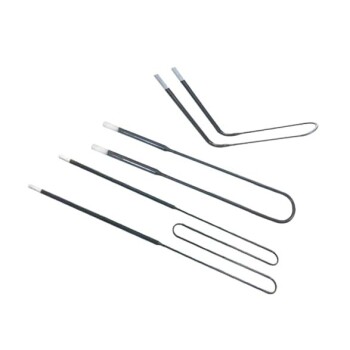
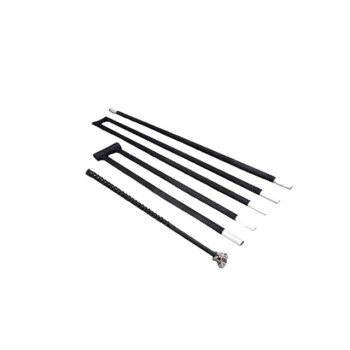
The primary technical significance of using molybdenum disilicide (MoSi2) heating elements lies in their ability to sustain a stable 1500°C environment essential for liquid-phase sintering. This specific thermal capacity allows for precise temperature control curves, which are critical for facilitating the chemical reactions required to densify red mud-alumina composites without the application of external mechanical pressure.
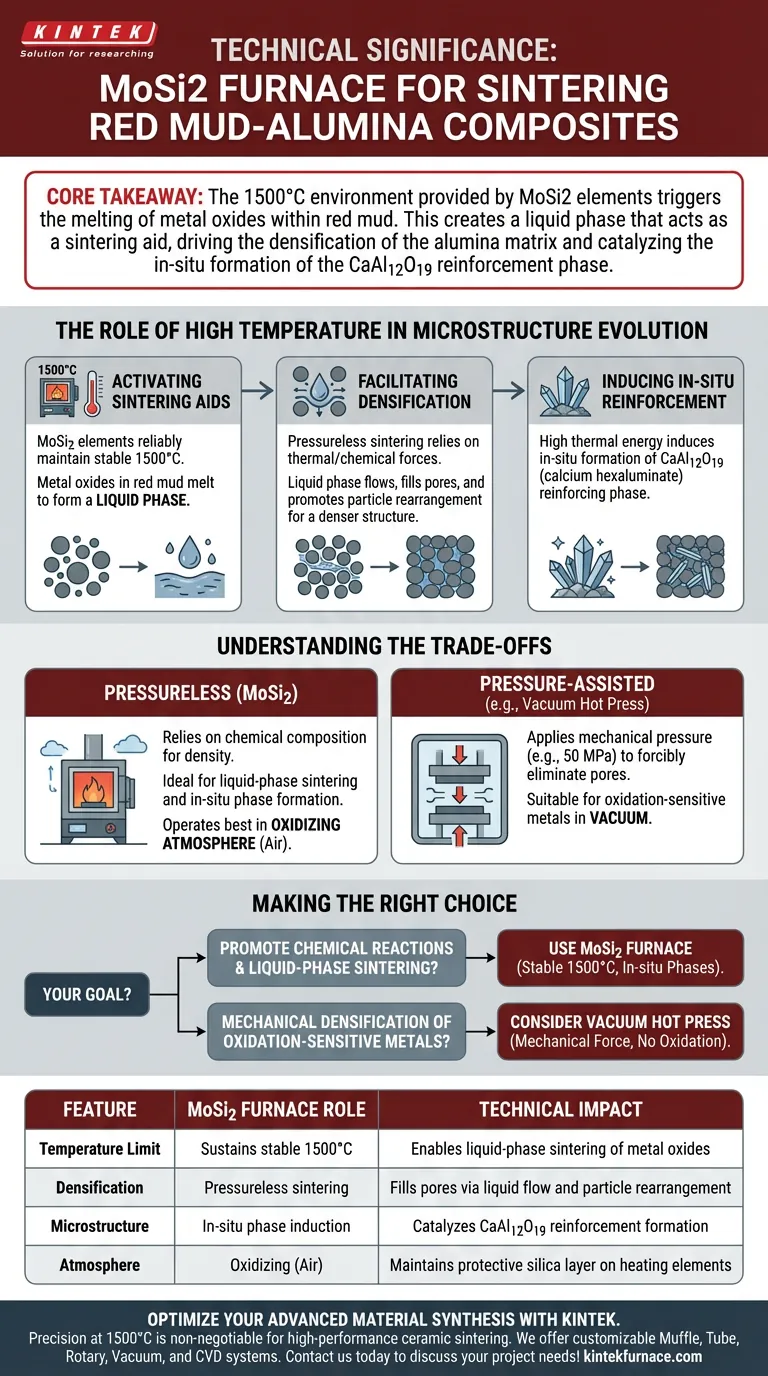
Core Takeaway The 1500°C environment provided by MoSi2 elements triggers the melting of metal oxides within red mud. This creates a liquid phase that acts as a sintering aid, driving the densification of the alumina matrix and catalyzing the in-situ formation of the CaAl12O19 reinforcement phase.
The Role of High Temperature in Microstructure Evolution
Activating Sintering Aids
Standard heating elements often degrade or lose stability at temperatures required for advanced ceramics. MoSi2 elements specifically enable the furnace to reach and maintain 1500°C reliably.
At this temperature, the metal oxides naturally present in the red mud undergo a phase transition. They melt to form a liquid phase, which is the mechanism that differentiates this process from solid-state sintering.
Facilitating Densification
In pressureless sintering, densification relies entirely on thermal and chemical driving forces rather than mechanical force.
The liquid phase generated by the high temperature flows between the solid alumina particles. This action fills pore spaces and promotes particle rearrangement, leading to a denser final composite structure.
Inducing In-Situ Reinforcement
The precise thermal control allows for specific chemical reactions to occur within the composite matrix.
The high thermal energy induces the formation of CaAl12O19 (calcium hexaluminate). This phase is not added externally; it forms "in-situ" (during the process) thanks to the reaction between the red mud components and the alumina, acting as a reinforcement phase to improve the material's properties.
Understanding the Trade-offs
Pressureless vs. Pressure-Assisted Sintering
While the MoSi2 furnace excels at pressureless sintering, it relies heavily on the chemical composition of the red mud to achieve density.
If the "liquid phase" formation is insufficient, the material may retain porosity. In contrast, techniques like vacuum hot pressing (mentioned in supplementary contexts) apply mechanical pressure (e.g., 50 MPa) to forcibly eliminate pores.
Atmosphere Limitations
MoSi2 elements typically operate best in oxidizing atmospheres (air) because they form a protective silica layer.
If your process requires a high vacuum to prevent oxidation of metallic components (as seen in copper or aluminum sintering), a standard MoSi2 box furnace may not be suitable without specific atmospheric control modifications.
Making the Right Choice for Your Goal
To determine if a high-temperature MoSi2 furnace is the correct tool for your composite development, consider your specific material objectives:
- If your primary focus is promoting chemical reactions and liquid-phase sintering: Utilize a MoSi2 furnace to achieve the stable 1500°C temperatures required to activate internal sintering aids and form in-situ phases like CaAl12O19.
- If your primary focus is mechanical densification of oxidation-sensitive metals: Consider a vacuum hot press furnace to apply mechanical force and prevent oxidation, as pressureless sintering in air may not achieve full density for these materials.
Ultimately, the MoSi2 furnace is the technical enabler for converting the waste oxides in red mud into functional sintering agents through precise high-temperature management.
Summary Table:
| Feature | MoSi2 Furnace Role | Technical Impact |
|---|---|---|
| Temperature Limit | Sustains stable 1500°C | Enables liquid-phase sintering of metal oxides |
| Densification | Pressureless sintering | Fills pores via liquid flow and particle rearrangement |
| Microstructure | In-situ phase induction | Catalyzes CaAl12O19 reinforcement formation |
| Atmosphere | Oxidizing (Air) | Maintains protective silica layer on heating elements |
Optimize Your Advanced Material Synthesis with KINTEK
Precision at 1500°C is non-negotiable for high-performance ceramic sintering. Backed by expert R&D and manufacturing, KINTEK offers a comprehensive range of Muffle, Tube, Rotary, Vacuum, and CVD systems, all customizable for your unique lab requirements.
Whether you are pursuing liquid-phase sintering with MoSi2 elements or require vacuum hot pressing for mechanical densification, our high-temperature solutions provide the thermal stability needed to drive in-situ reinforcement and full material density.
Ready to elevate your composite research? Contact us today to discuss your project needs!
Visual Guide
References
- Yongliang Chen, Shiwei Jiang. Wettability and Mechanical Properties of Red Mud–Al2O3 Composites. DOI: 10.3390/ma17051095
This article is also based on technical information from Kintek Furnace Knowledge Base .
Related Products
- Molybdenum Disilicide MoSi2 Thermal Heating Elements for Electric Furnace
- 1400℃ Muffle Oven Furnace for Laboratory
- Molybdenum Vacuum Heat Treat Furnace
- 1200℃ Muffle Oven Furnace for Laboratory
- 1800℃ High Temperature Muffle Oven Furnace for Laboratory
People Also Ask
- What are the typical application temperatures for molybdenum disilicide (MoSi2) heating elements? Master High-Temp Performance
- What is the primary use of molybdenum disilicide? Ideal for High-Temp Heating Elements
- What are the characteristics of molybdenum disilicide heating elements? Unlock High-Temp Performance
- What are the properties of molybdenum disilicide (MoSi2) that make it suitable for high-temperature applications? Discover Its High-Temp Resilience
- What are the applications of molybdenum disilicide heating elements? Achieve Extreme Heat Stability for Industrial Processes