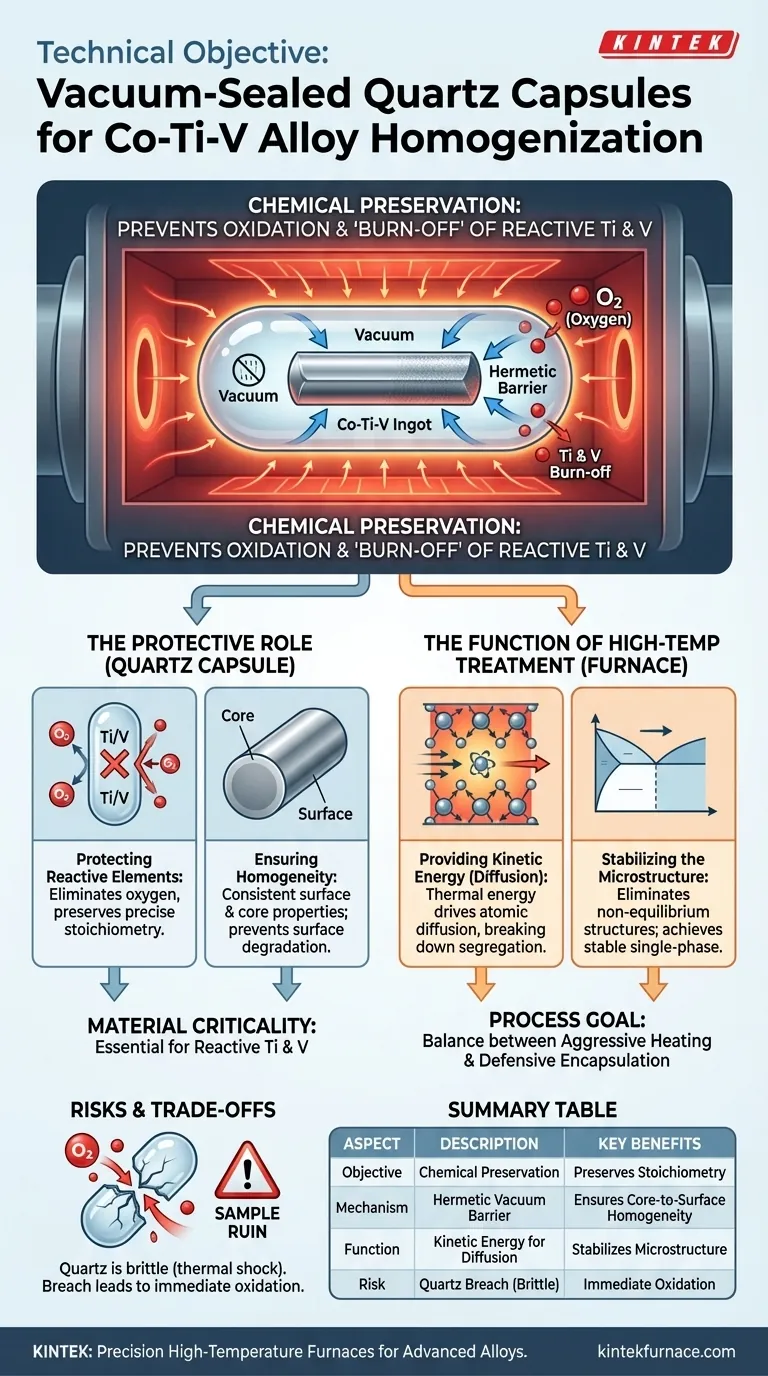
The technical objective is fundamentally about chemical preservation during thermal stress. By enclosing Co-Ti-V alloy ingots in vacuum-sealed quartz capsules, you establish a hermetic barrier that withstands temperatures as high as 1100 °C. This isolation prevents the oxidation and subsequent "burn-off" of highly reactive elements—specifically Titanium (Ti) and Vanadium (V)—during prolonged heat treatment cycles.
The quartz capsule acts as a sacrificial shield, maintaining a vacuum or inert environment around the ingot. This ensures that the chemical composition of the alloy's surface remains identical to its core, preventing surface degradation that would otherwise occur due to air exposure at elevated temperatures.
The Critical Role of Elemental Isolation
Protecting Reactive Elements
Titanium and Vanadium are classified as active elements. When exposed to oxygen at high temperatures, they oxidize rapidly.
In an open furnace environment, these elements would "burn off" or degrade. The vacuum-sealed quartz capsule creates a micro-environment that eliminates oxygen presence, preserving the precise stoichiometry of your alloy.
Ensuring Homogeneity from Core to Surface
The goal of homogenization is consistency. If the surface oxidizes, the material properties at the exterior will differ significantly from the interior.
The quartz barrier ensures that the performance characteristics of the alloy surface remain consistent with the bulk material. This allows for accurate testing and application of the alloy post-treatment.
The Function of High-Temperature Treatment
Providing Kinetic Energy for Diffusion
While the capsule protects, the furnace heat drives the process. The high-temperature environment (e.g., 1100 °C) provides the necessary thermal energy for atoms to move.
This kinetic energy enables atoms within the alloy to diffuse effectively. This diffusion is essential for breaking down the segregation that occurs during the initial melting phase.
Stabilizing the Microstructure
The ultimate goal of this thermal cycle is to eliminate non-equilibrium structures.
By maintaining high heat for extended periods (up to 48 hours) inside the capsule, the alloy achieves a stable, single-phase solid solution structure. This is particularly critical for medium and high entropy alloys where structural stability is paramount.
Understanding the Trade-offs
The Limitations of Quartz
While quartz offers excellent high-temperature resistance and sealing properties, it is not indestructible. It is brittle and subject to thermal shock if cooled or heated too rapidly.
The Risk of Breach
The integrity of the process relies entirely on the seal. If the quartz capsule fails or leaks during the 48-hour cycle, oxygen will infiltrate the environment immediately.
This would result in the exact oxidation and elemental loss the process was designed to prevent, likely ruining the sample.
Making the Right Choice for Your Goal
To maximize the effectiveness of your homogenization process, consider the following specific objectives:
- If your primary focus is compositional accuracy: Prioritize a high-quality vacuum seal to prevent even trace amounts of oxygen from reacting with the Titanium and Vanadium.
- If your primary focus is structural uniformity: Ensure the furnace temperature is maintained consistently (e.g., 1100 °C) for the full duration to allow sufficient atomic diffusion throughout the ingot.
Successful homogenization relies on the balance between aggressive heating to drive diffusion and defensive encapsulation to preserve chemistry.
Summary Table:
| Aspect | Description |
|---|---|
| Primary Objective | Chemical preservation; prevent oxidation and 'burn-off' of reactive elements (Ti, V) during high-temperature thermal stress. |
| Mechanism | Creates a hermetic, vacuum-sealed barrier around the ingot, isolating it from oxygen at temperatures up to 1100 °C. |
| Key Benefits | Preserves precise stoichiometry, ensures core-to-surface homogeneity, enables efficient atomic diffusion, stabilizes microstructure. |
| Material Criticality | Essential for reactive elements like Titanium (Ti) and Vanadium (V) in Co-Ti-V alloys. |
| Limitations/Risks | Quartz is brittle (thermal shock risk); capsule breach during treatment leads to immediate oxidation and sample ruin. |
Achieve unparalleled material integrity for your advanced alloys with KINTEK's precision high-temperature furnaces. Backed by expert R&D and manufacturing, KINTEK offers Muffle, Tube, Rotary, Vacuum, CVD systems, and other lab high-temp furnaces, all customizable for unique needs. Ensure your homogenization processes, like those for Co-Ti-V alloys, consistently deliver precise chemical and structural uniformity. Contact us today to optimize your thermal processing solutions.
Visual Guide
References
- The Effect of Nb on the Microstructure and High-Temperature Properties of Co-Ti-V Superalloys. DOI: 10.3390/coatings15010053
This article is also based on technical information from Kintek Furnace Knowledge Base .
Related Products
- CF KF Flange Vacuum Electrode Feedthrough Lead Sealing Assembly for Vacuum Systems
- Ultra-High Vacuum Flange Aviation Plug Glass Sintered Airtight Circular Connector for KF ISO CF
- Vacuum Sealed Continuous Working Rotary Tube Furnace Rotating Tube Furnace
People Also Ask
- Why is a vacuum sealing process necessary for the synthesis of TaAs2 single crystals? Ensuring Purity in CVT Method
- Why is a PTFE-lined stainless steel autoclave used for Ni12P5 synthesis? Key Benefits for Nanomaterial Production
- What is the function of PTFE sealing rings in plastic pyrolysis? Ensure Safe, Anaerobic Material Decomposition
- What is the function of a Teflon-lined stainless steel autoclave in the hydrothermal synthesis of Bi2O3 precursors?
- Why is a stainless steel autoclave with a Teflon liner necessary for BiVO4? Ensure Purity & High Performance