
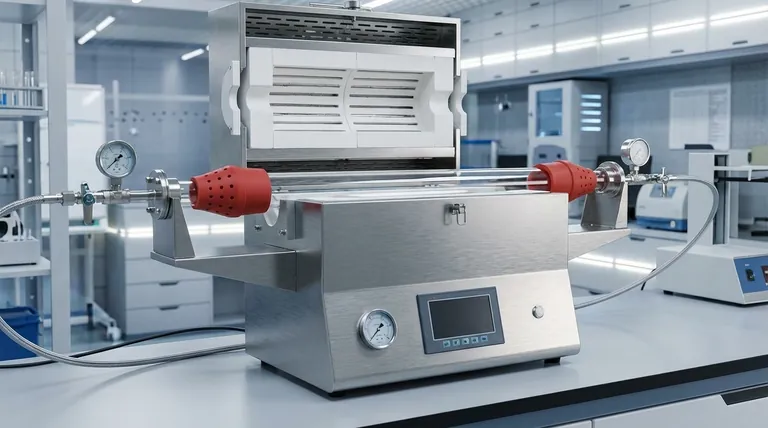
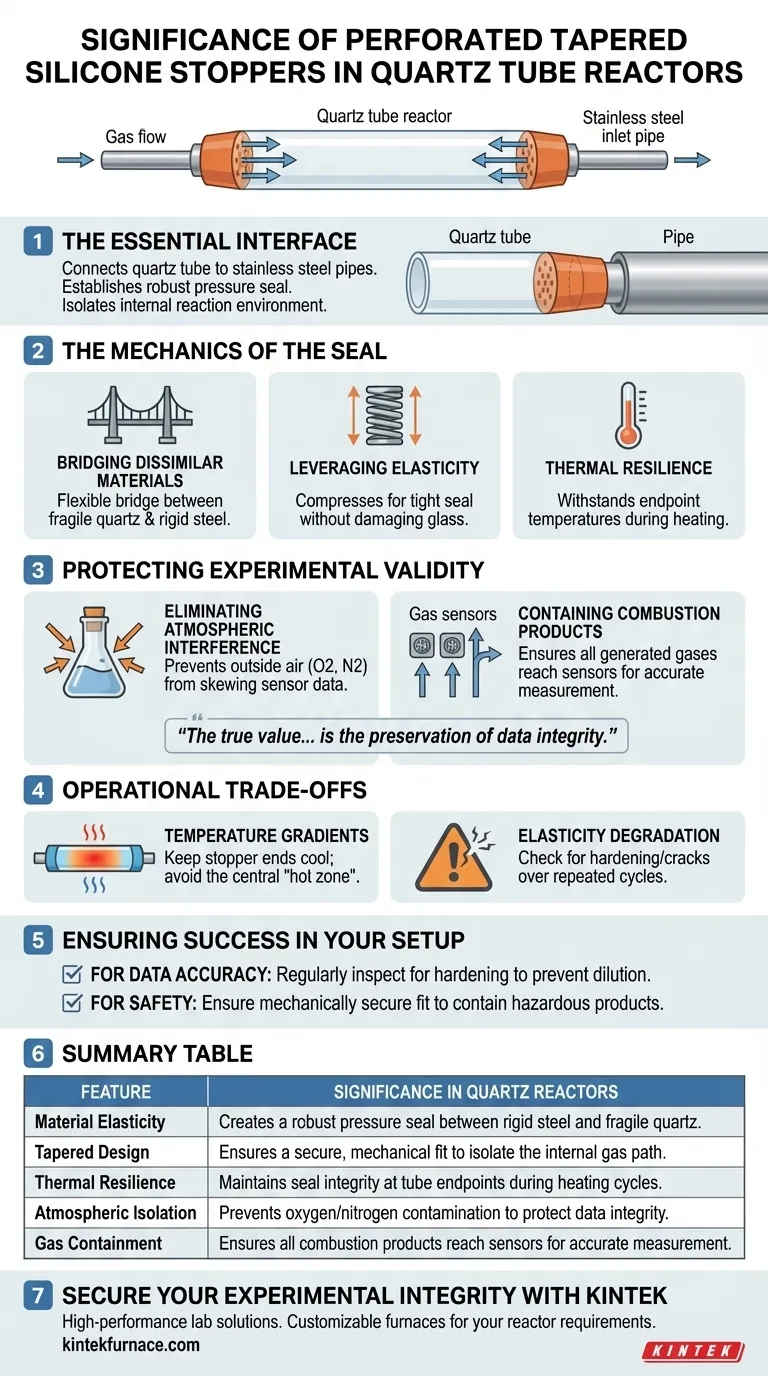
Perforated tapered silicone stoppers serve as the essential interface connecting the quartz tube reactor to stainless steel inlet and outlet pipes. Their primary significance lies in establishing a robust pressure seal that mechanically isolates the internal reaction environment from the external atmosphere.
The true value of these components is the preservation of data integrity. By preventing gas leaks and atmospheric contamination, they ensure that emission sensors measure only the specific chemical reactions occurring within the tube, rather than artifacts caused by dilution or escape.
The Mechanics of the Seal
Bridging Dissimilar Materials
In a reactor setup, you must connect fragile quartz glass to rigid stainless steel plumbing.
The perforated stopper acts as a flexible bridge between these two distinct materials.
Leveraging Elasticity for Pressure Tightness
The silicone material is chosen specifically for its elasticity.
When inserted, the tapered shape compresses against the quartz and steel, creating a tight pressure seal that rigid connectors cannot achieve without risking damage to the glass.
Thermal Resilience
These stoppers are designed to withstand the operational temperatures found at the tube's endpoints.
Their temperature resistance ensures the seal remains intact even as the reactor heats up, preventing the material from degrading or deforming during the experiment.
Protecting Experimental Validity
Eliminating Atmospheric Interference
The most critical role of the stopper is preventing unregulated external air from entering the system.
If outside air leaks in, it introduces oxygen and nitrogen that were not part of the controlled experiment.
This contamination would skew sensor data, making it impossible to determine which emissions resulted from the reaction and which came from the room air.
Containing Combustion Products
Conversely, the stopper ensures that all gases generated during combustion remain inside the gas path.
If products leak out before reaching the sensors, your emission data will be incomplete and quantitatively inaccurate.
A perfect seal guarantees that the output collected by the sensors is a true reflection of the chemical processes inside the quartz tube.
Understanding the Operational Trade-offs
Temperature Gradients
While the reference highlights the temperature resistance of silicone, it is important to note that silicone cannot withstand the same peak temperatures as quartz or stainless steel.
You must ensure the ends of the tube—where the stoppers are located—are kept cool enough to remain within the silicone's thermal limits, unlike the central "hot zone" of the reactor.
Elasticity Degradation
Over repeated heating cycles, even high-quality silicone can lose some of its elasticity.
If the material hardens or cracks, the pressure seal will fail, compromising the isolation of the gas path described above.
Ensuring Success in Your Setup
To maximize the reliability of your reactor data, verify your seal based on your specific objectives:
- If your primary focus is Data Accuracy: regularly inspect the stoppers for signs of hardening to ensure no external air is diluting your emission readings.
- If your primary focus is Safety: ensure the tapered fit is mechanically secure to prevent hazardous combustion products from leaking into the laboratory environment.
The stopper is not just a plug; it is the boundary that defines the validity of your entire experiment.
Summary Table:
| Feature | Significance in Quartz Reactors |
|---|---|
| Material Elasticity | Creates a robust pressure seal between rigid steel and fragile quartz. |
| Tapered Design | Ensures a secure, mechanical fit to isolate the internal gas path. |
| Thermal Resilience | Maintains seal integrity at tube endpoints during heating cycles. |
| Atmospheric Isolation | Prevents oxygen/nitrogen contamination to protect data integrity. |
| Gas Containment | Ensures all combustion products reach sensors for accurate measurement. |
Secure Your Experimental Integrity with KINTEK
Don't let faulty seals compromise your research data. KINTEK provides high-performance lab solutions backed by expert R&D and precision manufacturing. Whether you need specialized sealing components or advanced Muffle, Tube, Rotary, Vacuum, or CVD systems, our high-temperature furnaces are fully customizable to meet your unique reactor requirements.
Ready to optimize your thermal processing setup? Contact our technical experts today to discover how KINTEK can enhance your laboratory's accuracy and safety.
Visual Guide
References
- Casey Coffland, Elliott T. Gall. An open-source linear actuated-quartz tube furnace with programmable ceramic heater movement for laboratory-scale studies of combustion and emission. DOI: 10.2139/ssrn.5687995
This article is also based on technical information from Kintek Furnace Knowledge Base .
Related Products
- Laboratory Quartz Tube Furnace RTP Heating Tubular Furnace
- Vertical Laboratory Quartz Tube Furnace Tubular Furnace
People Also Ask
- What physical conditions does a laboratory Tube Furnace provide for SOEC? Precision Heat for Solid Oxide Characterization
- What are the main features and functions of a laboratory tube furnace? Unlock Precise High-Temp Control for Your Lab
- What parameters must be controlled when calcining freeze-dried oxide precursors in a laboratory tube furnace? A Guide
- What role does a laboratory tube furnace play in geological and mineralogical research? Unlock Earth's Secrets with Precision
- Why is control of heating rate and gas flow in a lab tube furnace critical for EM wave absorption materials?

