
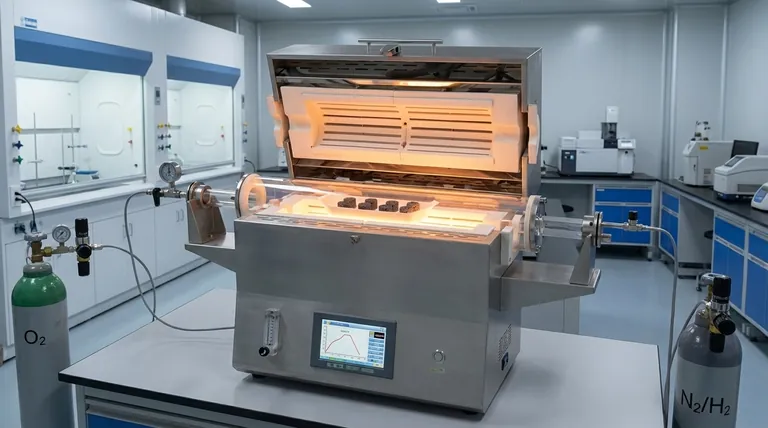
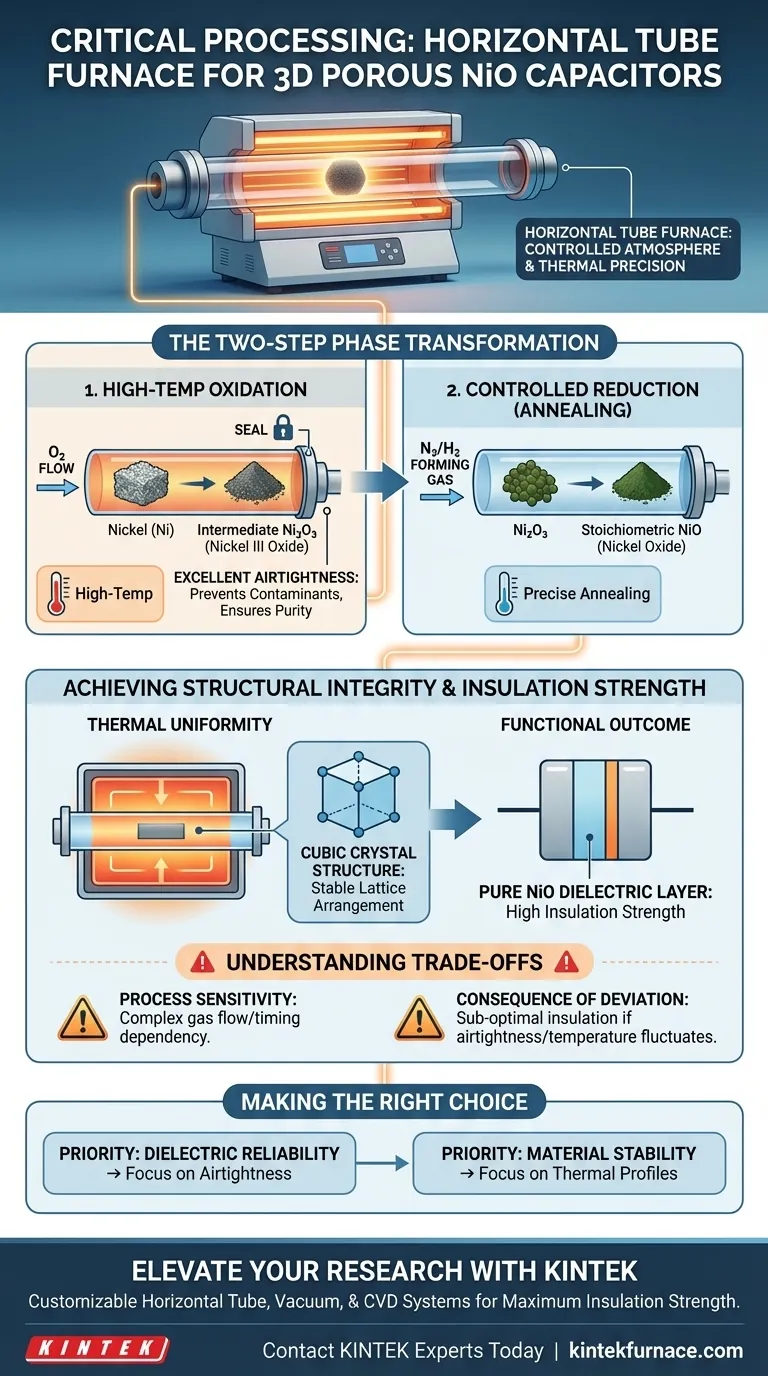
The critical processing conditions provided by a horizontal tube furnace are a strictly controlled atmosphere and precise thermal uniformity. These features enable a specific two-step phase transformation—high-temperature oxidation followed by controlled reduction—which is required to convert nickel into stoichiometric nickel oxide (NiO) with a stable cubic crystal structure.
The integrity of the dielectric layer relies on converting intermediate phases into pure, stoichiometric NiO. This requires the exceptional airtightness and thermal precision that a tube furnace provides to ensure high insulation strength.
Achieving Stoichiometry Through Atmosphere Control
The Oxidation Phase
The first critical step involves high-temperature oxidation. The furnace allows for a consistent flow of oxygen to interact with the material.
This environment converts the initial nickel component into an intermediate phase, specifically nickel (III) oxide (Ni₂O₃). This oxidation serves as the foundational step for the subsequent structural transformation.
The Reduction Phase
Following oxidation, the material must undergo an annealing process in a forming gas, such as a nitrogen/hydrogen (N₂/H₂) mix.
This step acts as a reduction phase, chemically altering the Ni₂O₃. It effectively transforms the intermediate oxide into stoichiometric NiO, which is the desired final state for the capacitor's dielectric.
The Role of Airtightness
These chemical reactions are highly sensitive to external contaminants. The excellent airtightness of the horizontal tube furnace is paramount here.
By isolating the internal environment, the furnace ensures that the atmosphere consists only of the intended process gases. This isolation guarantees the chemical purity required to achieve the correct phase structure.
Thermal Uniformity and Structural Integrity
Ensuring Cubic Crystal Structure
Temperature control is not just about reaching a specific degree; it is about maintaining temperature uniformity across the entire sample.
The tube furnace provides the stable thermal profile necessary to crystallize the NiO into a cubic crystal structure. This specific lattice arrangement is directly responsible for the material's physical stability.
Impact on Insulation Strength
The ultimate goal of this thermal processing is functional reliability. The combination of stoichiometric composition and cubic structure ensures the insulation strength of the dielectric layer.
Without the precise temperature profiles provided by the furnace, the dielectric layer may suffer from defects, compromising the capacitor's performance.
Understanding the Trade-offs
Process Sensitivity
While the horizontal tube furnace offers precision, it also demands rigorous process control. The two-step nature of the treatment (oxidation followed by reduction) creates a complex dependency on gas flow rates and switching timing.
Consequence of Deviation
If the airtightness is compromised or the temperature profile fluctuates even slightly, the material may fail to reach the stoichiometric NiO state. This results in sub-optimal insulation properties, rendering the 3D porous capacitor ineffective for high-performance applications.
Making the Right Choice for Your Goal
To maximize the performance of your 3D porous NiO capacitors, align your processing parameters with your specific engineering objectives:
- If your primary focus is Dielectric Reliability: Prioritize the airtightness of the furnace system to prevent atmospheric contamination and ensure purely stoichiometric NiO formation.
- If your primary focus is Material Stability: Focus on the precision of the temperature profiles during the annealing phase to guarantee the formation of a robust cubic crystal structure.
Precision in the furnace environment is the single most important factor in determining the final insulation quality of your device.
Summary Table:
| Process Phase | Gas Environment | Temperature Objective | Structural Outcome |
|---|---|---|---|
| Oxidation | Oxygen (O₂) Flow | High-Temp Oxidation | Formation of Ni₂O₃ intermediate |
| Reduction | Forming Gas (N₂/H₂) | Controlled Annealing | Conversion to stoichiometric NiO |
| Crystallization | Inert/Process Gas | Uniform Thermal Profile | Stable cubic crystal lattice |
| Final State | Sealed Atmosphere | High Insulation Strength | Pure NiO dielectric layer |
Elevate Your Semiconductor Research with KINTEK
Precise phase transformation in NiO capacitors demands the highest standards of atmospheric purity and thermal stability. KINTEK provides state-of-the-art Horizontal Tube, Vacuum, and CVD systems designed to meet the rigorous needs of advanced materials engineering.
Backed by expert R&D and manufacturing, our high-temp furnaces are fully customizable to your specific gas flow and temperature profile requirements, ensuring your dielectric layers achieve maximum insulation strength and structural integrity.
Ready to optimize your lab's thermal processing?
Visual Guide
References
- Baichuan Zhang, Jihua Zhang. Novel 3D Capacitors: Integrating Porous Nickel-Structured and Through-Glass-Via-Fabricated Capacitors. DOI: 10.3390/nano15110819
This article is also based on technical information from Kintek Furnace Knowledge Base .
Related Products
- Vertical Laboratory Quartz Tube Furnace Tubular Furnace
- 1700℃ High Temperature Laboratory Tube Furnace with Alumina Tube
- Vacuum Sealed Continuous Working Rotary Tube Furnace Rotating Tube Furnace
- Split Multi Heating Zone Rotary Tube Furnace Rotating Tube Furnace
- Laboratory Vacuum Tilt Rotary Tube Furnace Rotating Tube Furnace
People Also Ask
- What are the key differences between single-zone and multi-zone vertical tube furnaces? Choose the Right Furnace for Your Lab
- What is the purpose of using an industrial-grade vertical tube furnace in phosphorus recovery? High-Fidelity Simulation
- What physical conditions does a vertical tube furnace provide for desulfurization experiments? Precision Heat Control
- How does a vertical single-temperature zone tube furnace facilitate the growth of high-quality PdSe2 single crystals?
- How are wafers loaded and unloaded in a vertical tube furnace? Achieve Precision and Purity in Wafer Processing



















