
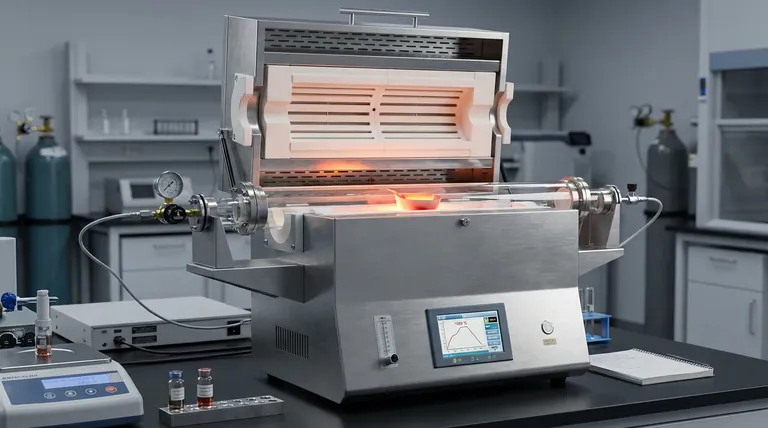
The critical function of a high-temperature tube furnace in this process is to facilitate a precise atomic phase transition. By generating temperatures reaching 1000 °C, the furnace provides the thermal energy necessary for atoms to overcome diffusion barriers, converting a disordered solid solution into an ordered intermetallic compound with an L10 structure. Simultaneously, its superior sealing capabilities maintain a stable reducing atmosphere, which is essential for ensuring the crystal purity and intrinsic activity of the final catalyst.
The tube furnace does not simply heat the material; it acts as a precise mechanism to force atomic ordering. Without the specific combination of high thermal energy and a controlled reducing environment, the Pt2CoCu or Pt2CoNi precursors would fail to achieve the L10 ordered structure required for peak catalytic performance.
Driving the Phase Transition
To understand the necessity of the tube furnace, one must look beyond the heat and focus on the atomic behavior of the metals involved.
Overcoming Diffusion Energy Barriers
Creating an intermetallic compound requires moving atoms within a solid structure. This process faces significant diffusion energy barriers.
The high-temperature tube furnace provides the extreme thermal energy (up to 1000 °C) required to surmount these barriers. This heat mobilizes the atoms, allowing them to migrate from their initial positions to more energetically favorable sites.
Achieving the L10 Ordered Structure
The ultimate goal of this annealing process is structural transformation. The material begins as a disordered solid solution, where atoms are randomly distributed.
Through the controlled thermal treatment, the furnace drives a phase transition into an ordered intermetallic compound with an L10 structure. This specific ordered arrangement of Platinum, Cobalt, and Copper (or Nickel) atoms is the primary factor defining the catalyst's superior intrinsic activity.
Controlling the Chemical Environment
Temperature alone is insufficient; the chemical atmosphere during annealing is equally critical for preventing degradation.
Maintaining a Stable Reducing Atmosphere
For these specific catalysts, exposure to oxygen at high temperatures would be detrimental. A tube furnace offers superior sealing compared to standard box furnaces.
This sealing allows for the maintenance of a strictly reducing atmosphere (often a mixture like Hydrogen/Argon). This environment prevents the oxidation of the metal precursors and ensures the reduction process is consistent throughout the material.
Enhancing Intrinsic Stability
The combination of high heat and a protective atmosphere results in a highly ordered crystal structure.
By eliminating impurities and ensuring proper atomic ordering, the furnace significantly improves the stability of the catalyst. This ensures that the catalyst retains its activity over time, rather than degrading under operational stress.
Understanding the Trade-offs
While the high-temperature tube furnace is essential for forming L10 structures, it introduces specific challenges that must be managed.
Risk of Thermal Sintering
The same high temperatures required for atomic diffusion can also lead to sintering, where catalyst particles clump together.
If the dwell time or temperature is not precisely managed, the active surface area of the catalyst will decrease, reducing overall performance. The tube furnace requires rigorous calibration to balance atomic ordering against particle growth.
Batch Limitations
Tube furnaces generally have a smaller working volume compared to box or muffle furnaces.
This limits the quantity of catalyst that can be synthesized in a single run. For large-scale production, this can introduce a bottleneck, requiring multiple batches which may introduce slight variations in consistency if not strictly controlled.
Making the Right Choice for Your Goal
The use of a high-temperature tube furnace is a strategic decision based on the specific structural requirements of your material.
- If your primary focus is high catalytic activity: Prioritize the furnace's ability to reach and hold 1000 °C to ensure the formation of the L10 ordered structure.
- If your primary focus is material purity: Leverage the furnace's sealing capability to maintain a strictly reducing atmosphere, preventing oxidation of the Cobalt, Copper, or Nickel components.
Success in synthesizing Pt2CoCu or Pt2CoNi catalysts relies on using the tube furnace not just as a heater, but as an instrument for precise atomic engineering.
Summary Table:
| Feature | Impact on Catalyst Synthesis |
|---|---|
| 1000 °C Thermal Energy | Overcomes diffusion barriers to form L10 ordered structures |
| Superior Sealing | Maintains stable reducing atmospheres to prevent oxidation |
| Precise Atmosphere Control | Ensures crystal purity and high intrinsic activity |
| Controlled Cooling | Minimizes thermal sintering and maintains active surface area |
Maximize Your Catalyst Performance with KINTEK Precision
Achieving the perfect L10 ordered structure for Pt2CoCu or Pt2CoNi catalysts requires more than just heat—it requires exact atmospheric control and thermal uniformity. Backed by expert R&D and world-class manufacturing, KINTEK offers a comprehensive range of Tube, Muffle, Rotary, Vacuum, and CVD systems. Whether you are conducting fundamental research or scaling up production, our furnaces are fully customizable to meet your unique intermetallic synthesis needs.
Ready to elevate your material science? Contact us today to discuss your custom furnace requirements with our technical team!
References
- Peng Yin, Hai‐Wei Liang. Machine-learning-accelerated design of high-performance platinum intermetallic nanoparticle fuel cell catalysts. DOI: 10.1038/s41467-023-44674-1
This article is also based on technical information from Kintek Furnace Knowledge Base .
Related Products
- 1400℃ High Temperature Laboratory Tube Furnace with Alumina Tube
- 1700℃ High Temperature Laboratory Tube Furnace with Alumina Tube
- 1200℃ Split Tube Furnace Laboratory Quartz Tube Furnace with Quartz Tube
- Vertical Laboratory Quartz Tube Furnace Tubular Furnace
- 2200 ℃ Tungsten Vacuum Heat Treat and Sintering Furnace
People Also Ask
- How does zone-melting in tube furnaces synthesize bismuth micro-wires? Master Single-Crystal Thermoelectric Growth
- How are high-temperature laboratory tube furnaces applied in long-term vacuum homogenization heat treatments for intermetallic samples?
- How are high-temp tube furnaces used to measure diffusion coefficients per Fick's law? Master Precision Annealing
- How do high-temperature laboratory tube furnaces ensure environmental stability? Precision Thermal Reduction Tips
- How are high-temperature tube furnaces applied in testing ceramic-supported alloy membranes? Insights



















