
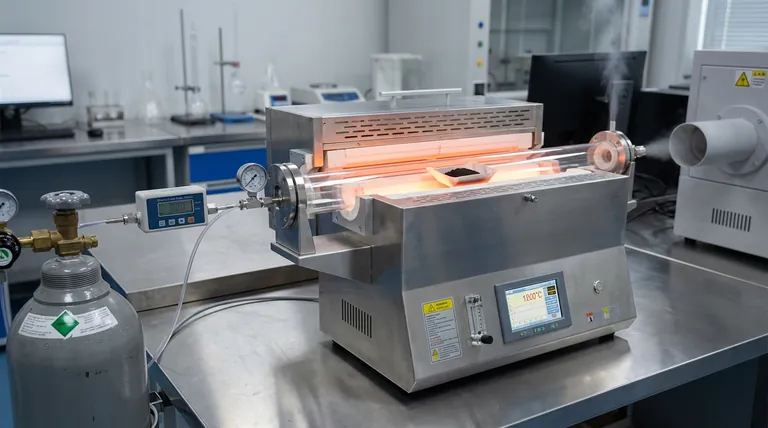
A tube furnace with controlled nitrogen flow fundamentally outperforms traditional heating methods by creating an inert, protective environment that is essential for high-temperature material synthesis. By replacing oxygen with nitrogen, this setup prevents the oxidative degradation of sensitive materials, such as carbon nanotubes, while enabling precise thermal regulation to fine-tune structural properties.
Core Takeaway The combination of a sealed tube furnace and nitrogen flow shifts pyrolysis from a simple heating process to a precision engineering tool. It allows you to decouple temperature effects from oxidation, giving you control over the material’s final crystallinity, defect density, and surface chemistry.
The Critical Role of Atmosphere Control
Preventing Oxidative Loss
The most immediate advantage of using a nitrogen flow is the creation of an inert protective atmosphere. In traditional open-air heating, carbon-based materials would burn or degrade rapidly at high temperatures.
According to your primary reference, utilizing a nitrogen flow during pyrolysis at 700 °C effectively prevents the oxidative loss of carbon nanotubes. This ensures the material survives the thermal treatment intact.
Enabling Reduction Environments
Beyond simple protection, the atmosphere can actively strip away unwanted chemical groups. Traditional heating often traps oxygen-containing functional groups within the material.
A controlled atmosphere allows for the effective removal of these groups. This is critical for restoring electrical conductivity in materials like graphene oxide and engineered carbon structures.
Precision Engineering of Material Properties
Balancing Graphitization and Defects
In advanced materials science, "quality" does not always mean a perfect crystal structure. Often, specific defects are required for performance.
The precise temperature control of a tube furnace allows you to balance graphitization (ordering the carbon lattice) against defect formation. By manipulating this balance—measured as the ID/IG ratio—you can engineer specific electronic or physical behaviors.
Tuning Surface Chemistry
The structural changes induced by this controlled heating directly impact how the material interacts with its environment.
Specifically, the primary reference notes that regulating the pyrolysis temperature ensures the resulting carbon nanotube layer possesses ideal hydrophobicity. This level of surface property tuning is difficult to achieve with the uneven heating profiles of traditional furnaces.
Why Traditional Methods Fall Short
Inability to Regulate Electronic Structure
Traditional heating methods typically lack the precision required to guide complex, in-situ solid-phase reactions.
A tube furnace provides the specific thermal field necessary to convert metal components into carbide clusters or grow graphitic layers. This achieves a regulation of the electronic structure that is virtually impossible with standard heating techniques.
Lack of Uniformity
Standard ovens or open heating elements often suffer from thermal gradients.
Tube furnaces provide a uniform, "precisely controlled temperature field." This uniformity is essential for consistent batch-to-batch results, particularly when converting precursors like graphene oxide into reduced forms.
Understanding the Trade-offs
Risk of Secondary Thermal Degradation
While tube furnaces excel at heating the sample uniformly, they heat the entire environment.
In contrast to methods like infrared heating—which targets the sample while keeping the surrounding gas cool—a tube furnace keeps the carrier gas hot. This can potentially lead to secondary thermal degradation of volatile byproducts if they are not evacuated quickly enough.
Complexity of Operation
Compared to a simple muffle furnace, a tube furnace requires gas management systems (flow meters, regulators) and vacuum seals. This adds a layer of operational complexity and maintenance.
Making the Right Choice for Your Goal
To maximize the benefits of this equipment, align your settings with your specific material objectives:
- If your primary focus is Structural Integrity: Prioritize the nitrogen flow rate to ensure a completely inert environment, preventing any oxidative loss of carbon nanotubes.
- If your primary focus is Surface Functionality: Adjust the pyrolysis temperature carefully to manipulate the ID/IG ratio, thereby tuning the material's hydrophobicity and defect density.
- If your primary focus is Electronic Conductivity: Use the controlled reduction environment to aggressively remove oxygen-containing functional groups and restore the carbon lattice.
Ultimately, the tube furnace is not just a heater; it is a reactor that allows you to dictate the chemical and structural destiny of your material.
Summary Table:
| Feature | Tube Furnace with Nitrogen Flow | Traditional Heating Methods |
|---|---|---|
| Atmosphere | Inert/Controlled (Nitrogen) | Oxidative (Ambient Air) |
| Oxidation Risk | Near Zero - Prevents degradation | High - Risk of material loss/burning |
| Precision | Precise ID/IG ratio & defect control | Low - Inconsistent thermal fields |
| Surface Tuning | High (Hydrophobicity/Graphitization) | Minimal to None |
| Chemical Purity | Removes oxygen functional groups | Traps unwanted chemical groups |
Elevate Your Material Synthesis with KINTEK
Don't let oxidative degradation compromise your high-temperature research. KINTEK’s advanced tube furnaces provide the precise atmosphere control and thermal uniformity required for complex pyrolysis and carbon nanotube synthesis. Backed by expert R&D and manufacturing, we offer customizable Muffle, Tube, Rotary, Vacuum, and CVD systems tailored to your laboratory's unique requirements.
Ready to achieve superior material properties? Contact us today to find your custom furnace solution.
References
- Sheida Morsali, Mahmoud Moharrami. Synthesis and characterization of modified alumina membrane with carbon nano-tubes for separation of ethanol from water using sweeping gas membrane distillation. DOI: 10.1039/d5ra01731a
This article is also based on technical information from Kintek Furnace Knowledge Base .
Related Products
- Vacuum Sealed Continuous Working Rotary Tube Furnace Rotating Tube Furnace
- 1400℃ High Temperature Laboratory Tube Furnace with Alumina Tube
- 1700℃ High Temperature Laboratory Tube Furnace with Alumina Tube
- 1200℃ Split Tube Furnace Laboratory Quartz Tube Furnace with Quartz Tube
- Vertical Laboratory Quartz Tube Furnace Tubular Furnace
People Also Ask
- What is the purpose of rotary tube furnaces? Achieve Uniform Heat Treatment for Powders and Granules
- What are the key advantages of using a rotary tube furnace? Achieve Dynamic, Uniform Heating for Powders
- How does the amount of material processed vary between batch and continuous rotary tube furnaces? Scale Your Production Efficiently
- What are the advantages of rotary tube furnaces in fuel compatibility? Boost Efficiency and Cut Costs
- What is the temperature range of some rotary tube furnaces? Achieve Uniform Heating Up to 1200°C



















