
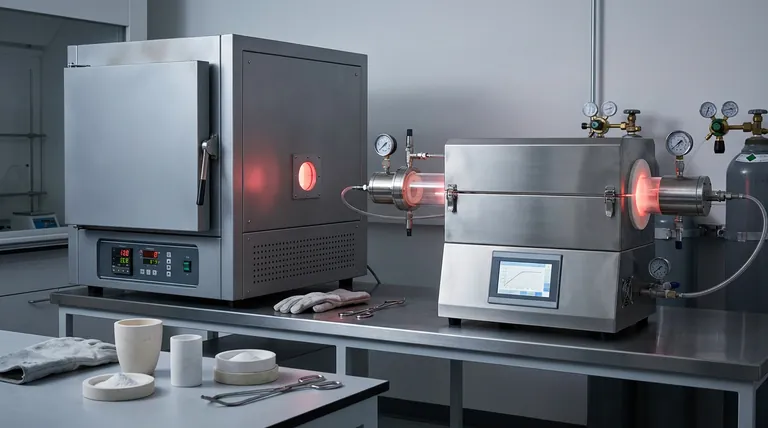
High-performance box or tube furnaces function as the critical drivers for densification in the production of Li1.3Al0.3Ti1.7(PO4)3 (LATP) electrolytes. They provide the precise thermal energy required to transform "green bodies" (unfired compacted powder) into dense ceramics by facilitating atomic diffusion and eliminating residual pores through strictly controlled heating rates and holding times.
Core Takeaway The primary role of these furnaces is to generate a stable thermal field that promotes the atomic diffusion necessary for grain growth. This process eliminates porosity and creates a highly dense ceramic structure with efficient ion transmission channels, which are the defining factor for the electrolyte's performance.
Driving Densification and Grain Growth
Facilitating Atomic Diffusion
The fundamental role of the furnace is to provide the energy required to activate atomic movement. A stable thermal field within the chamber drives atoms to move across grain boundaries, initiating the transition from loose powder to solid ceramic.
Eliminating Residual Pores
As atomic diffusion accelerates, the furnace heat forces the material to compact. This process systematically removes the voids (pores) found in the green body, resulting in a continuous, solid structure.
Establishing Ion Transmission Channels
The ultimate goal of this densification is functional, not just structural. By eliminating pores and optimizing grain growth, the furnace helps form high-efficiency channels that allow ions to transmit freely through the electrolyte.
The Importance of Thermal Precision
Controlling Heating Rates
High-performance furnaces allow operators to strictly regulate how quickly the temperature rises. This control is vital to prevent thermal shock, ensuring the material heats interaction uniformly without cracking.
Managing Holding Times
The duration for which the material is held at peak temperature dictates the final microstructure. The furnace must maintain this temperature precisely to allow sufficient densification without causing excessive, uncontrolled grain growth.
Ensuring a Stable Thermal Field
Temperature uniformity within the furnace chamber is non-negotiable. It ensures that the LATP electrolyte sinters evenly across its entire volume, preventing gradients that could lead to inconsistent ionic conductivity.
Understanding the Trade-offs: Box vs. Tube
Volume vs. Atmosphere Control
Box furnaces typically offer larger chamber volumes, making them suitable for processing larger batches of LATP electrolytes simultaneously. However, they may offer less precise control over the sintering atmosphere compared to tube variants.
The Role of Sealed Environments
Tube furnaces feature a sealed structure that excels in controlling the sintering atmosphere. While box furnaces are excellent for general densification, the sealed nature of a tube furnace allows for the precise regulation of gas flow and oxidation states, which can be critical for maintaining material purity.
Making the Right Choice for Your Goal
- If your primary focus is maximizing ionic conductivity: Prioritize a furnace with exceptional thermal stability to ensure uniform grain growth and the formation of efficient ion transmission channels.
- If your primary focus is research and atmosphere precision: Choose a high-temperature tube furnace to leverage its sealed structure for strict control over environmental variables and gas flow.
Success in LATP sintering relies not just on reaching a temperature, but on the stability and precision of the thermal environment provided by your furnace.
Summary Table:
| Feature | Role in LATP Sintering | Impact on Performance |
|---|---|---|
| Atomic Diffusion | Facilitates movement across grain boundaries | Transforms powder into dense ceramic |
| Thermal Precision | Regulates heating rates and holding times | Prevents cracking and ensures uniform microstructure |
| Porosity Control | Eliminates residual pores/voids | Creates continuous channels for ion transport |
| Atmosphere Control | Manages gas flow (primarily in Tube Furnaces) | Maintains chemical purity and oxidation states |
Elevate Your Battery Material Research with KINTEK
Precision is the difference between a brittle ceramic and a high-performance solid-state electrolyte. At KINTEK, we understand that LATP sintering requires absolute thermal stability and atmospheric control.
Backed by expert R&D and manufacturing, KINTEK offers a comprehensive range of Muffle, Tube, Rotary, Vacuum, and CVD systems. Whether you need the high-volume capacity of our box furnaces or the superior atmospheric sealing of our tube furnaces, all our lab high-temp systems are fully customizable to meet your unique research or production needs.
Ready to optimize your grain growth and ionic conductivity? Contact our technical experts today to find the perfect furnace solution for your laboratory.
References
- Q.Z. Zeng, Zhongmin Wang. Influence of Zr Addition on the Microstructure and Hydrogenation Kinetics of Ti50−xV25Cr25Zrx (x = 0, 5, 7, and 9) Alloys. DOI: 10.3390/ma17061366
This article is also based on technical information from Kintek Furnace Knowledge Base .
Related Products
- 1400℃ High Temperature Laboratory Tube Furnace with Alumina Tube
- 1700℃ High Temperature Laboratory Tube Furnace with Alumina Tube
- 1200℃ Split Tube Furnace Laboratory Quartz Tube Furnace with Quartz Tube
- Vertical Laboratory Quartz Tube Furnace Tubular Furnace
- 1700℃ Controlled Inert Nitrogen Atmosphere Furnace
People Also Ask
- How are high-temperature laboratory tube furnaces applied in long-term vacuum homogenization heat treatments for intermetallic samples?
- How do high-temperature laboratory tube furnaces ensure environmental stability? Precision Thermal Reduction Tips
- How are high-temperature tube furnaces applied in testing ceramic-supported alloy membranes? Insights
- What is the mechanism of a high-temperature furnace in Bi-2223 sintering? Achieve Precision Phase Transformation
- What is the function of a furnace in CuAlMn alloy treatment? Achieve Perfect Microstructural Homogenization



















