
Modern 70mm tube furnaces are engineered with a suite of integrated safety features designed to protect the operator, the equipment, and the experimental sample. The most common of these are over-temperature protection to prevent overheating, safety interlocks that cut power when the furnace is opened, and systems to manage controlled gas atmospheres safely, such as flow monitors and leak detectors. These systems work together to ensure secure operation during high-temperature processing.
The core principle of modern furnace safety is moving beyond simple temperature control. It's about creating an integrated system that actively monitors for electrical, thermal, and atmospheric anomalies and defaults to a safe state, protecting both personnel and the integrity of the experiment.
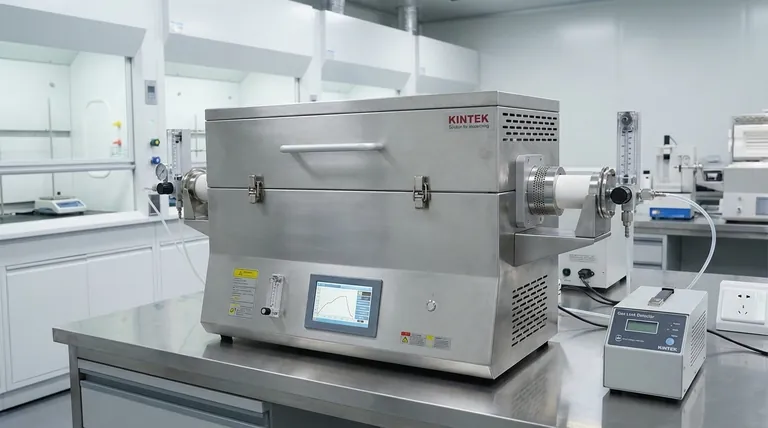
Protecting the Operator: Physical Safety
The most immediate risks in high-temperature work are direct physical harm from heat and pressure. Modern furnaces address these with passive and active mechanisms.
Double-Wall Housing and Active Cooling
Modern furnaces feature a double-layer steel housing. This design allows for airflow between the inner and outer walls, which actively dissipates heat.
This construction keeps the external surface temperature remarkably low, often below 50°C (122°F), even when the internal temperature is over 800°C (1472°F). This drastically reduces the risk of accidental burns for operators.
Safety Interlocks on Access Points
A critical feature is the positive break safety switch or interlock system. This mechanism automatically cuts power to the heating elements the moment the furnace door or chamber is opened.
This prevents any possibility of operator exposure to the extreme radiant heat of the furnace interior, making sample loading and unloading fundamentally safer.
Overpressure Safeguards
When a tube is sealed or a reaction generates gas, internal pressure can build rapidly, creating a risk of the quartz or ceramic tube shattering.
To mitigate this, furnaces used for these applications can be equipped with pressure relief valves or sensors that automatically shut down the process if pressure exceeds a safe threshold.
Protecting the Equipment: Electrical and Thermal Safeguards
Beyond operator safety, these features protect the furnace itself from self-destruction, ensuring long-term reliability and preventing costly damage.
Over-Temperature Protection (OTP)
This is a redundant safety controller that operates independently of the main temperature programmer. The user sets a maximum allowable temperature slightly above the desired setpoint.
If the primary controller fails or a thermocouple malfunctions, the OTP will cut power to the heating elements, preventing a catastrophic thermal runaway that could destroy the elements, insulation, and the sample.
Thermocouple Break Protection
The thermocouple is the furnace's primary temperature sensor. If it breaks or becomes disconnected, a naive controller might interpret the signal as a low temperature and apply full power indefinitely.
Modern controllers have built-in thermocouple break protection. They recognize the faulty signal and immediately shut down the heating system, preventing uncontrolled heating.
Overcurrent Protection
This functions like a sophisticated circuit breaker for the furnace. It protects the sensitive control electronics and power systems from damage caused by electrical faults or power surges.
Managing the Process: Atmospheric Safety
For experiments requiring a controlled atmosphere (e.g., inert gas or reactive gases), managing the gas environment is a primary safety concern.
Gas Flow Monitoring
Furnaces designed for atmospheric control include gas flow monitors or controllers. These ensure that the correct volume of gas is flowing through the tube.
An alert or shutdown can be triggered if flow stops, which could compromise the experiment or, with reactive gases, create a hazardous condition.
Gas Leak Detection
When working with flammable (e.g., hydrogen) or toxic gases, gas leak detectors are a crucial addition to the system.
These sensors are placed near the furnace and will trigger alarms and potentially an automatic shutdown of the gas supply if a leak from a fitting or a compromised tube is detected.
Fume and Exhaust Management
While often external to the furnace, proper ventilation is an integral part of the safety system. Volatile materials or reaction byproducts must be safely removed.
Operating the tube furnace within a fume hood or connecting its exhaust port to a dedicated local exhaust system is essential for managing hazardous fumes and ensuring operator and environmental safety.
Understanding the Trade-offs and Limitations
While these features provide robust protection, it's crucial to understand their context and limitations to maintain a truly safe environment.
Features Must Match the Application
A simple furnace for heat treating in air does not require and will not include gas leak detection or overpressure safeguards. Users must critically assess the specific hazards of their experiment—be it high pressure, flammable gas, or toxic byproducts—and ensure the furnace they choose is equipped to handle them.
The Myth of "Failsafe"
These safety features are powerful tools, not infallible guarantees. They require correct installation, regular calibration (especially OTP and gas sensors), and routine maintenance. A disabled interlock or an improperly set OTP creates a dangerous illusion of safety. Operator training remains the most important safety feature of all.
Cost vs. Required Safety
Advanced safety systems, particularly automated gas management and leak detection, add to the furnace's cost and complexity. While it may be tempting to select a simpler unit, the choice must be dictated by the real risks of the process, not by budget alone.
Making the Right Choice for Your Goal
Select your furnace and its safety configuration based on the specific risks inherent in your planned work.
- If your primary focus is high-temperature processing in ambient air: Prioritize excellent over-temperature protection, reliable door interlocks, and a double-wall housing for a low external temperature.
- If your primary focus is working with inert or non-flammable process gases: In addition to the above, you must have systems for overpressure protection and accurate gas flow monitoring.
- If your primary focus is processing with flammable or toxic gases: All of the above are required, but the system must also include integrated gas leak detection and be operated within an appropriate, certified ventilation system.
Ultimately, understanding these integrated safety systems empowers you to operate high-temperature equipment with confidence and control.
Summary Table:
| Safety Feature | Purpose |
|---|---|
| Over-Temperature Protection | Prevents overheating and thermal runaway |
| Safety Interlocks | Cuts power when furnace is opened |
| Double-Wall Housing | Reduces external surface temperature |
| Gas Flow Monitoring | Ensures correct gas flow for experiments |
| Gas Leak Detection | Detects leaks of flammable or toxic gases |
| Overpressure Safeguards | Prevents tube rupture from pressure buildup |
| Thermocouple Break Protection | Stops heating if sensor fails |
| Overcurrent Protection | Guards against electrical faults |
Ensure your lab's safety and efficiency with KINTEK's advanced high-temperature furnace solutions! Leveraging exceptional R&D and in-house manufacturing, we provide diverse laboratories with reliable options like Tube Furnaces, Muffle Furnaces, Rotary Furnaces, Vacuum & Atmosphere Furnaces, and CVD/PECVD Systems. Our strong deep customization capability allows us to precisely meet your unique experimental requirements, integrating essential safety features for peace of mind. Contact us today to discuss how we can support your high-temperature processing goals!
Visual Guide

Related Products
- Vertical Laboratory Quartz Tube Furnace Tubular Furnace
- Vacuum Sealed Continuous Working Rotary Tube Furnace Rotating Tube Furnace
- Magnesium Extraction and Purification Condensing Tube Furnace
- Split Multi Heating Zone Rotary Tube Furnace Rotating Tube Furnace
- High Pressure Laboratory Vacuum Tube Furnace
People Also Ask
- What are the key differences between single-zone and multi-zone vertical tube furnaces? Choose the Right Furnace for Your Lab
- How do heat treatment processes influence the configuration of a vertical tube furnace? Optimize for Quenching, Annealing, and More
- How are metal support wires selected for sample suspension? Expert Guide to High-Temp Furnace Materials
- What are the main characteristics of vertical tube furnaces? Optimize Your Lab with Space-Saving, Uniform Heating
- How does a vertical single-temperature zone tube furnace facilitate the growth of high-quality PdSe2 single crystals?



















