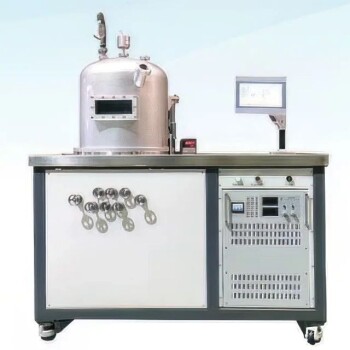
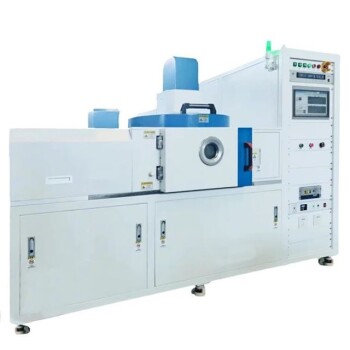
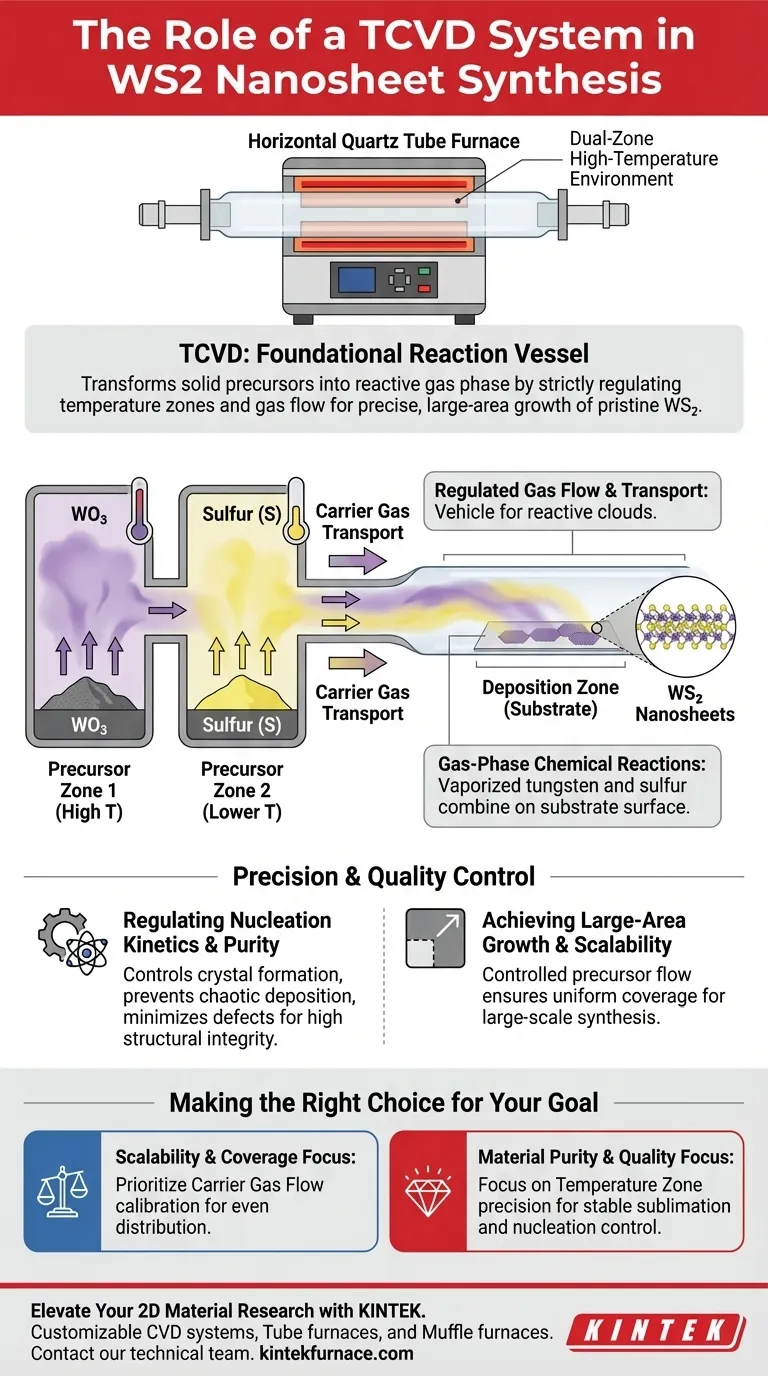
A Thermal Chemical Vapor Deposition (TCVD) system serves as the foundational reaction vessel for synthesizing Tungsten Disulfide (WS2) nanosheets. It orchestrates the growth process by creating a dual-zone high-temperature environment within a horizontal quartz tube furnace, where solid precursors—Sulfur (S) and Tungsten Trioxide (WO3)—are sublimated and transported by carrier gases to deposit as high-quality, two-dimensional layers on a substrate.
The TCVD system transforms solid chemical precursors into a reactive gas phase by strictly regulating temperature zones and gas flow, enabling the precise, large-area growth of pristine WS2 structures.
The Mechanics of the Reaction Environment
The Horizontal Quartz Tube Setup
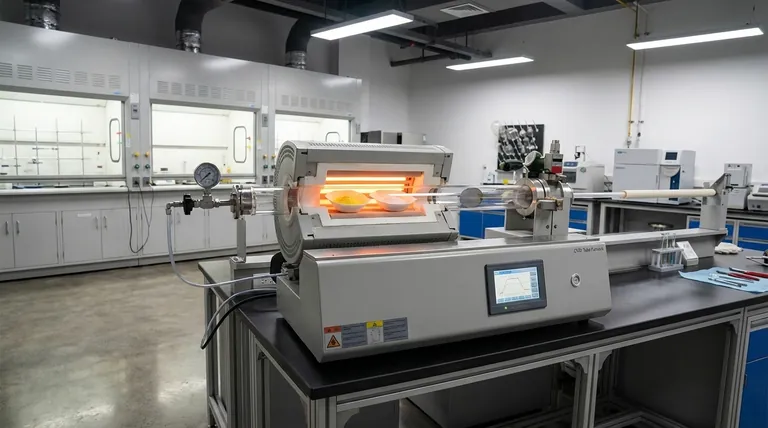
The core of the TCVD system is a horizontal quartz tube furnace. This tube acts as the reaction chamber, providing a clean, isolated environment necessary for high-purity synthesis.
Creating Specific Temperature Zones
Unlike simple heating elements, the TCVD system is designed to manage separate temperature zones. This is critical because the precursors used for WS2 synthesis have vastly different thermal requirements.
Thermal Separation
The system allows for the independent heating of Tungsten Trioxide (WO3) and Sulfur (S). This ensures that both materials reach their specific sublimation points at the exact right moment to facilitate the reaction.
The Role of Precursors and Transport
Sublimation of Precursors
The primary function of the heat is sublimation. The system converts solid WO3 and S into a vapor state, releasing them as reactive gases within the tube.
Carrier Gas Transport
Once the precursors are vaporized, the system utilizes carrier gases to move them down the tube. These gases act as a vehicle, transporting the reactive clouds from the source zones toward the target substrate.
Gas-Phase Chemical Reactions
Deposition occurs through a gas-phase chemical reaction. The vaporized tungsten and sulfur combine on the surface of the substrate to form the desired WS2 nanosheets.
Precision and Quality Control
Regulating Nucleation Kinetics
By managing the furnace temperature and pressure, the system controls nucleation kinetics. This dictates how the crystals begin to form and grow, preventing random or chaotic deposition.
Achieving Large-Area Growth
The controlled flow of precursors ensures uniform coverage. This capability allows for the synthesis of large-area materials rather than just isolated microscopic clusters.
High-Quality Structure
The precise environment minimizes defects. The result is the formation of high-quality, two-dimensional materials with high structural integrity.
Understanding the Trade-offs
Complexity of Multi-Zone Control
Operating a TCVD system requires balancing multiple variables simultaneously. If the temperature in the sulfur zone fluctuates even slightly, it can alter the stoichiometry of the final product, leading to poor quality WS2.
Sensitivity to Gas Flow Rates
The carrier gas flow is a double-edged sword. While necessary for transport, an aggressive flow rate can blow the precursors past the substrate before they deposit, while a flow that is too slow may cause uneven thickness or premature deposition.
Making the Right Choice for Your Goal
To maximize the effectiveness of a TCVD system for WS2 synthesis, you must align the system settings with your specific objectives.
- If your primary focus is Scalability and Coverage: Prioritize the calibration of carrier gas flow rates to ensure the vaporized precursors are distributed evenly across the entire length of the substrate.
- If your primary focus is Material Purity and Quality: Focus heavily on the precision of the temperature zones, ensuring the precursors sublime at stable rates to control nucleation kinetics effectively.
Success in WS2 synthesis relies not just on heating the materials, but on the precise orchestration of their transport and reaction.
Summary Table:
| Component/Process | Role in WS2 Synthesis |
|---|---|
| Horizontal Quartz Tube | Provides a clean, isolated environment for high-purity reaction. |
| Dual Temperature Zones | Independently regulates sublimation of Sulfur and Tungsten Trioxide. |
| Carrier Gas Flow | Transports vaporized precursors to the substrate for deposition. |
| Nucleation Kinetics | Controls crystal formation to ensure high structural integrity. |
| Substrate Deposition | Facilitates gas-phase reactions for large-area 2D material growth. |
Elevate Your 2D Material Research with KINTEK
Precise control over temperature zones and gas flow is non-negotiable for high-quality WS2 synthesis. Backed by expert R&D and world-class manufacturing, KINTEK provides industry-leading CVD systems, Tube furnaces, and Muffle furnaces—all fully customizable to meet your unique laboratory requirements.
Whether you are focusing on scalability or material purity, our systems deliver the stability your research demands. Contact our technical team today to discuss your specific needs and discover how our advanced thermal solutions can optimize your synthesis outcomes.
Visual Guide
References
- Mohammad Shahbazi, Ramin Mohammadkhani. High performance in the DC sputtering-fabricated Au/WS2 optoelectronic device. DOI: 10.1038/s41598-025-87873-0
This article is also based on technical information from Kintek Furnace Knowledge Base .
Related Products
- Custom Made Versatile CVD Tube Furnace Chemical Vapor Deposition CVD Equipment Machine
- HFCVD Machine System Equipment for Drawing Die Nano Diamond Coating
- Multi Heating Zones CVD Tube Furnace Machine for Chemical Vapor Deposition Equipment
- Cylindrical Resonator MPCVD Machine System for Lab Diamond Growth
- RF PECVD System Radio Frequency Plasma Enhanced Chemical Vapor Deposition
People Also Ask
- What is a CVD tube furnace and what is its primary function? Discover Precision Thin-Film Deposition
- Why are CVD tube furnace sintering systems indispensable for 2D material research and production? Unlock Atomic-Scale Precision
- Which industries and research fields benefit from CVD tube furnace sintering systems for 2D materials? Unlock Next-Gen Tech Innovations
- How does CVD tube furnace sintering enhance graphene growth? Achieve Superior Crystallinity and High Electron Mobility
- What improvements can be made to the bonding force of gate dielectric films using a CVD tube furnace? Enhance Adhesion for Reliable Devices