
The primary function of an alumina crucible in the self-flux growth of CsV3Sb5 single crystals is to serve as a robust, high-temperature containment vessel. It houses the reactive Cs-Sb flux and raw materials, providing a stable environment capable of withstanding temperatures up to 1000°C without chemically interacting with the growth mixture.
In crystal synthesis, the integrity of the container is as critical as the raw materials. The alumina crucible is selected specifically for its ability to maintain chemical inertness under extreme heat, ensuring the final crystal structure is not compromised by dissolved impurities from the vessel itself.
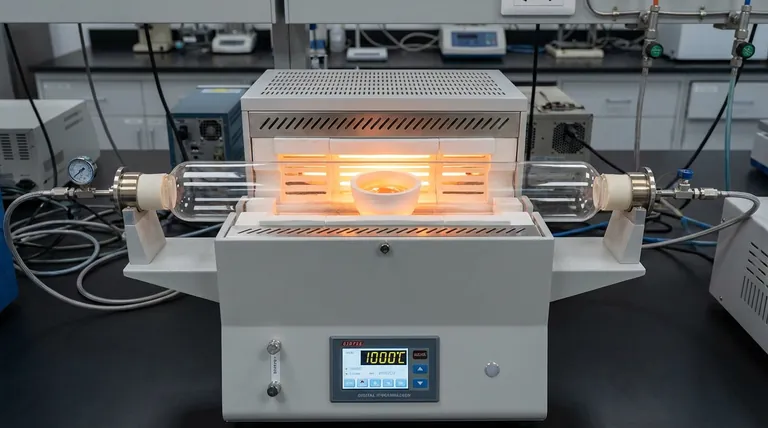
Engineering the Growth Environment
To understand the role of the crucible, one must look beyond simple containment. In self-flux growth, the crucible is an active component of the thermal system but must remain a passive component of the chemical system.
Withstanding Extreme Temperatures
The growth of CsV3Sb5 requires a thermal cycle that reaches significant highs. The alumina crucible acts as a thermal shield and structural support, designed to withstand environments up to 1000°C.
At these temperatures, lesser materials might soften or deform. Alumina maintains its structural rigidity, ensuring the physical safety of the experiment throughout the heating and cooling phases.
Resisting Chemical Attack
The process utilizes a Cs-Sb flux to facilitate crystal growth. Fluxes can be highly reactive and corrosive, often dissolving the container material in standard setups.
Alumina possesses superior chemical stability against this specific flux composition. It acts as an effective barrier, preventing the molten mixture from breaching the containment wall during the long growth cycle.
The Criticality of Material Purity
The choice of alumina is driven fundamentally by the need for a pristine reaction environment. This is where the deep need for high-quality crystal synthesis is addressed.
Preventing Sample Contamination
If a crucible reacts with the flux, elements from the container leach into the solution. This introduces foreign atoms into the crystal lattice, ruining the sample's electronic or magnetic properties.
Because alumina does not react with the Cs-Sb flux, it guarantees the purity of the crystal growth environment. The resulting CsV3Sb5 crystals are formed solely from the intended raw materials, free from external contaminants.
Understanding the Constraints
While alumina is the material of choice for this specific application, understanding its role requires acknowledging the operational boundaries.
Stability Limits
The effectiveness of the crucible is bound by the 1000°C operational ceiling mentioned in the context of this process. Exceeding this temperature range could compromise the crucible's integrity or lead to unexpected reactivity.
Specificity of Flux Compatibility
Alumina is chosen specifically for its inertness regarding the Cs-Sb flux. It is important to note that this inertness is chemically specific; while excellent for this process, alumina may not be suitable for different flux compositions used in other crystal growth methods.
Making the Right Choice for Your Goal
Selecting the correct containment hardware is the first step toward reproducible science.
- If your primary focus is High Purity: Prioritize the chemical stability of the alumina crucible to ensure no reaction occurs between the vessel and the Cs-Sb flux.
- If your primary focus is Process Safety: Ensure your thermal protocols do not exceed the crucible's rated resistance of 1000°C to prevent structural failure.
The success of CsV3Sb5 growth relies on the alumina crucible acting as a silent partner—present to hold the heat, but invisible to the chemistry.
Summary Table:
| Feature | Role in CsV3Sb5 Growth |
|---|---|
| Temperature Resistance | Maintains structural integrity up to 1000°C thermal cycles. |
| Chemical Inertness | Prevents reactions with corrosive Cs-Sb flux. |
| Contamination Control | Ensures no foreign ions leach into the crystal lattice. |
| Structural Rigidity | Provides a stable containment vessel for reactive molten fluxes. |
Achieve Scientific Precision with KINTEK
High-purity crystal growth demands reliable containment that never compromises your results. At KINTEK, we understand that the integrity of your experiment depends on the quality of your labware.
Backed by expert R&D and world-class manufacturing, we provide high-performance alumina crucibles, Muffle, Tube, Rotary, Vacuum, and CVD systems. Whether you are performing self-flux growth or complex material synthesis, our lab high-temp furnaces and specialized vessels are fully customizable to meet your unique research needs.
Ready to elevate your lab's performance? Contact our technical experts today to find the perfect solution for your thermal processing requirements.
References
- Kazumi Fukushima, Shingo Yonezawa. Violation of emergent rotational symmetry in the hexagonal Kagome superconductor CsV3Sb5. DOI: 10.1038/s41467-024-47043-8
This article is also based on technical information from Kintek Furnace Knowledge Base .
Related Products
- 1400℃ High Temperature Laboratory Tube Furnace with Alumina Tube
- 1700℃ High Temperature Laboratory Tube Furnace with Alumina Tube
People Also Ask
- How does zone-melting in tube furnaces synthesize bismuth micro-wires? Master Single-Crystal Thermoelectric Growth
- How are high-temperature laboratory tube furnaces applied in long-term vacuum homogenization heat treatments for intermetallic samples?
- How are high-temp tube furnaces used to measure diffusion coefficients per Fick's law? Master Precision Annealing
- How do high-temperature laboratory tube furnaces ensure environmental stability? Precision Thermal Reduction Tips
- How are high-temperature tube furnaces applied in testing ceramic-supported alloy membranes? Insights

