
Infrared (IR) pyrometers fundamentally improve thermal control by providing a non-contact, direct measurement of the substrate's actual surface temperature. Unlike thermocouples, which are prone to errors caused by contact resistance and the mechanical challenges of rotating substrates, pyrometers deliver real-time monitoring with exceptional precision, achieving an accuracy of ±1°C at deposition temperatures of 500°C.
The transition from thermocouples to IR pyrometers shifts the process from inferring temperature via physical contact to measuring the actual surface state directly. This eliminates mechanical interference and thermal lag, ensuring the stability required for critical MBE growth and annealing phases.
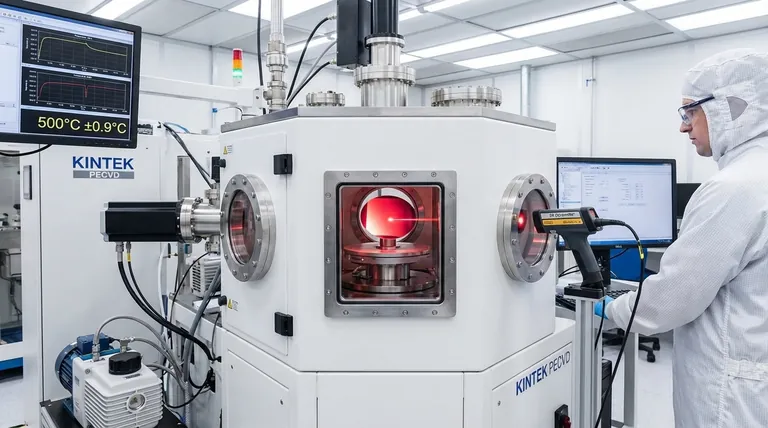
Overcoming the Limitations of Contact Measurement
Eliminating Contact Resistance
Thermocouples rely on physical touch to measure heat. This introduces contact resistance, a variable that causes discrepancies between the sensor's reading and the actual temperature of the material.
IR pyrometers bypass this issue entirely. By measuring thermal radiation remotely, they provide a true reading of the substrate surface without the errors introduced by physical interfaces.
Facilitating Substrate Rotation
Uniform material growth in Molecular Beam Epitaxy (MBE) often requires the substrate to rotate. Traditional wired thermocouples are mechanically ill-suited for rotating stages, often leading to signal noise or complex slip-ring requirements.
Because IR pyrometers are non-contact devices, they remain unaffected by the mechanical movement of the substrate. This allows for continuous, uninterrupted monitoring regardless of rotation speed.
Precision in Critical Process Phases
High-Accuracy Deposition
Stable material growth demands tight thermal tolerances. The primary reference confirms that IR pyrometers can maintain an accuracy of ±1°C at deposition temperatures of 500°C.
This level of precision ensures that the growth kinetics remain constant. It prevents temperature drifts that could alter the crystal structure or stoichiometry of the layer being deposited.
Control During High-Temperature Annealing
The benefits of direct surface measurement extend beyond the initial growth. During high-temperature annealing stages, precise thermal profiles are necessary to activate dopants or cure defects.
Pyrometers provide real-time feedback during these rapid temperature changes. This allows the control system to react instantly to the actual surface temperature, rather than waiting for heat to soak through to a backside thermocouple.
Understanding the Operational Differences
Direct Surface vs. Indirect Proxy
The most significant distinction is what is actually being measured. Thermocouples typically measure the back of a wafer holder or a heater element, serving as a proxy for the substrate temperature.
In contrast, IR pyrometers measure the substrate surface directly. This removes the guesswork regarding thermal transfer efficiency between the heater and the wafer, providing the data that actually matters for the physics of the growth process.
Real-Time Responsiveness
Thermocouples have thermal mass, which induces a lag in response time. If the heater power changes, the thermocouple takes time to register the shift.
IR pyrometers offer real-time monitoring. Because they detect light (infrared radiation), the feedback is instantaneous, allowing for tighter closed-loop control of the growth environment.
Making the Right Choice for Your Goal
To optimize your MBE process, align your instrumentation with your specific constraints:
- If your primary focus is Uniformity via Rotation: Switch to IR pyrometers to eliminate the mechanical noise and connection issues inherent to using thermocouples on rotating stages.
- If your primary focus is Process Stability: leverage the ±1°C accuracy of pyrometers to ensure the actual surface temperature matches your setpoint, eliminating contact resistance errors.
Adopting non-contact pyrometry transforms thermal management from a reactive estimation to a precise, proactive control strategy.
Summary Table:
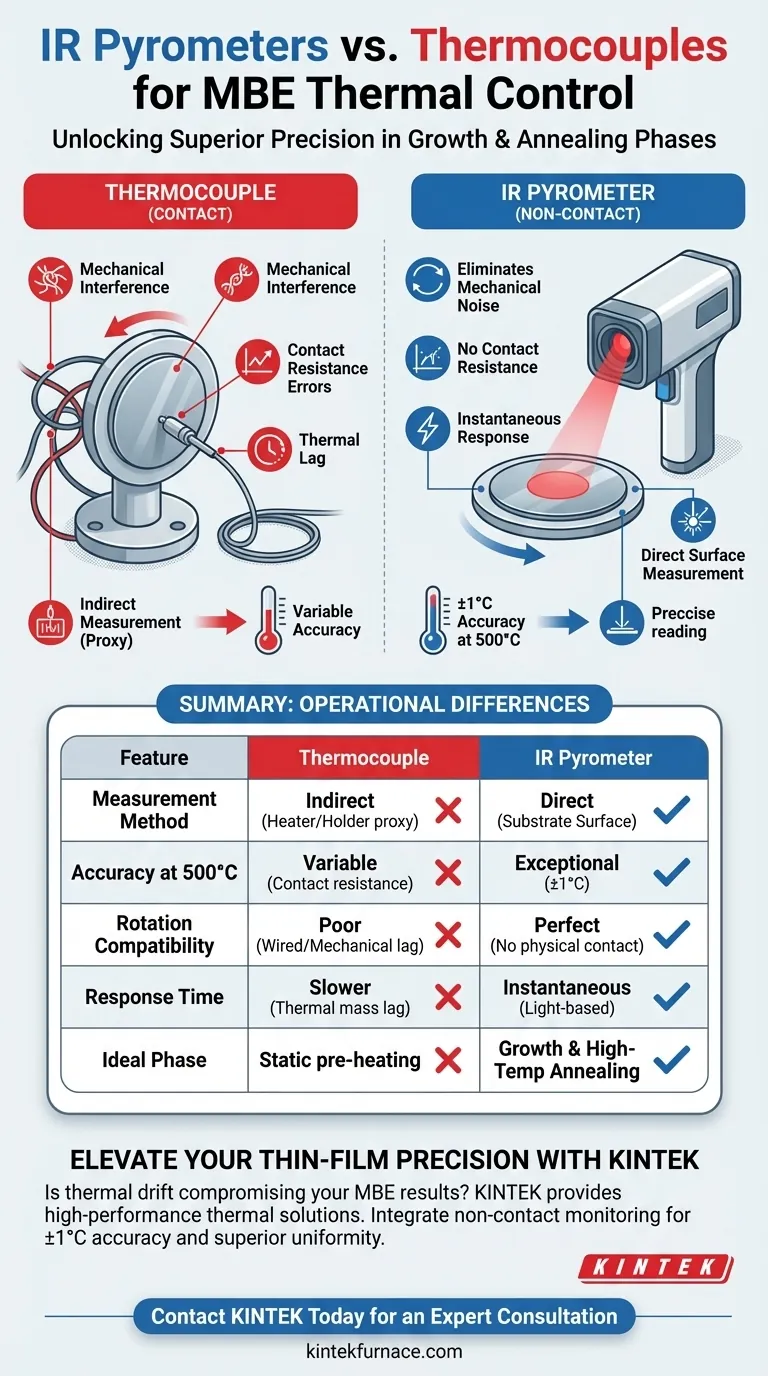
| Feature | Thermocouple (Contact) | IR Pyrometer (Non-Contact) |
|---|---|---|
| Measurement Method | Indirect (Heater/Holder proxy) | Direct (Substrate Surface) |
| Accuracy at 500°C | Variable (Contact resistance) | Exceptional (±1°C) |
| Rotation Compatibility | Poor (Wired/Mechanical lag) | Perfect (No physical contact) |
| Response Time | Slower (Thermal mass lag) | Instantaneous (Light-based) |
| Ideal Phase | Static pre-heating | Growth & High-Temp Annealing |
Elevate Your Thin-Film Precision with KINTEK
Is thermal drift compromising your MBE growth or annealing results? KINTEK provides high-performance thermal solutions designed for the most demanding laboratory environments. Backed by expert R&D and manufacturing, we offer Muffle, Tube, Rotary, Vacuum, and CVD systems, along with specialized heating components that are fully customizable to your unique research needs.
Don't settle for indirect measurements and mechanical interference. Let our team help you integrate the precision of non-contact monitoring into your workflow to ensure ±1°C accuracy and superior material uniformity.
Ready to optimize your lab's thermal control? Contact KINTEK Today for a Expert Consultation
Visual Guide
References
- Emanuele Pompei, Stefano Veronesi. Novel Structures of Gallenene Intercalated in Epitaxial Graphene. DOI: 10.1002/smll.202505640
This article is also based on technical information from Kintek Furnace Knowledge Base .
Related Products
- High Temperature Muffle Oven Furnace for Laboratory Debinding and Pre Sintering
- Multi Zone Laboratory Quartz Tube Furnace Tubular Furnace
- Laboratory Quartz Tube Furnace RTP Heating Tubular Furnace
- Vertical Laboratory Quartz Tube Furnace Tubular Furnace
- 1200℃ Controlled Inert Nitrogen Atmosphere Furnace
People Also Ask
- What thermal phenomena occur during polymer binder burnout in ceramic green bodies? Lab Furnace Guide
- Why is controlled heat treatment in a muffle furnace necessary for calcined clay? Achieve Optimal Pozzolanic Activity
- What role does a high-temperature muffle furnace play in STFO synthesis? Achieve Pure Perovskite Results
- How does a high-temperature muffle furnace facilitate the formation of LaNbxAl1−xO3+δ perovskite structures? Key Roles
- What role does a high-temperature muffle furnace play in the multi-stage synthesis of Li0.5MnFe1.5O4? Key to Pure Spinel



















