
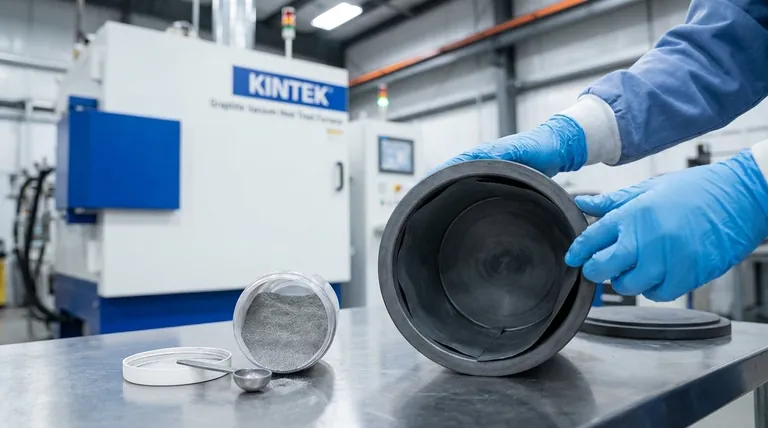
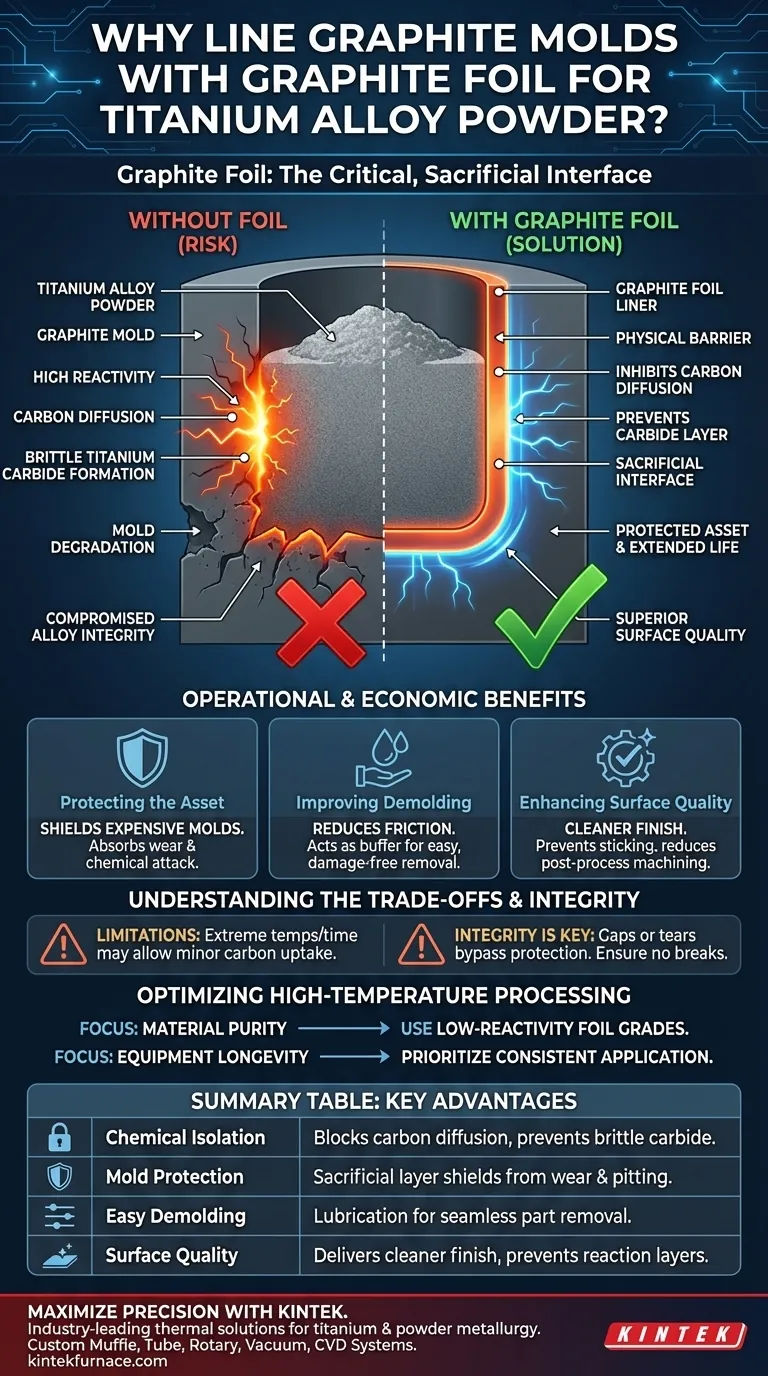
Graphite foil serves as a critical, sacrificial interface between raw materials and processing equipment. Its primary function is to act as a physical barrier that isolates highly reactive titanium alloy powder from the graphite mold walls. This isolation prevents the titanium from chemically bonding with the mold to form a brittle carbide layer, protects the expensive mold from degradation, and significantly eases post-processing cleanup.
Titanium possesses an extremely high affinity for carbon at elevated temperatures, which can lead to severe material degradation if left unchecked. By lining the mold with graphite foil, engineers create a physical shield that blocks direct contact, preventing carbon diffusion reactions while significantly extending the service life of the mold.
Mitigating Chemical Reactivity
The Titanium-Carbon Challenge
Titanium is notorious for its high reactivity, particularly at the elevated temperatures required for sintering or molding. If titanium powder comes into direct contact with a graphite mold, it will react vigorously with the carbon.
Preventing Carbide Formation
This reaction creates a layer of titanium carbide, a hard and brittle compound that can compromise the integrity of the alloy. The graphite foil acts as an isolation layer, physically separating the two materials to inhibit this carbon diffusion.
Using Low-Reactivity Materials
Specific "low-reactivity" graphite foils are often selected for this task. These are engineered to provide the necessary thermal properties of graphite while minimizing the chemical potential for reaction with the metal powder.
Operational and Economic Benefits
Protecting the Asset
Graphite molds are precision-machined and expensive to replace. The foil acts as a liner that absorbs the wear and chemical attack, effectively shielding the inner walls of the mold from damage.
Improving Demolding
Beyond chemical isolation, the foil provides lubrication and buffering. This reduces friction resistance between the consolidated part and the mold wall, making it much easier to remove the sample without damaging the mold or the part.
Enhancing Surface Quality
By preventing the titanium from sticking to the mold and reducing surface reactions, the foil ensures a cleaner finish on the final product. This reduces the need for aggressive post-process machining or grinding to remove reaction layers.
Understanding the Trade-offs
The Limitations of Graphite Foil
While graphite foil significantly reduces the risk of reaction, it is fundamentally still a carbon-based material. At extreme temperatures or prolonged exposure times, some carbon uptake is still possible, though it will be far less severe than direct mold contact.
The Importance of Integrity
The foil is a physical barrier, meaning its effectiveness relies entirely on its structural integrity. If the foil tears during loading or if gaps are left between the powder and the mold, the titanium will bypass the protection and react directly with the mold wall.
Optimizing High-Temperature Processing
To achieve the best results when working with reactive alloys and graphite tooling, consider your specific operational priorities:
- If your primary focus is Material Purity: Ensure you select low-reactivity graphite foil grades to minimize any potential carbon diffusion into the titanium alloy.
- If your primary focus is Equipment Longevity: Prioritize the consistent application of the foil liner to prevent "sticking," which is the leading cause of premature mold wear and surface pitting.
By treating the foil lining not just as a spacer, but as an essential chemical shield, you ensure the longevity of your tooling and the quality of your final alloy.
Summary Table:
| Benefit | Description |
|---|---|
| Chemical Isolation | Prevents the formation of brittle titanium carbide by blocking carbon diffusion. |
| Mold Protection | Acts as a sacrificial layer to shield expensive graphite tooling from wear and pitting. |
| Easy Demolding | Provides lubrication that reduces friction, making part removal seamless and damage-free. |
| Surface Quality | Delivers a cleaner finish on titanium parts by preventing sticking and reaction layers. |
Maximize Your High-Temperature Processing Precision
Don't let chemical reactions compromise your material integrity or destroy your expensive tooling. KINTEK provides industry-leading thermal solutions backed by expert R&D and manufacturing. Whether you require Muffle, Tube, Rotary, Vacuum, or CVD systems, our high-temp furnaces are fully customizable to meet the rigorous demands of titanium alloy processing and powder metallurgy.
Protect your assets and achieve superior results with KINTEK’s specialized laboratory equipment. Contact us today to discuss your unique project needs!
Visual Guide
Related Products
People Also Ask
- Why are vacuum heat treating furnaces essential for aerospace? Ensure Superior Material Integrity for High-Stakes Applications
- What is the primary application of vacuum heat treating furnaces in aerospace? Enhance Component Performance with Precision
- What is the process of vacuum heat treating? Achieve Superior Metallurgical Properties
- How does vacuum heat treating work in terms of temperature and time control? Master Precise Material Transformations
- How does a vacuum heat treating furnace improve the condition of metal alloys? Achieve Superior Metal Performance
