
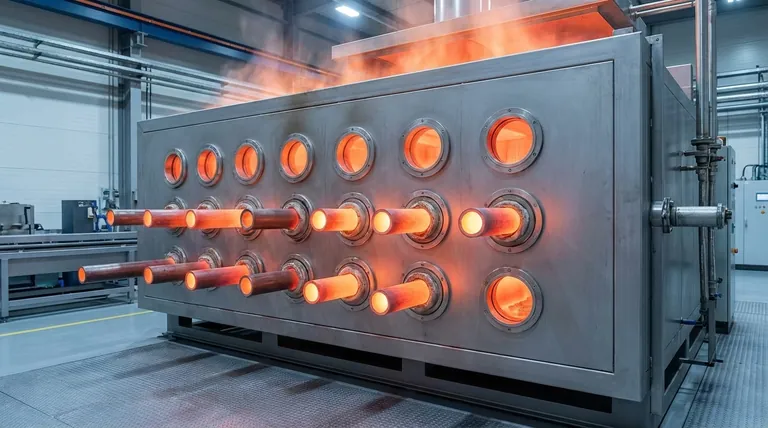
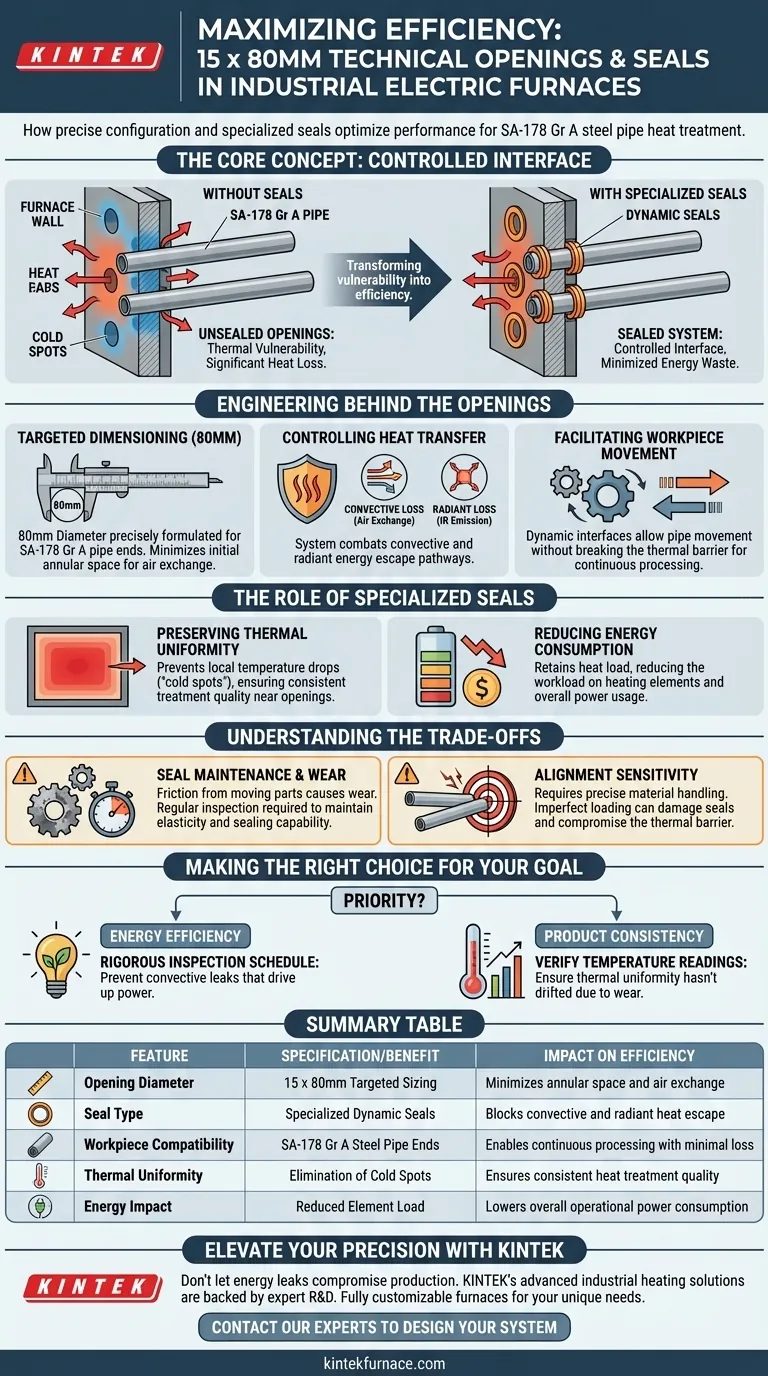
The precise configuration of fifteen 80mm technical openings allows for the targeted heat treatment of SA-178 Gr A steel pipe ends without compromising the furnace's thermal envelope. By integrating specialized seals that accommodate workpiece movement, these openings drastically reduce convective and radiant heat escape, directly translating to stabilized internal temperatures and lower energy requirements.
By effectively isolating the internal environment, these specialized seals transform a potential thermal vulnerability—multiple hull penetrations—into a controlled interface that supports continuous processing while minimizing energy waste.
The Engineering Behind the Openings
Targeted Dimensioning
The openings are manufactured with a specific 80mm diameter. This dimension is calculated to accommodate the insertion of SA-178 Gr A steel pipe ends.
By matching the opening size closely to the workpiece, the design naturally limits the annular space available for air exchange. This minimizes the initial potential for heat loss before seals are even applied.
Controlling Heat Transfer Mechanisms
The system is designed to combat two specific types of energy loss: convective and radiant.
Convective loss occurs when hot furnace atmosphere escapes through gaps, while radiant loss involves direct emission of infrared energy. The integration of the openings with the seals blocks both pathways effectively.
Facilitating Workpiece Movement
Industrial heat treatment often requires the movement or rotation of parts during the cycle.
The technical openings are not static plugs; they are dynamic interfaces. The design allows the pipe ends to move as required by the process without breaking the thermal barrier.
The Role of Specialized Seals
Preserving Thermal Uniformity
Consistency is critical in heat treatment. If heat escapes through the openings, it creates "cold spots" near the furnace wall.
The seals prevent these local temperature drops. This ensures that the internal thermal uniformity remains intact, guaranteeing that the pipe ends near the openings receive the exact same treatment as those deeper in the furnace.
Reducing Energy Consumption
When a furnace loses heat, the heating elements must work harder to compensate.
By minimizing leakage through the fifteen openings, the furnace retains its heat load more effectively. This directly reduces the overall energy consumption required to maintain the process temperature.
Understanding the Trade-offs
Seal Maintenance and Wear
While these seals are essential for efficiency, they introduce a maintenance variable. Because they interact with moving workpieces, the seals are subject to friction and mechanical wear.
Degraded seals will compromise both efficiency and thermal uniformity. They require regular inspection to ensure they have not lost their elasticity or sealing capability.
Alignment Sensitivity
The effectiveness of an 80mm opening depends on precise loading.
If the SA-178 Gr A pipes are not aligned perfectly with the openings, they may physically damage the seals during insertion or movement. This requires precise material handling systems to prevent damage to the thermal barrier.
Making the Right Choice for Your Goal
To maximize the value of this furnace configuration, consider your operational priorities:
- If your primary focus is Energy Efficiency: Implement a rigorous inspection schedule for the seals to prevent convective leaks that will silently drive up power usage.
- If your primary focus is Product Consistency: Regularly verify temperature readings near the technical openings to ensure the thermal uniformity has not drifted due to seal wear.
Proper management of these interfaces ensures your furnace operates at peak thermal efficiency.
Summary Table:
| Feature | Specification/Benefit | Impact on Efficiency |
|---|---|---|
| Opening Diameter | 15 x 80mm Targeted Sizing | Minimizes annular space and air exchange |
| Seal Type | Specialized Dynamic Seals | Blocks convective and radiant heat escape |
| Workpiece Compatibility | SA-178 Gr A Steel Pipe Ends | Enables continuous processing with minimal loss |
| Thermal Uniformity | Elimination of Cold Spots | Ensures consistent heat treatment quality |
| Energy Impact | Reduced Element Load | Lowers overall operational power consumption |
Elevate Your Heat Treatment Precision with KINTEK
Don’t let energy leaks compromise your production quality. KINTEK’s advanced industrial heating solutions are backed by expert R&D and manufacturing, offering high-performance Muffle, Tube, Rotary, Vacuum, and CVD systems. Whether you need specialized technical openings or custom thermal barriers, our furnaces are fully customizable to meet your unique laboratory and industrial requirements.
Ready to optimize your thermal efficiency? Contact our experts today to design a high-temperature system tailored to your specific workpiece and energy-saving goals.
Visual Guide
References
- Gustavo Ribeiro Zanini, LUIS CARLOS GERON. PROJETO DE UM FORNO ELÉTRICO INDUSTRIAL PARA TRATAMENTO TÉRMICO TUBOS DE AÇO SA-178 GR A. DOI: 10.52138/citec.v17i01.437
This article is also based on technical information from Kintek Furnace Knowledge Base .
Related Products
- Electric Rotary Kiln Small Rotary Furnace for Activated Carbon Regeneration
- Electric Rotary Kiln Continuous Working Small Rotary Furnace Kiln for Pyrolysis Plant Heating
- Electric Rotary Kiln Pyrolysis Furnace Plant Machine Small Rotary Kiln Calciner
- Spark Plasma Sintering SPS Furnace
- 1200℃ Controlled Inert Nitrogen Atmosphere Furnace
People Also Ask
- What are the main applications of a rotary kiln electric furnace? Achieve Uniform Heat Treatment for Powders
- What are the key components of a rotary kiln electric furnace? Unlock Efficient Thermal Processing
- What is the significance of the refractory lining in a rotary kiln electric furnace? Unlock Efficiency and Longevity
- What advantages do electric rotary kilns offer over fuel-based kilns? Boost Efficiency and Purity in Your Process
- What materials can be processed in an electric rotary kiln? Versatile Solutions for Advanced Materials



















