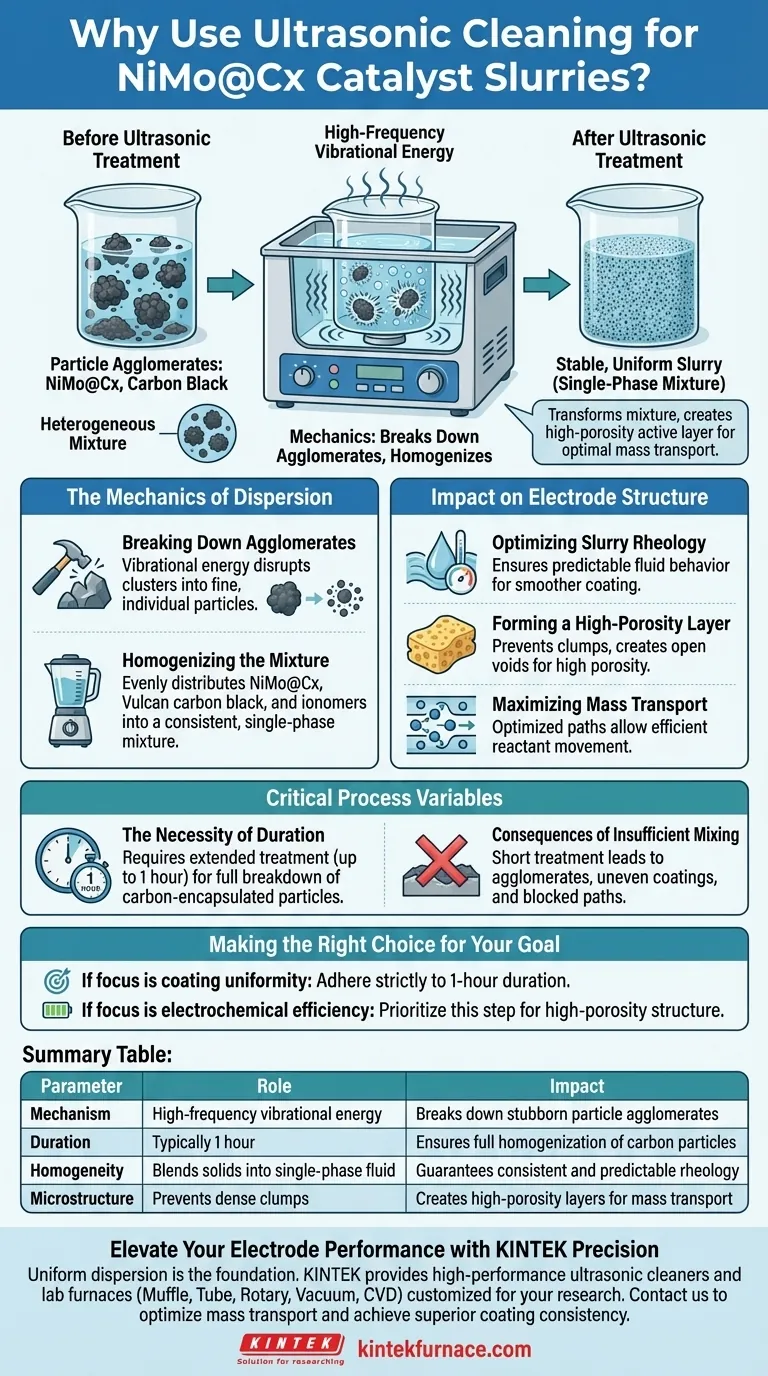
The primary purpose of using an ultrasonic cleaner is to utilize high-frequency vibrational energy to thoroughly disperse NiMo@Cx catalyst particles, Vulcan carbon black, and ionomers within a solvent mixture. This mechanical action effectively breaks down stubborn particle agglomerates, ensuring the slurry achieves the necessary consistency for uniform electrode coating.
Extended ultrasonic treatment transforms a heterogeneous mixture into a stable, uniform slurry. This step is fundamental to creating a high-porosity active layer that optimizes mass transport within the final electrochemical cell.
The Mechanics of Dispersion
Breaking Down Agglomerates
Catalyst particles and carbon supports have a natural tendency to cluster together. The ultrasonic cleaner generates vibrational energy that physically disrupts these agglomerates, separating them into finer, individual particles.
Homogenizing the Mixture
To create an effective slurry, the solid components must be evenly distributed within the isopropanol and water solvent. Ultrasonic treatment ensures that the NiMo@Cx, Vulcan carbon black, and ionomers are blended into a consistent, single-phase mixture.
Impact on Electrode Structure
Optimizing Slurry Rheology
The flow properties, or rheology, of the slurry are dictated by how well the solids are dispersed. Breaking down particles ensures the fluid behaves predictably during application, leading to a smoother coating process.
Forming a High-Porosity Layer
A uniform dispersion is required to build an active layer with high porosity. By preventing large clumps from forming, the slurry dries into a structure that maintains open voids rather than dense, blocked regions.
Maximizing Mass Transport
The physical structure of the electrode directly impacts electrochemical performance. The high porosity achieved through ultrasonic mixing creates optimized paths for mass transport, allowing reactants to move efficiently through the cell.
Critical Process Variables
The Necessity of Duration
Achieving a truly uniform dispersion is not instantaneous. The process typically requires extended treatment, often lasting up to one hour, to fully break down carbon-encapsulated particles.
Consequences of Insufficient Mixing
If the ultrasonic treatment is cut short, agglomerates will remain in the slurry. This leads to uneven coatings and blocked transport paths, significantly degrading the final performance of the electrochemical cell.
Making the Right Choice for Your Goal
To maximize the effectiveness of your electrode preparation, consider the following regarding the ultrasonication step:
- If your primary focus is coating uniformity: Adhere strictly to the one-hour treatment duration to ensure all agglomerates are eliminated before application.
- If your primary focus is electrochemical efficiency: Prioritize this step to guarantee the high-porosity structure required for optimal mass transport paths.
Proper slurry preparation is the invisible foundation of high-performance electrode fabrication.
Summary Table:
| Parameter | Role in Slurry Preparation | Impact on Performance |
|---|---|---|
| Mechanism | High-frequency vibrational energy | Breaks down stubborn particle agglomerates |
| Duration | Typically 1 hour of treatment | Ensures full homogenization of carbon particles |
| Homogeneity | Blends solids into single-phase fluid | Guarantees consistent and predictable rheology |
| Microstructure | Prevents formation of dense clumps | Creates high-porosity layers for mass transport |
Elevate Your Electrode Performance with KINTEK Precision
Uniform dispersion is the foundation of high-performance electrochemistry. At KINTEK, we understand the critical role of preparation in catalyst development. Backed by expert R&D and world-class manufacturing, we provide high-performance ultrasonic cleaners and lab high-temp furnaces—including Muffle, Tube, Rotary, Vacuum, and CVD systems—all customizable to your unique research needs.
Ready to optimize your mass transport and achieve superior coating consistency? Contact KINTEK today to discover how our advanced laboratory solutions can refine your material synthesis and electrode fabrication process.
Visual Guide
References
- Sun Seo Jeon, Hyunjoo Lee. Degradation of NiMo Catalyst Under Intermittent Operation of Anion Exchange Membrane Water Electrolyzer and its Mitigation by Carbon Encapsulation. DOI: 10.1002/aenm.202501800
This article is also based on technical information from Kintek Furnace Knowledge Base .
Related Products
- High Temperature Muffle Oven Furnace for Laboratory Debinding and Pre Sintering
- Stainless Steel Quick Release Vacuum Chain Three Section Clamp
- Multi Heating Zones CVD Tube Furnace Machine for Chemical Vapor Deposition Equipment
- Electric Rotary Kiln Small Rotary Furnace for Activated Carbon Regeneration
- Vacuum Dental Porcelain Sintering Furnace for Dental Laboratories
People Also Ask
- What thermal phenomena occur during polymer binder burnout in ceramic green bodies? Lab Furnace Guide
- Why is controlled heat treatment in a muffle furnace necessary for calcined clay? Achieve Optimal Pozzolanic Activity
- What role does a high-temperature muffle furnace play in STFO synthesis? Achieve Pure Perovskite Results
- How does a high-temperature muffle furnace facilitate the formation of LaNbxAl1−xO3+δ perovskite structures? Key Roles
- What role does a high-temperature muffle furnace play in the formation of biochar catalysts? Master Catalyst Synthesis