
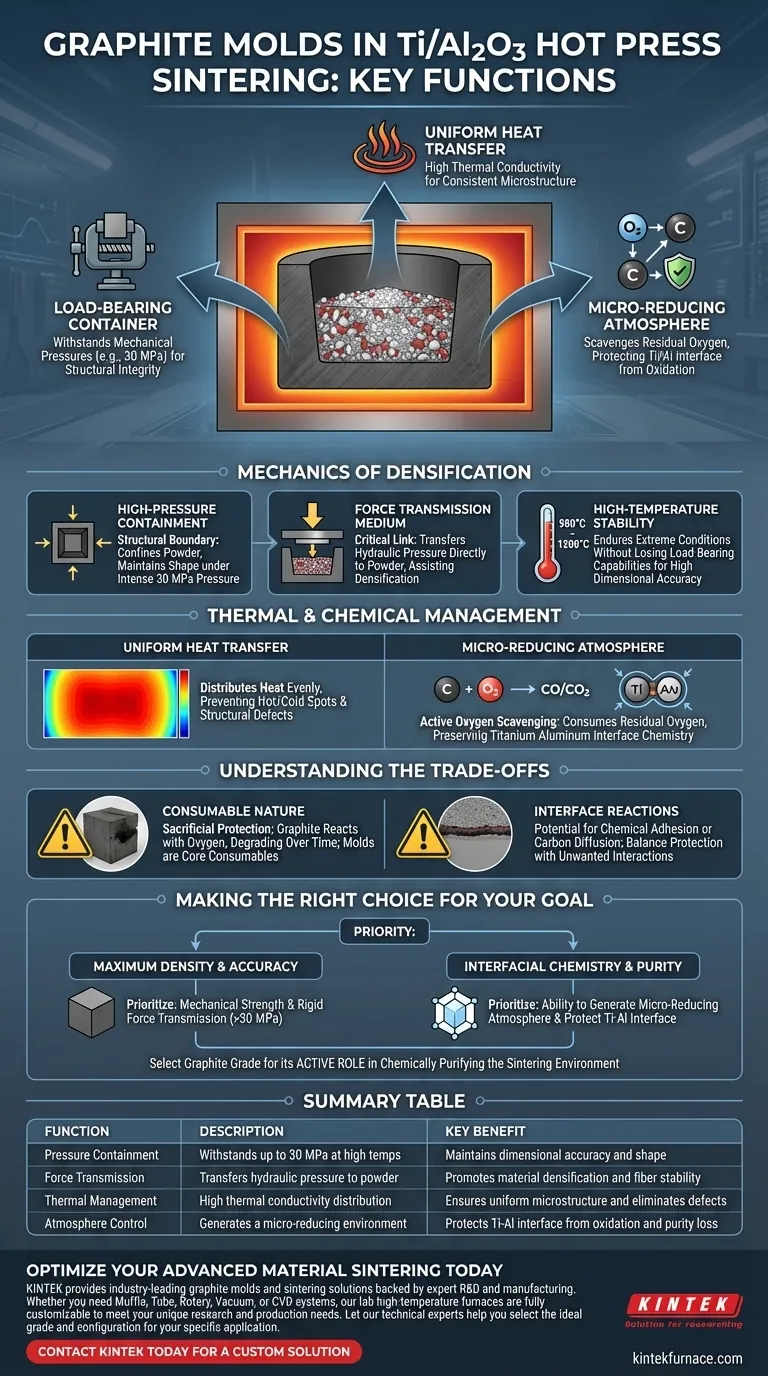
High-strength graphite molds function as essential, multi-purpose process vessels that actively facilitate the densification and chemical stabilization of Ti/Al2O3 composites. They serve three simultaneous roles: acting as a load-bearing container capable of withstanding mechanical pressures (e.g., 30 MPa), ensuring uniform heat transfer via high thermal conductivity, and generating a micro-reducing atmosphere that shields the material from oxidation.
Graphite molds are not merely passive containers; they are active process participants that facilitate densification through pressure transmission while chemically shielding the composite from oxidation via a self-generated reducing atmosphere.
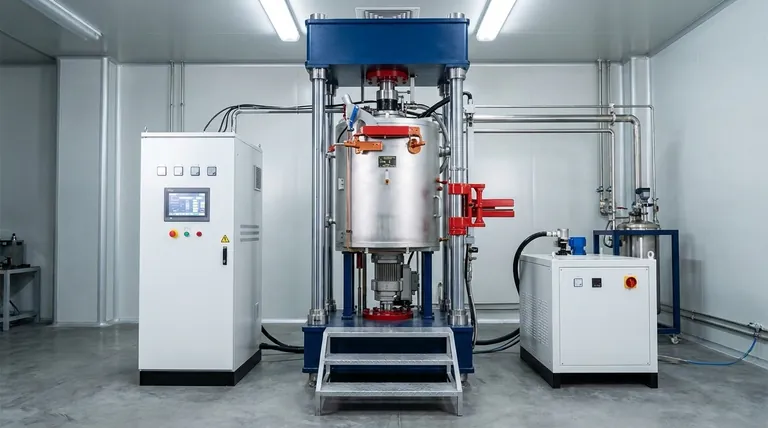
The Mechanics of Densification
High-Pressure Containment
The primary mechanical function of the graphite mold is to serve as a robust container for the powder forming process. It acts as a structural boundary, confining the loose powder mixture into a specific shape. Crucially, it must maintain its structural integrity without deformation while subjected to intense mechanical pressures, typically around 30 MPa.
Force Transmission Medium
Beyond simple containment, the mold acts as the critical link between the hydraulic machinery and the composite material. It serves as a force transmission medium, effectively transferring the externally applied hydraulic pressure directly to the powder sample. This transmission is vital for assisting in material densification and minimizing macroscopic fiber displacement during the sintering phase.
High-Temperature Stability
The sintering of Ti/Al2O3 composites requires environments ranging from 980°C to 1200°C. The graphite mold possesses the necessary high-temperature strength to endure these conditions without losing its load-bearing capabilities. This ensures the final sintered body achieves high dimensional accuracy and the desired density.
Thermal and Chemical Management
Uniform Heat Transfer
Achieving a consistent microstructure requires precise temperature control across the entire sample. Graphite molds utilize their excellent thermal conductivity to ensure heat is distributed uniformly to the sample. This prevents localized hot or cold spots that could lead to inconsistent material properties or structural defects.
Creation of a Micro-Reducing Atmosphere
A unique chemical function of the graphite mold is its interaction with the immediate environment at high temperatures. The graphite generates a micro-reducing atmosphere, which actively consumes residual oxygen within the chamber. This "oxygen scavenging" effect is critical for maintaining the purity of the composite constituents.
Protection of the Titanium-Aluminum Interface
The presence of oxygen can be detrimental to Titanium-based composites, causing unwanted oxidation. By consuming residual oxygen, the graphite mold specifically protects the titanium-aluminum interface. This preservation of the interface chemistry is essential for ensuring the mechanical strength and coherence of the final composite.
Understanding the Trade-offs
The Consumable Nature of Graphite
While graphite is chemically stable, it functions partly by reacting with oxygen, effectively acting as a consumable component. This sacrificial protection means the molds degrade over time and must be treated as core consumables rather than permanent fixtures.
Interface Reactions
While the mold protects against oxidation, the graphite itself is in direct contact with the composite matrix. In some metal matrix composites, this can lead to chemical adhesion or reaction layers, though graphite generally resists severe sticking in vacuum environments. Operators must monitor the balance between necessary chemical protection and unwanted carbon diffusion into the sample surface.
Making the Right Choice for Your Goal
When optimizing the hot press sintering process for Ti/Al2O3 composites, consider which function of the mold is most critical to your specific quality metrics.
- If your primary focus is Maximum Density and Dimensional Accuracy: Prioritize the mold's mechanical strength and its ability to act as a rigid force transmission medium under pressures exceeding 30 MPa.
- If your primary focus is Interfacial Chemistry and Material Purity: Rely on the mold's ability to generate a micro-reducing atmosphere to scavenge oxygen and protect the sensitive titanium-aluminum interface.
Select your graphite grade not just for its ability to hold shape, but for its active role in chemically purifying the sintering environment.
Summary Table:
| Function | Description | Key Benefit |
|---|---|---|
| Pressure Containment | Withstands up to 30 MPa at high temps | Maintains dimensional accuracy and shape |
| Force Transmission | Transfers hydraulic pressure to powder | Promotes material densification and fiber stability |
| Thermal Management | High thermal conductivity distribution | Ensures uniform microstructure and eliminates defects |
| Atmosphere Control | Generates a micro-reducing environment | Protects Ti-Al interface from oxidation and purity loss |
Optimize Your Advanced Material Sintering Today
Achieving the perfect balance of density and chemical purity in Ti/Al2O3 composites requires more than just high temperatures—it demands high-performance process vessels. KINTEK provides industry-leading graphite molds and sintering solutions backed by expert R&D and manufacturing.
Whether you need Muffle, Tube, Rotary, Vacuum, or CVD systems, our lab high-temperature furnaces are fully customizable to meet your unique research and production needs. Let our technical experts help you select the ideal grade and configuration for your specific application.
Contact KINTEK Today for a Custom Solution
Visual Guide
Related Products
People Also Ask
- Why are vacuum heat treating furnaces essential for aerospace? Ensure Superior Material Integrity for High-Stakes Applications
- What is the primary application of vacuum heat treating furnaces in aerospace? Enhance Component Performance with Precision
- How does a vacuum heat treating furnace improve the condition of metal alloys? Achieve Superior Metal Performance
- How does vacuum heat treating work in terms of temperature and time control? Master Precise Material Transformations
- What is the process of vacuum heat treating? Achieve Superior Metallurgical Properties
