
In the high-temperature synthesis of Na2In2As3 crystals, the alumina crucible serves as the primary containment vessel that physically isolates chemically aggressive reactants, while the quartz tube encapsulation creates the necessary hermetically sealed environment.
Specifically, the alumina crucible holds the sodium, indium, and arsenic mixture to prevent the molten alkali metal (sodium) from chemically attacking the outer vessel. Simultaneously, the quartz tube creates a closed system that maintains an inert atmosphere, protecting the synthesis from environmental interference.
Core Takeaway: This dual-layer containment strategy is essential because standard quartz tubing cannot survive direct contact with molten sodium at 1000 °C. The alumina acts as a chemical shield, while the quartz acts as an atmospheric seal.
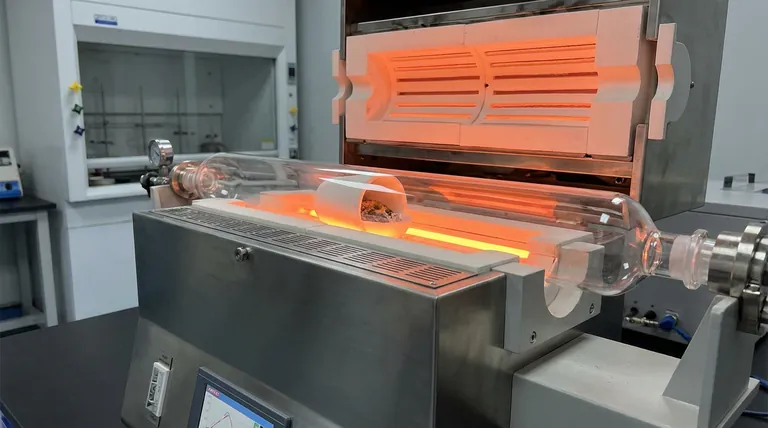
The Role of the Inner Alumina Crucible
Chemical Stability Against Alkali Metals
The primary function of the alumina crucible is to withstand the corrosive nature of the reactants. Sodium, an alkali metal used in this synthesis, becomes highly reactive in its molten state.
Alumina possesses superior chemical stability that prevents it from reacting with the sodium, indium, or arsenic mixture. This inertness ensures the stoichiometry of the crystal remains pure and unaffected by the container material.
Protecting the Outer Vessel
Crucially, the alumina crucible acts as a physical barrier between the reactants and the outer quartz tube. Without this barrier, the active molten sodium would react directly with the silica in the quartz.
This reaction would compromise the structural integrity of the quartz tube, leading to vessel failure and the potential loss of the experiment.
Thermal Resilience at 1000 °C
The synthesis process reaches temperatures as high as 1000 °C. Alumina provides the necessary thermal resistance to maintain its structural form and containment capabilities at these extreme heat levels.
The Role of External Quartz Encapsulation
Creating a Controlled Atmosphere
The quartz tube acts as the encapsulation layer that surrounds the inner alumina crucible. Its primary purpose is to provide a sealed, isolated environment for the reaction to take place.
This allows the synthesis to occur under a vacuum or a specific inert atmosphere, which is critical for controlling the thermodynamics of crystal formation.
Preventing Atmospheric Contamination
By establishing a micro-closed-loop environment, the quartz tube effectively shields the reactants from the outside world.
This isolation prevents atmospheric oxygen and moisture from entering the reaction zone, which would otherwise oxidize the reactants and contaminate the final Na2In2As3 crystal lattice.
Understanding the Constraints and Trade-offs
The Vulnerability of Quartz
While quartz is excellent for sealing and transparency, it is chemically vulnerable to alkali metals. You cannot simplify this setup by removing the alumina crucible; doing so would result in the rapid etching or breaching of the quartz wall by the sodium.
Complexity vs. Purity
Using a dual-container system introduces complexity regarding thermal conductivity and physical spacing. However, this is a necessary trade-off to achieve high-purity crystals, as relying on a single material often fails to provide both the chemical resistance (alumina) and the hermetic sealing capability (quartz) required simultaneously.
Making the Right Choice for Your Goal
When designing a synthesis protocol for reactive intermetallic compounds, consider the following principles:
- If your primary focus is handling alkali metals (Na, K, Li): You must use an inner liner like alumina, as these elements will destroy quartz or glass directly at high temperatures.
- If your primary focus is atmospheric control: You must rely on quartz encapsulation to create a vacuum-tight seal that prevents oxidation during the heating and cooling phases.
Success in growing Na2In2As3 lies in recognizing that neither material can perform the job alone; they function as an interdependent system.
Summary Table:
| Component | Primary Function | Key Material Benefit |
|---|---|---|
| Alumina Crucible | Inner containment & chemical barrier | Resistant to molten sodium (alkali) attack at 1000 °C |
| Quartz Tube | Outer encapsulation & atmospheric seal | Enables vacuum/inert environment; prevents oxidation |
| Dual-Layer System | Integrated protection | Combines chemical stability with hermetic isolation |
Elevate Your Crystal Growth Precision with KINTEK
Don't let vessel failure compromise your high-purity research. Backed by expert R&D and manufacturing, KINTEK offers high-performance Muffle, Tube, Rotary, Vacuum, and CVD systems—all fully customizable to handle the most reactive synthesis challenges. Whether you are working with alkali metals or complex intermetallics, our specialized laboratory furnaces provide the thermal stability and atmospheric control you need for repeatable success.
Ready to optimize your synthesis workflow? Contact us today to discuss your custom high-temperature equipment needs with our technical team.
References
- Memristive InAs‐Based Semiconductors with Anisotropic Ion Transport. DOI: 10.1002/adma.202500056
This article is also based on technical information from Kintek Furnace Knowledge Base .
Related Products
- 1400℃ High Temperature Laboratory Tube Furnace with Alumina Tube
- 1700℃ High Temperature Laboratory Tube Furnace with Alumina Tube
People Also Ask
- How does zone-melting in tube furnaces synthesize bismuth micro-wires? Master Single-Crystal Thermoelectric Growth
- How do high-temperature laboratory tube furnaces ensure environmental stability? Precision Thermal Reduction Tips
- How are high-temp tube furnaces used to measure diffusion coefficients per Fick's law? Master Precision Annealing
- How are high-temperature laboratory tube furnaces applied in long-term vacuum homogenization heat treatments for intermetallic samples?
- How are high-temperature tube furnaces applied in testing ceramic-supported alloy membranes? Insights

