
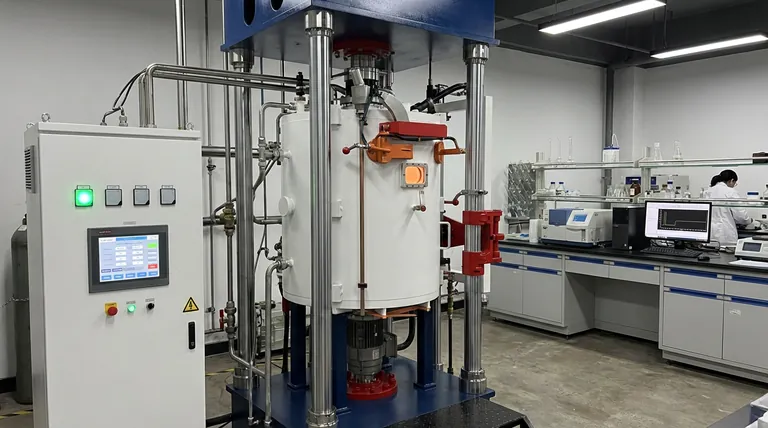
The primary function of an industrial vacuum drying oven in the preparation of Si-RuO2 catalysts is to dehydrate resin mixtures impregnated with metal precursors at a controlled temperature of 60°C. By creating a vacuum environment, the oven significantly lowers the boiling point of solvents, enabling efficient moisture removal without the high heat that causes premature precipitation. This ensures that silicon and ruthenium components maintain an atomic-level uniform dispersion within the resin matrix.
Core Insight: The vacuum drying process is not simply about removing water; it is a preservation mechanism for chemical homogeneity. By decoupling temperature from evaporation rates, it prevents the thermal agitation that typically causes active metals to aggregate, "locking in" the uniform structure established during impregnation.
The Mechanics of Vacuum Dehydration
Lowering the Thermal Threshold
The fundamental advantage of this method is the manipulation of the solvent's boiling point.
By reducing the atmospheric pressure within the chamber, the oven allows solvents and moisture to evaporate rapidly at just 60°C.
This bypasses the need for high thermal energy, which is critical for preserving sensitive precursor materials.
Protecting the Resin Matrix
High temperatures often degrade organic resin supports or cause the physical collapse of the material's pore structure.
Vacuum drying maintains a gentle thermal profile, preventing structural cracking or deterioration of the organic-inorganic hybrid precursor.
This gentle approach ensures the resin remains stable, acting as a consistent host for the active metals.
Ensuring Atomic-Level Uniformity
Preventing Premature Precipitation
In standard thermal drying, solvent evaporation often occurs unevenly, creating concentration gradients that force dissolved metals to precipitate out of the solution too early.
This typically results in large, inactive clusters of metal rather than fine particles.
Vacuum drying ensures a steady removal of solvent, preventing these saturation spikes and keeping the metal precursors dissolved until they are locked into the solid matrix.
Achieving Homogeneous Dispersion
The ultimate goal of using a vacuum oven for Si-RuO2 preparation is the atomic-level dispersion of components.
The process minimizes the "migration forces" that usually drag metal salts to the outer surface of the support during evaporation.
By mitigating this migration, the oven prevents the formation of an "eggshell" distribution (where metals sit only on the surface) and ensures the silicon and ruthenium are evenly distributed throughout the entire catalyst body.
Understanding the Trade-offs
Process Speed vs. Structural Integrity
While vacuum drying is superior for uniformity, it is generally slower than rapid convective drying methods.
Operators must accept a longer processing time to achieve high-quality dispersion; rushing this step with higher heat or rapid airflow defeats the purpose of using a vacuum.
Penetration Depth
While vacuum drying reduces the migration of metals to the surface, it does not always eliminate it entirely.
The drying rate is often lower than quick-drying techniques, resulting in a dispersion profile that is superior to standard air drying but distinct from freeze-drying.
It requires careful calibration of pressure and temperature to balance the evaporation rate with the capillary forces inside the material's pores.
Optimizing Your Preparation Protocol
To ensure the highest quality Si-RuO2 catalysts, align your drying strategy with your specific material requirements:
- If your primary focus is atomic dispersion: Prioritize the 60°C vacuum setpoint to minimize thermal agitation and prevent metal aggregation.
- If your primary focus is structural stability: Rely on the vacuum environment to remove solvents without oxidizing the resin or collapsing the pore structure.
- If your primary focus is reproducibility: Maintain strict control over the pressure gradient to ensure consistent drying rates across different batches.
By utilizing the vacuum oven effectively, you transform the drying step from a simple dehydration task into a critical control point for defining the catalyst's final active surface area.
Summary Table:
| Feature | Function in Si-RuO2 Preparation | Benefit |
|---|---|---|
| Vacuum Environment | Lowers solvent boiling point | Efficient moisture removal at low 60°C |
| Low Temp (60°C) | Prevents thermal agitation | Preserves sensitive precursors & resin matrix |
| Uniform Evaporation | Eliminates concentration gradients | Prevents premature metal precipitation |
| Migration Control | Minimizes salt movement to surface | Ensures atomic-level homogeneous dispersion |
Elevate Your Catalyst Performance with KINTEK
Maximize the precision of your chemical synthesis with KINTEK’s advanced thermal solutions. Backed by expert R&D and manufacturing, KINTEK offers specialized Vacuum, Muffle, Tube, Rotary, and CVD systems designed to meet the rigorous demands of catalyst development. Whether you need to ensure atomic-level uniformity or preserve sensitive resin matrices, our customizable lab high-temp furnaces provide the stability your research requires.
Ready to optimize your drying protocol? Contact KINTEK today for a customized solution!
References
- Xinyu Ping, Zidong Wei. Locking the lattice oxygen in RuO2 to stabilize highly active Ru sites in acidic water oxidation. DOI: 10.1038/s41467-024-46815-6
This article is also based on technical information from Kintek Furnace Knowledge Base .
Related Products
- Vacuum Heat Treat Sintering Furnace Molybdenum Wire Vacuum Sintering Furnace
- Vacuum Heat Treat Sintering and Brazing Furnace
- Dental Porcelain Zirconia Sintering Ceramic Vacuum Press Furnace
- Vacuum Induction Melting Furnace
- Vacuum Hot Press Furnace Machine Heated Vacuum Press
People Also Ask
- What are the main structural components of a vacuum sintering furnace? Unlock Precision in High-Temperature Processing
- What is the purpose of setting a mid-temperature dwell stage? Eliminate Defects in Vacuum Sintering
- How does vacuum sintering improve dimensional tolerances? Achieve Uniform Shrinkage and Precision
- What are the key components of a vacuum sintering furnace? Essential Parts for Precision Material Processing
- How does vacuum sintering contribute to cost reduction in material processing? Lower Expenses with Superior Parts





