
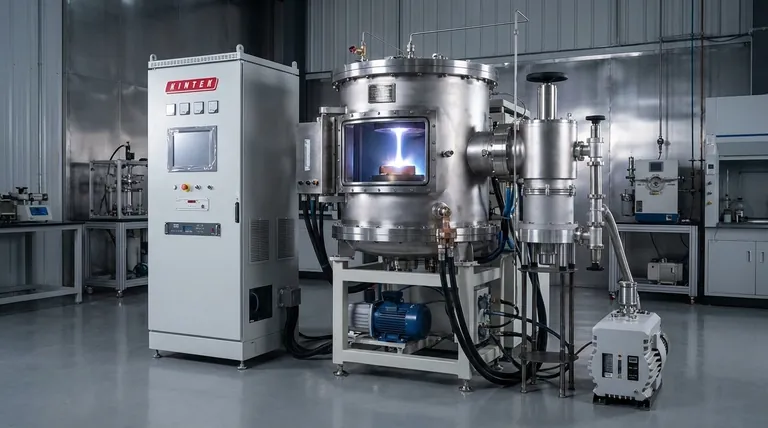
The primary function of a vacuum arc furnace in the production of Ti-6Al-7Nb alloys is to create a controlled environment that simultaneously melts raw materials and preserves their purity. By utilizing the intense heat of an electric arc within a vacuum, the furnace fully melts the alloy components while preventing detrimental chemical reactions with atmospheric gases.
The vacuum arc furnace solves the critical challenge of Titanium's high reactivity by decoupling the heating process from atmospheric exposure. It ensures that the high temperatures required for melting do not result in oxidation or nitrogen contamination, guaranteeing the precise chemical composition necessary for high-performance alloys.
The Core Mechanism: Heat and Isolation
Generating High-Intensity Heat
The furnace utilizes an electric arc to generate the extreme temperatures required to melt the raw materials.
This process is capable of quickly melting high-melting-point metals, ensuring the complete fusion of the Titanium, Aluminum, and Niobium components.
The Vacuum Shield
Crucially, this melting occurs within a vacuum environment.
At high temperatures, Titanium is highly reactive; the vacuum effectively eliminates gases like oxygen and nitrogen from the chamber.
This isolation prevents the alloy from reacting with these gases, which would otherwise compromise the material's structural integrity.
Why Purity is Critical for Ti-6Al-7Nb
Precise Chemical Control
The primary reference highlights that the vacuum environment allows for precise control over the chemical composition of the final alloy.
By removing variables introduced by air, manufacturers ensure the alloy meets exact specifications.
Preventing Oxidative Loss
Supplementary data indicates that active elements, such as Aluminum and Titanium, suffer from oxidative loss if exposed to air at melting temperatures.
The vacuum arc furnace prevents this loss, ensuring that the active elements remain in the alloy rather than forming oxides (slag).
Critical Process Distinctions
Melting vs. Sintering
It is vital to distinguish the vacuum arc furnace from vacuum sintering furnaces.
While sintering furnaces operate at lower temperatures (e.g., 1200 °C) for solid-state diffusion and porous skeleton formation, the vacuum arc furnace is designed for the complete liquid melting of the raw stock.
Melting vs. Heat Treatment
Similarly, this process is distinct from Argon atmosphere furnaces used for solution treatment and aging (around 1050 °C).
The vacuum arc furnace is the foundational step that creates the ingot, whereas atmosphere furnaces are used later to optimize microstructure and reduce residual stress.
Making the Right Choice for Your Goal
- If your primary focus is material purity: The vacuum arc furnace is non-negotiable for preventing oxygen and nitrogen contamination during the liquid phase.
- If your primary focus is process efficiency: This equipment provides the fastest method for completely melting high-melting-point reactive metals like Niobium and Titanium.
The vacuum arc furnace is the gatekeeper of quality, transforming raw, reactive elements into a stable, high-purity alloy ingot.
Summary Table:
| Feature | Vacuum Arc Furnace (VAR) | Vacuum Sintering Furnace | Argon Atmosphere Furnace |
|---|---|---|---|
| Primary Process | Complete liquid phase melting | Solid-state diffusion | Solution treatment & aging |
| Temperature Range | Extremely High (above melting points) | Moderate (e.g., 1200°C) | Lower (e.g., 1050°C) |
| Key Outcome | High-purity alloy ingots | Porous skeletons/compacts | Microstructure optimization |
| Atmosphere | High Vacuum | Vacuum | Inert Argon Gas |
| Material Focus | Preventing gas contamination | Material bonding | Stress relief & hardening |
Elevate Your Alloy Production with KINTEK Precision
Don't let atmospheric contamination compromise your high-performance materials. Backed by expert R&D and manufacturing, KINTEK offers a comprehensive range of Vacuum, CVD, Muffle, Tube, and Rotary systems, all customizable to meet the rigorous demands of reactive metal processing like Ti-6Al-7Nb production.
Whether you are melting high-purity ingots or perfecting microstructure through heat treatment, our high-temperature lab furnaces provide the precise control and reliability you need to succeed. Contact us today to find your custom furnace solution!
References
- Anjar Oktikawati, Agus Setiawan. Electrochemical characteristic and microstructure of Ti-6Al-7Nb alloy by centrifugal casting for orthopedic implant based on ageing time variations. DOI: 10.15587/1729-4061.2024.302614
This article is also based on technical information from Kintek Furnace Knowledge Base .
Related Products
- Vacuum Hot Press Furnace Machine Heated Vacuum Press Tube Furnace
- Vacuum Sealed Continuous Working Rotary Tube Furnace Rotating Tube Furnace
- Vacuum Hot Press Furnace Machine Heated Vacuum Press
- Vacuum Heat Treat Furnace with Ceramic Fiber Liner
- Vacuum Heat Treat Sintering Furnace with Pressure for Vacuum Sintering
People Also Ask
- Why use Vacuum Hot Press (VHP) for ZnS Ceramics? Achieve Superior IR Transparency and Mechanical Strength
- What safety features are incorporated in vacuum hot press furnaces? Ensure Operator and Equipment Protection
- What are the benefits of the vacuum environment system in a vacuum hot press furnace? Unlock High-Density Sintering
- What is a vacuum hot press furnace? Unlock Superior Material Performance
- What temperature control features do vacuum hot press furnaces have? Achieve Precision in High-Temp Material Processing



















