
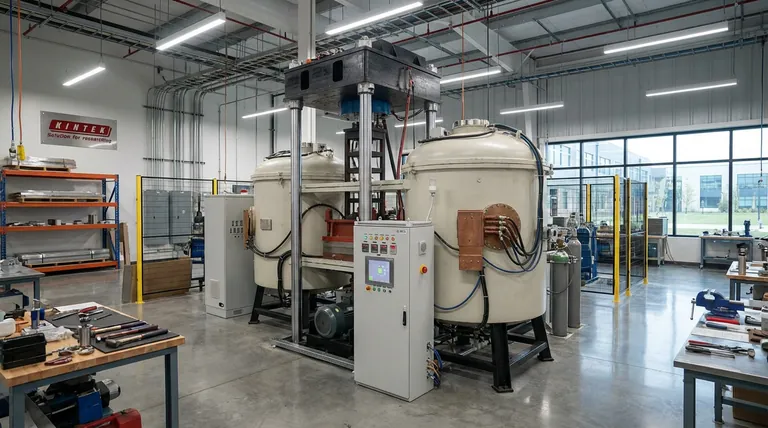
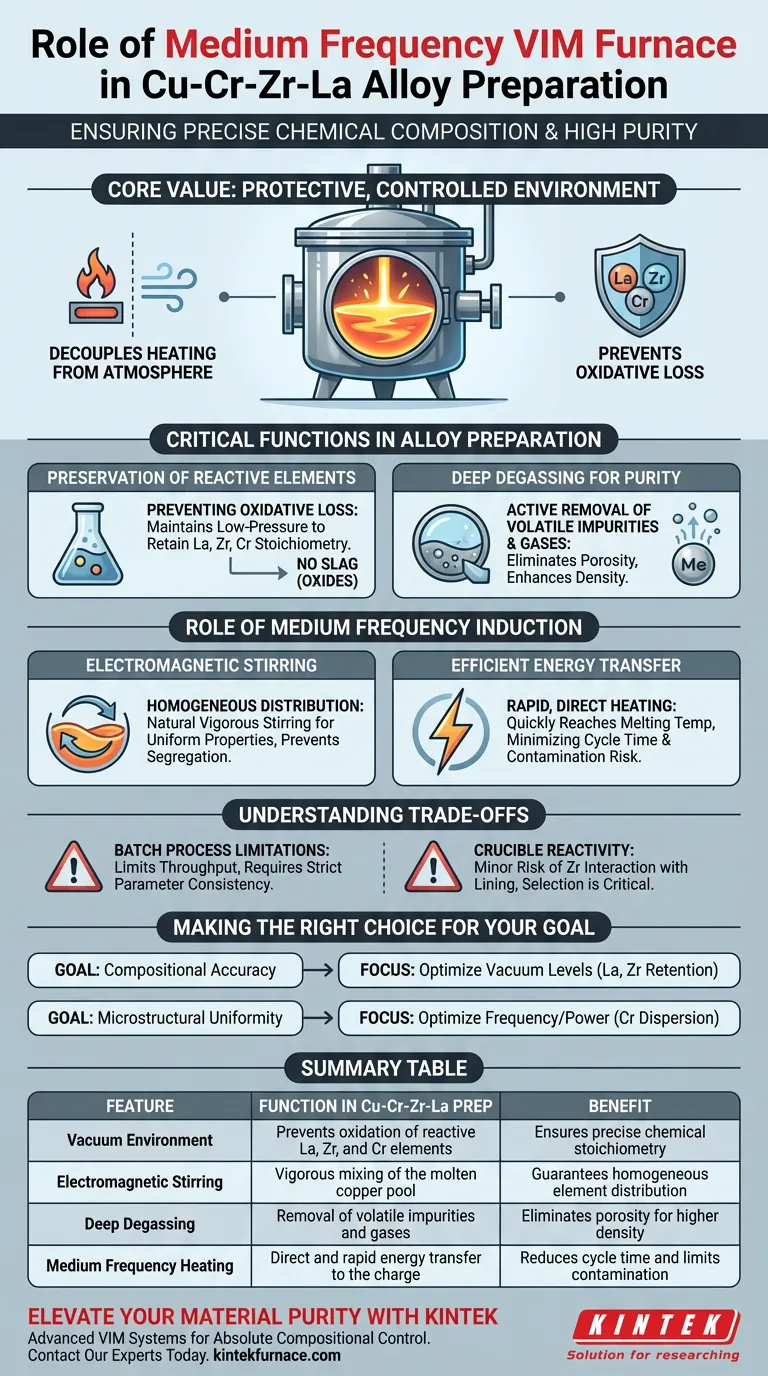
The primary role of a medium frequency vacuum induction melting (VIM) furnace is to ensure the precise chemical composition and high purity of Cu-Cr-Zr-La alloys by creating a protective, controlled environment. It utilizes electromagnetic principles to melt and stir the metal while strictly preventing the degradation of reactive alloying elements.
The core value of this furnace lies in its ability to decouple the heating process from atmospheric contamination. By operating in a vacuum, it prevents the oxidative loss of Lanthanum, Zirconium, and Chromium, ensuring the final ingot retains the exact stoichiometry required for high-performance applications.
Critical Functions in Alloy Preparation
The preparation of Cu-Cr-Zr-La (Copper-Chromium-Zirconium-Lanthanum) is technically demanding due to the reactivity of its components. The furnace addresses these challenges through three specific mechanisms.
Preservation of Reactive Elements
The most significant challenge in this alloy system is the high reactivity of Lanthanum (La), Zirconium (Zr), and Chromium (Cr).
Preventing Oxidative Loss
When exposed to oxygen at melting temperatures, these elements oxidize rapidly. Without a vacuum environment, significant amounts of La, Zr, and Cr would be lost as slag (oxides) rather than dissolving into the copper matrix. The VIM furnace mitigates this by maintaining a low-pressure environment, ensuring the final alloy retains the precise chemical composition intended by the formulation.
Deep Degassing for Purity
The vacuum environment performs a critical "cleaning" function known as degassing. It actively removes volatile impurities and gaseous byproducts from the liquid metal. This eliminates the risk of porosity in the final ingot, directly enhancing the density and microstructural integrity of the material.
The Role of Medium Frequency Induction
While the vacuum protects the chemistry, the medium frequency induction mechanism drives the physical quality of the melt.
Electromagnetic Stirring
Induction heating generates strong electromagnetic forces within the molten pool. This causes a natural, vigorous stirring action without the need for physical mechanical stirrers. For Cu-Cr-Zr-La alloys, this ensures a homogeneous distribution of the alloying elements, preventing segregation and ensuring uniform properties throughout the ingot.
Efficient Energy Transfer
Medium frequency induction provides rapid, direct heating to the metal charge. This efficiency allows the system to reach required melting temperatures quickly, minimizing the total time the metal spends in a molten state. Reduced cycle times further lower the risk of incidental contamination or crucible reactions.
Understanding the Trade-offs
While VIM is the superior choice for this alloy, it is important to recognize the operational constraints.
Batch Process Limitations
VIM is typically a batch process, which limits throughput compared to continuous casting methods. This requires strict consistency in operational parameters (vacuum levels, power input) from batch to batch to ensure reproducibility.
Crucible Reactivity
Although the vacuum removes air, the molten metal is still in contact with the crucible lining. At high temperatures, there is a minor risk of the reactive elements (especially Zirconium) interacting with the crucible material. Selecting the correct refractory lining is just as critical as the vacuum pressure itself.
Making the Right Choice for Your Goal
The use of a medium frequency VIM furnace is not just about melting; it is about chemical control.
- If your primary focus is Compositional Accuracy: Rely on the vacuum levels to strictly control the retention rates of Lanthanum and Zirconium, as these are the first to oxidize.
- If your primary focus is Microstructural Uniformity: Optimize the frequency and power settings to maximize the electromagnetic stirring effect, ensuring the Chromium is evenly dispersed.
Ultimately, this furnace serves as a purification tool, allowing you to synthesize complex copper alloys that would be impossible to produce in open-air induction systems.
Summary Table:
| Feature | Function in Cu-Cr-Zr-La Preparation | Benefit |
|---|---|---|
| Vacuum Environment | Prevents oxidation of reactive La, Zr, and Cr elements | Ensures precise chemical stoichiometry |
| Electromagnetic Stirring | Vigorous mixing of the molten copper pool | Guarantees homogeneous element distribution |
| Deep Degassing | Removal of volatile impurities and gases | Eliminates porosity for higher density |
| Medium Frequency Heating | Direct and rapid energy transfer to the charge | Reduces cycle time and limits contamination |
Elevate Your Material Purity with KINTEK
Precision is non-negotiable when synthesizing complex alloys like Cu-Cr-Zr-La. Backed by expert R&D and world-class manufacturing, KINTEK provides advanced Vacuum Induction Melting (VIM) systems, alongside our specialized Muffle, Tube, Rotary, and CVD furnaces—all fully customizable to your specific research or production needs. Ensure absolute compositional control and microstructural integrity in your high-temperature processes.
Contact Our Experts Today to Discuss Your Custom Alloy Needs
Visual Guide
References
- Hairui Zhi, Haitao Zhao. Low cycle fatigue behavior of Cu-Cr-Zr-La alloys. DOI: 10.1088/1742-6596/2951/1/012133
This article is also based on technical information from Kintek Furnace Knowledge Base .
Related Products
- Vacuum Induction Melting Furnace
- 600T Vacuum Induction Hot Press Vacuum Heat Treat and Sintering Furnace
- Small Vacuum Heat Treat and Tungsten Wire Sintering Furnace
- Dental Porcelain Zirconia Sintering Ceramic Vacuum Press Furnace
- 2200 ℃ Tungsten Vacuum Heat Treat and Sintering Furnace
People Also Ask
- What are the core functions of the High Vacuum Induction Melting (VIM) furnace? Optimize DD5 Superalloy Purification
- What role does a Vacuum Induction Melting furnace play in the production of high-aluminum nickel-based superalloys?
- What is the role of VIM and directional solidification in aero-engine blade substrates? Engineering Extreme Durability
- What are the technical advantages of using a Vacuum Induction Melting furnace in the development of advanced packaging steel?
- Why is a Vacuum Induction Melting furnace (VIM) used for Cu-Zn-Al-Sn alloys? Achieve Precision Composition Control



















