
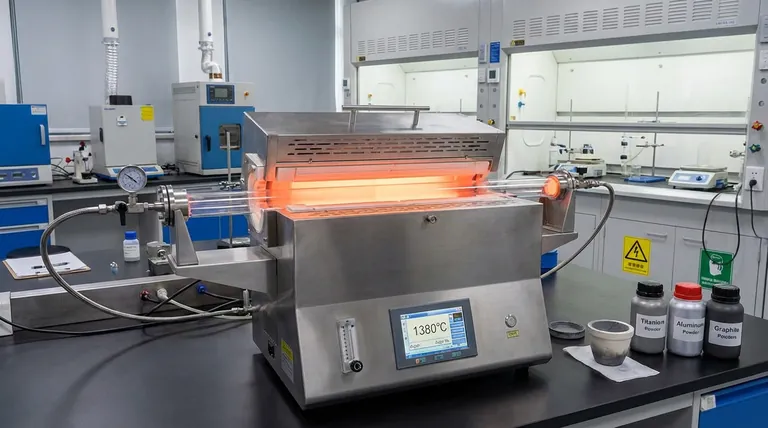
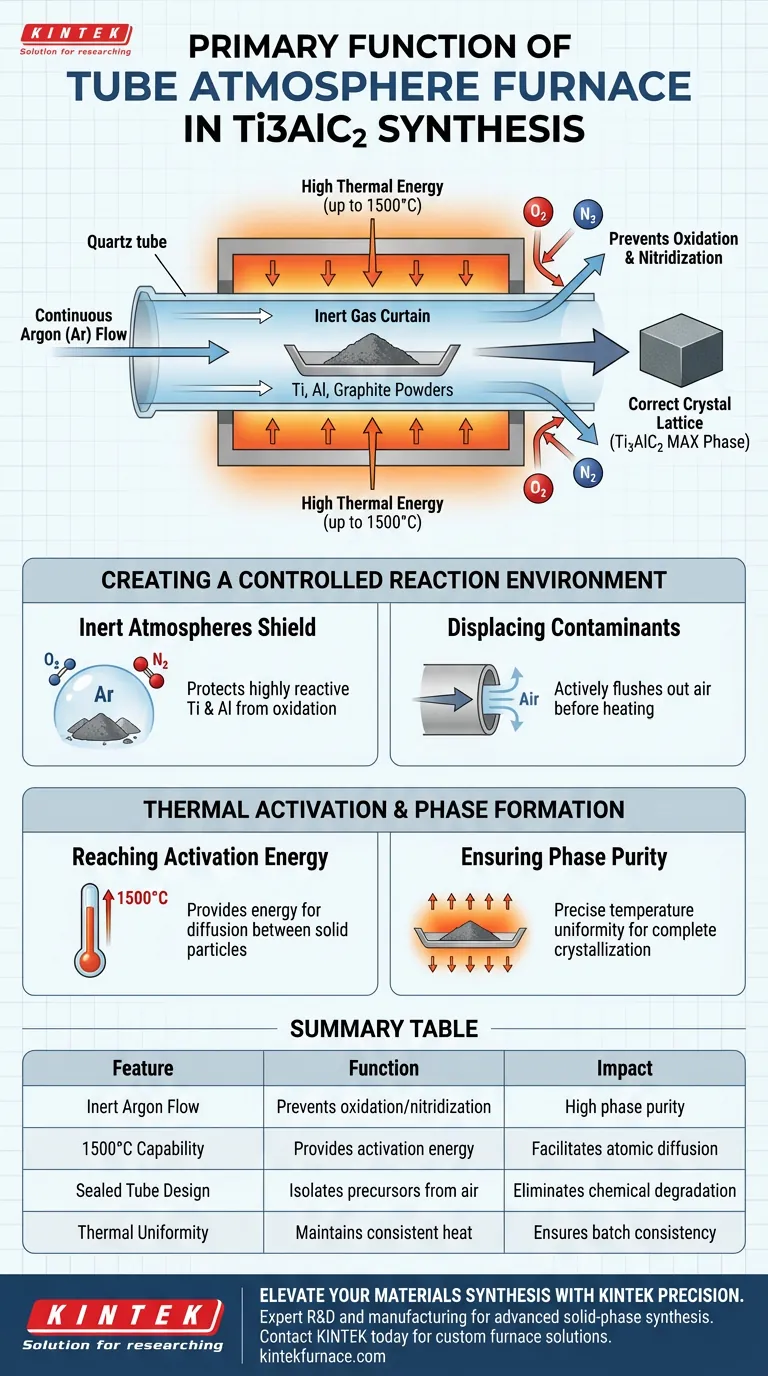
The primary function of a tube atmosphere furnace in the synthesis of Ti3AlC2 MAX phase materials is to generate the high thermal energy required for reaction while simultaneously preventing chemical degradation. It heats titanium, aluminum, and graphite powders to temperatures up to 1500°C while maintaining a continuous flow of inert Argon (Ar) gas. This isolates the reactive precursors from oxygen, ensuring the synthesis yields the correct crystal lattice rather than unwanted oxides.
Core Takeaway Reliable solid-phase synthesis requires balancing extreme heat with total chemical isolation. The tube atmosphere furnace acts as a controlled reactor that supplies the necessary activation energy for crystal formation while utilizing an inert gas curtain to strictly forbid the oxidation of highly reactive metal powders.
Creating a Controlled Reaction Environment
The Necessity of Inert Atmospheres
The most critical role of the furnace is shielding raw materials. Titanium and aluminum powders are highly reactive metals.
If exposed to oxygen or nitrogen at elevated temperatures, these materials will rapidly oxidize or nitridize. The tube furnace prevents this by creating a sealed environment purged with high-purity Argon.
Displacing Contaminants
Before heating begins, the furnace allows for the displacement of air within the chamber.
By maintaining a continuous flow of Argon, the system actively flushes out potential contaminants. This ensures that the environment remains chemically inert throughout the entire heating and cooling cycle.
Thermal Activation and Phase Formation
Reaching Activation Energy
Solid-phase synthesis requires significant thermal energy to initiate the reaction between powders.
The tube furnace provides the capability to reach temperatures up to 1500°C (often operating around 1380°C for this specific material). This high heat provides the activation energy needed for the diffusion of atoms between solid particles.
Ensuring Phase Purity
Beyond simply reaching high temperatures, the quality of the heat matters.
A high-quality tube furnace offers precise temperature uniformity. This ensures that the entire batch of material experiences the same thermal conditions, which is critical for achieving complete crystallization and high phase purity in the final Ti3AlC2 product.
Understanding the Trade-offs
Sensitivity to Gas Purity
While the furnace design is robust, the system is entirely dependent on the quality of the input gas.
Even a minor leak in the tube seals or low-purity Argon can introduce enough oxygen to ruin the synthesis. The furnace cannot "clean" impure gas; it can only maintain the atmosphere provided to it.
Batch Processing Limitations
Standard tube furnaces are typically designed for batch processing.
While excellent for ensuring uniformity and control in laboratory or pilot settings, they may limit throughput compared to continuous flow designs (like rotary furnaces) used for loose powder processing.
Making the Right Choice for Your Goal
To maximize the quality of your Ti3AlC2 synthesis, consider how you operate the equipment based on your specific objectives:
- If your primary focus is phase purity: Prioritize a furnace with a long constant temperature zone to ensure exceptional thermal uniformity across the entire sample boat.
- If your primary focus is preventing oxidation: Invest heavily in high-grade sealing flanges and ultra-high purity Argon gas sources to complement the furnace's isolation capabilities.
The tube atmosphere furnace is not just a heater; it is the primary vessel for protecting the delicate stoichiometry of your material against the environment.
Summary Table:
| Feature | Function in Ti3AlC2 Synthesis | Impact on Final Product |
|---|---|---|
| Inert Argon Flow | Prevents oxidation and nitridization of Ti/Al | Ensures high phase purity and lattice integrity |
| 1500°C Capability | Provides necessary activation energy | Facilitates atomic diffusion between solid particles |
| Sealed Tube Design | Isolates reactive precursors from air | Eliminates chemical degradation and contaminants |
| Thermal Uniformity | Maintains consistent heat across the sample | Prevents mixed phases and ensures batch consistency |
Elevate Your Materials Synthesis with KINTEK Precision
Achieving the perfect Ti3AlC2 MAX phase requires more than just heat; it demands absolute atmospheric control and thermal precision. Backed by expert R&D and manufacturing, KINTEK offers high-performance Tube, Muffle, Rotary, Vacuum, and CVD systems tailored for advanced solid-phase synthesis.
Whether you need customizable lab high-temp furnaces or industrial-scale solutions, our equipment is designed to protect your reactive precursors and ensure crystalline purity.
Ready to optimize your research? Contact KINTEK today to find your custom furnace solution.
Visual Guide
References
- Oyku Cetin, Hüsnü Emrah Ünalan. MXene‐Deposited Melamine Foam‐Based Iontronic Pressure Sensors for Wearable Electronics and Smart Numpads. DOI: 10.1002/smll.202403202
This article is also based on technical information from Kintek Furnace Knowledge Base .
Related Products
- 1200℃ Controlled Inert Nitrogen Atmosphere Furnace
- Mesh Belt Controlled Atmosphere Furnace Inert Nitrogen Atmosphere Furnace
- 1400℃ Controlled Inert Nitrogen Atmosphere Furnace
- 1700℃ Controlled Inert Nitrogen Atmosphere Furnace
- Controlled Inert Nitrogen Hydrogen Atmosphere Furnace
People Also Ask
- What factors should be considered when choosing a controlled atmosphere furnace? Ensure Optimal Performance for Your Materials
- What are the four main types of controlled atmospheres used in these furnaces? Optimize Your Heat Treatment Processes
- What are the operational considerations for a controlled atmosphere furnace? Master Key Factors for Material Processing
- Why is a controlled atmosphere furnace required for 316L debinding? Ensure Structural Integrity & Zero Cracks
- How does a controlled atmosphere furnace prevent oxidation and decarburization? Master Precision Heat Treatment



















