
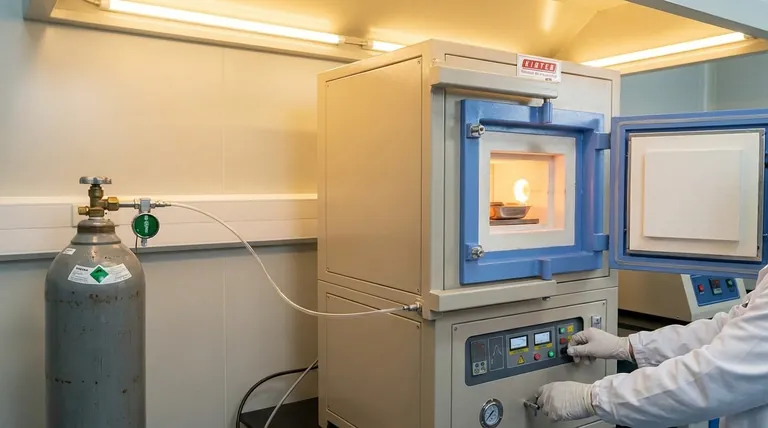
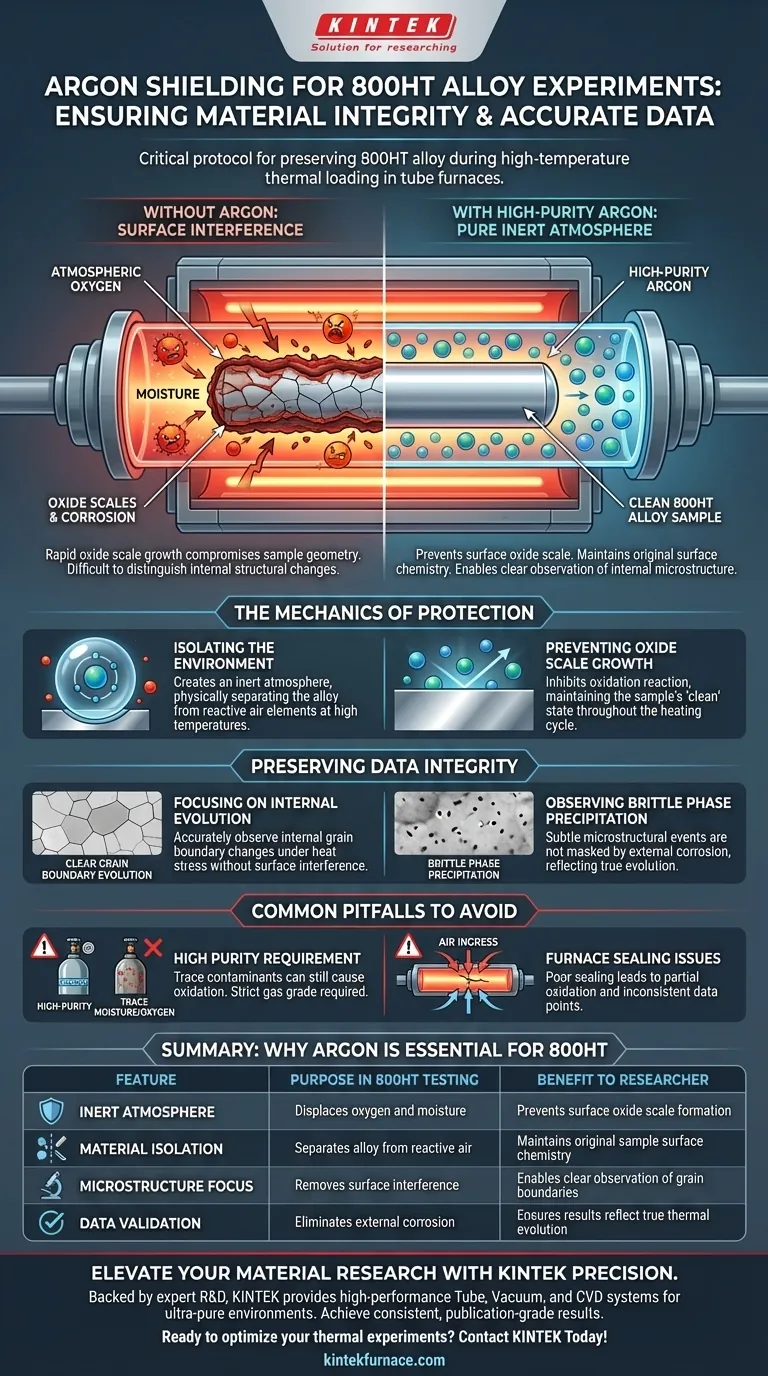
The introduction of argon shielding gas is a critical protocol for preserving the material integrity of 800HT alloy. By flooding the industrial-grade tube furnace with high-purity argon, you effectively displace atmospheric air and isolate the sample during thermal loading. This specific isolation is required to prevent the formation of oxide scales on the alloy's surface, which naturally occur when metals are exposed to oxygen at elevated temperatures.
High-temperature experiments are designed to test the internal limits of a material, but atmospheric oxygen creates surface interference. Argon shielding acts as a barrier, ensuring that the microstructural changes you observe are a result of thermal loading, not surface oxidation.
The Mechanics of Protection
Isolating the Material Environment
At high temperatures, the 800HT alloy is highly reactive to the oxygen present in standard air. Introducing argon creates an inert atmosphere within the furnace chamber. This physically separates the alloy from the reactive elements that would otherwise alter its surface chemistry.
Preventing Oxide Scale Growth
Without a shielding gas, the alloy would rapidly develop oxide scales—layers of corrosion product on the exterior. These scales can be thick and brittle, fundamentally changing the geometry and surface characteristics of your sample. Argon inhibits this chemical reaction entirely, maintaining the sample in its original "clean" state throughout the heating cycle.
Preserving Data Integrity
Focusing on Internal Evolution
The primary goal of these simulations is often to study the material's internal behavior. Researchers need to observe how the internal grain boundaries evolve under heat stress. If the surface is compromised by heavy oxidation, it becomes difficult to distinguish between internal structural changes and surface-level degradation.
Observing Brittle Phase Precipitation
Thermal loading experiments often aim to identify the precipitation of brittle phases within the alloy. Argon shielding ensures that these subtle microstructural events are not masked or influenced by external corrosion. It guarantees that the data collected reflects the true microstructural evolution of the 800HT alloy solely due to temperature and time.
Common Pitfalls to Avoid
The Requirement for High Purity
It is not enough to simply use standard argon; the reference specifies high-purity argon. If the gas contains trace amounts of moisture or oxygen, oxidation can still occur, invalidating the experiment. You must ensure the gas grade meets the strict requirements of the sensitivity of the alloy.
Furnace Sealing Issues
Even with high-purity gas, the protective atmosphere is only as good as the furnace seal. If the tube furnace is not properly sealed, air can ingress and contaminate the environment. This leads to partial oxidation, which can be even more confusing to analyze than full oxidation because it creates inconsistent data points.
Making the Right Choice for Your Goal
To ensure your thermal loading experiments yield valid, publication-grade data, you must align your atmospheric controls with your specific research objectives.
- If your primary focus is internal microstructure: You must use high-purity argon to prevent surface artifacts from obscuring grain boundary evolution.
- If your primary focus is mechanical property retention: You should utilize the shielding gas to ensure that failure modes are driven by thermal aging (brittle phases) rather than surface corrosion cracking.
By controlling the atmosphere, you transform a generic heat test into a precise investigation of material science principles.
Summary Table:
| Feature | Purpose in 800HT Testing | Benefit to Researcher |
|---|---|---|
| Inert Atmosphere | Displaces oxygen and moisture | Prevents surface oxide scale formation |
| Material Isolation | Separates alloy from reactive air | Maintains original sample surface chemistry |
| Microstructure Focus | Removes surface interference | Enables clear observation of grain boundaries |
| Data Validation | Eliminates external corrosion | Ensures results reflect true thermal evolution |
Elevate Your Material Research with KINTEK Precision
Don't let surface oxidation compromise your critical thermal loading data. Backed by expert R&D and world-class manufacturing, KINTEK provides high-performance Tube, Vacuum, and CVD systems designed to maintain the ultra-pure inert environments required for sensitive alloys like 800HT. Whether you need a standard setup or a fully customizable solution for your unique high-temp lab needs, our team is ready to help you achieve consistent, publication-grade results.
Ready to optimize your thermal experiments? Contact KINTEK Today!
Visual Guide
References
- Damian Sierakowski, S. Kąc. Evaluation of the Microstructure and Corrosion Resistance of the 800HT Alloy After Long-Term Operation. DOI: 10.3390/app15169188
This article is also based on technical information from Kintek Furnace Knowledge Base .
Related Products
- Vacuum Sealed Continuous Working Rotary Tube Furnace Rotating Tube Furnace
- 1400℃ High Temperature Laboratory Tube Furnace with Alumina Tube
- 1700℃ High Temperature Laboratory Tube Furnace with Alumina Tube
- Magnesium Extraction and Purification Condensing Tube Furnace
- High Pressure Laboratory Vacuum Tube Furnace
People Also Ask
- What is the purpose of rotary tube furnaces? Achieve Uniform Heat Treatment for Powders and Granules
- What are the key advantages of using a rotary tube furnace? Achieve Dynamic, Uniform Heating for Powders
- How does the amount of material processed vary between batch and continuous rotary tube furnaces? Scale Your Production Efficiently
- What are the advantages of rotary tube furnaces in fuel compatibility? Boost Efficiency and Cut Costs
- What is the temperature range of some rotary tube furnaces? Achieve Uniform Heating Up to 1200°C



















