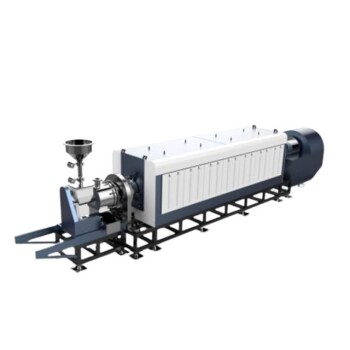
The continuous introduction of argon gas is critical because it creates and maintains an oxygen-free environment within the muffle furnace. By displacing air, the argon prevents the biomass from burning (combusting) and forces it to undergo thermal decomposition instead.
The argon shield is the defining factor that distinguishes valuable pyrolysis from simple burning; without it, high temperatures would cause the organic material to react with oxygen, resulting in ash rather than biochar.
The Function of an Inert Atmosphere
Preventing Oxidative Combustion
In a standard environment, heating biomass to high temperatures triggers combustion. Oxygen reacts with the carbon in the material, rapidly converting it into carbon dioxide and ash.
Argon acts as a barrier, ensuring that oxygen cannot interact with the heated feedstock. This creates an "inert" atmosphere where combustion is chemically impossible, regardless of the temperature.
Facilitating Thermal Cracking
When oxygen is removed from the equation, the biomass undergoes thermal cracking, also known as pyrolysis. This process breaks down complex organic bonds using heat alone.
Continuous gas flow ensures this specific reaction pathway remains stable. It forces the material to decompose into volatile gases and solid carbon, rather than burning away completely.
Preserving Material Structure
Protecting the Carbon Skeleton
The primary goal of biochar production is to create a stable, solid carbon structure. This structure is often referred to as the carbon skeleton.
If oxygen is present, this skeleton disintegrates during the heating process. The argon flow preserves this framework, resulting in a high-quality biochar product with the desired porosity and stability.
Preventing Ash Formation
Ash is essentially the mineral residue left over after carbon has burned away. A high ash content indicates that the pyrolysis process failed or was inefficient.
By maintaining a continuous flow of argon, you strictly limit ashing. This ensures the final product is composed of organic carbon rather than inorganic mineral waste.
Common Pitfalls to Avoid
The Risk of Interrupted Flow
A common mistake is stopping the gas flow too early or allowing interruptions. Even a brief pause allows oxygen to re-enter the chamber, leading to immediate surface oxidation.
This results in a "burned" exterior on the biochar particles. It significantly reduces the overall yield and compromises the chemical properties of the material.
Incomplete Purging
It is not enough to simply flow gas during the peak heating phase. If the furnace is not thoroughly flushed with argon before the temperature rises, residual oxygen will attack the biomass during the ramp-up phase.
Making the Right Choice for Your Goal
To guarantee high-quality biochar, you must view the argon flow as a critical active ingredient, not just a passive safety measure.
- If your primary focus is Maximizing Carbon Yield: Ensure the argon flow remains continuous to prevent carbon elements from converting into CO2 gas.
- If your primary focus is Product Purity: Verify the flow rate is sufficient to maintain positive pressure, preventing any external oxygen from leaking in and creating ash.
The quality of your final biochar is directly proportional to the integrity of your inert atmosphere.
Summary Table:
| Feature | With Argon Flow (Pyrolysis) | Without Argon Flow (Combustion) |
|---|---|---|
| Primary Reaction | Thermal cracking of organic bonds | Oxidative combustion of carbon |
| Final Product | High-purity biochar (Carbon skeleton) | Inorganic mineral ash |
| Atmosphere | Inert / Oxygen-free | Oxidizing |
| Carbon Retention | Maximized carbon yield | Carbon lost as $CO_2$ |
| Material Quality | Porous and stable structure | Disintegrated residue |
Elevate Your Biochar Production with KINTEK Precision
High-quality biochar requires more than just heat; it demands a flawlessly controlled environment. KINTEK provides industry-leading muffle, tube, and vacuum furnace systems specifically engineered to maintain the strict inert atmospheres necessary for advanced pyrolysis.
Backed by expert R&D and manufacturing, our systems are fully customizable to meet your unique lab or industrial requirements. Whether you are maximizing carbon yield or ensuring product purity, KINTEK’s high-temperature solutions provide the stability and precision you need to prevent oxidation and ensure consistent results.
Ready to optimize your thermal processing? Contact us today to find the perfect furnace for your application.
References
- Zorica Lopičić, Jelena Avdalović. Efficient Removal of Water Soluble Fraction of Diesel Oil by Biochar Sorption Supported by Microbiological Degradation. DOI: 10.3390/pr12050964
This article is also based on technical information from Kintek Furnace Knowledge Base .
Related Products
- Electric Rotary Kiln Small Rotary Furnace Biomass Pyrolysis Plant Rotating Furnace
- 1400℃ Muffle Oven Furnace for Laboratory
- 1200℃ Muffle Oven Furnace for Laboratory
- Laboratory Muffle Oven Furnace with Bottom Lifting
- High Temperature Muffle Oven Furnace for Laboratory Debinding and Pre Sintering
People Also Ask
- What are the main applications of a rotary kiln electric furnace? Achieve Uniform Heat Treatment for Powders
- What are the key components of a rotary kiln electric furnace? Unlock Efficient Thermal Processing
- What is the significance of the refractory lining in a rotary kiln electric furnace? Unlock Efficiency and Longevity
- What is the benefit of adjustable speed control in rotary kilns? Optimize Efficiency and Quality
- What are the main advantages of using rotary kilns for bulk solids processing? Achieve High-Volume, Uniform Thermal Processing