
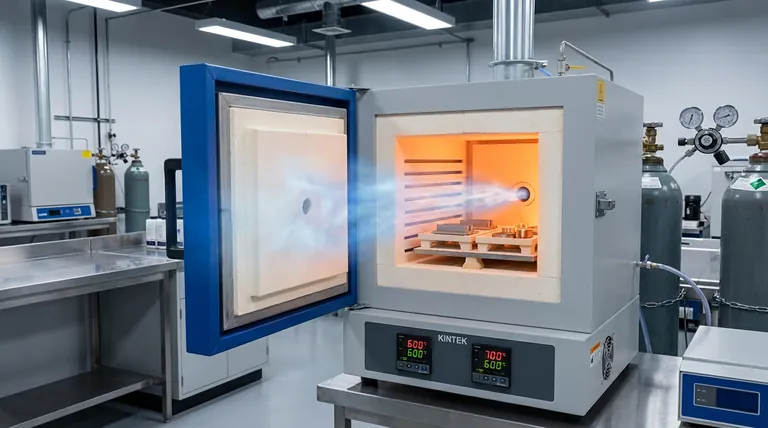
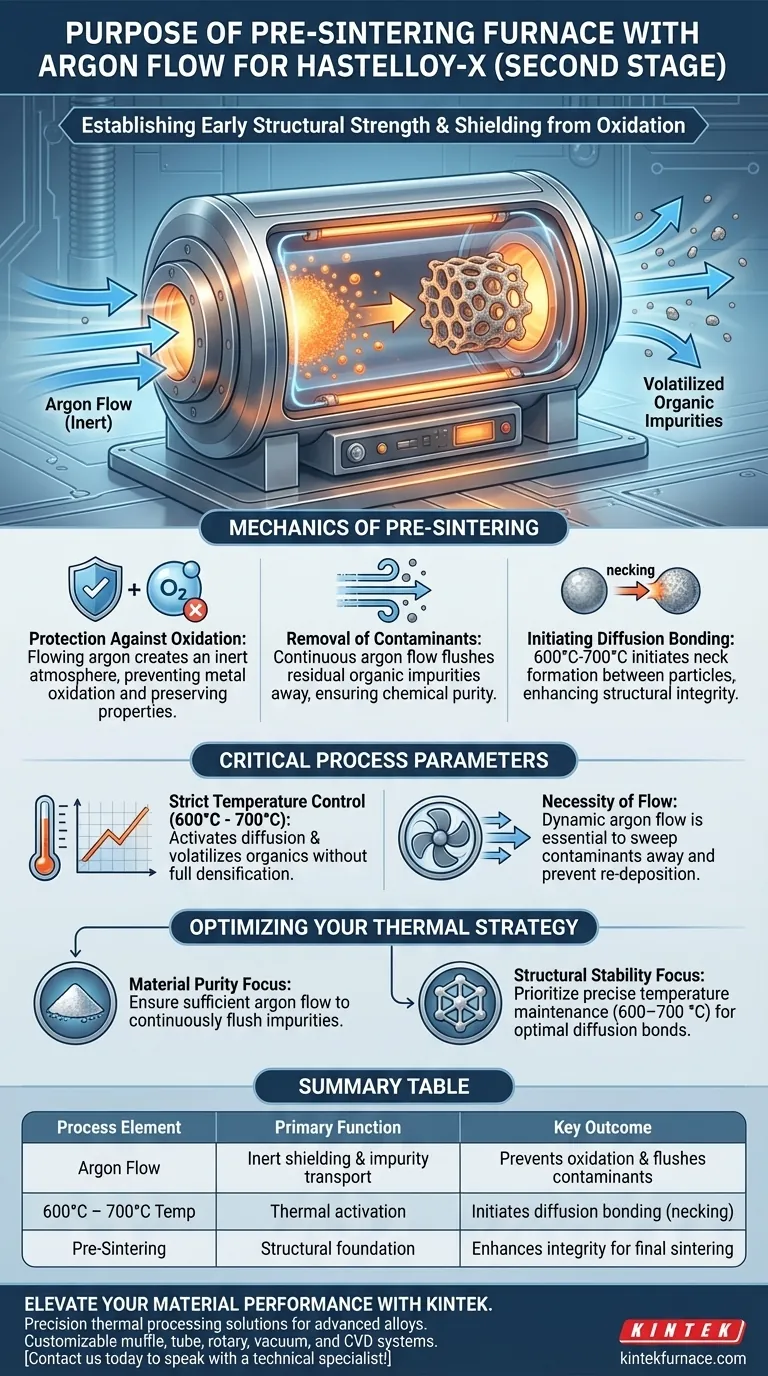
The primary purpose of using a pre-sintering furnace with an argon flow is to shield the Hastelloy-X metal skeleton from oxidation while establishing early structural strength. By maintaining a temperature range of 600 °C to 700 °C, this process facilitates the removal of impurities and initiates the bonding required for the material to survive final processing.
The argon flow serves a dual purpose: it acts as a protective barrier against oxidation and a transport medium for removing residual organic impurities. Simultaneously, the thermal energy creates initial diffusion bonds, transforming loose powder into a cohesive, porous structure ready for high-temperature sintering.
The Mechanics of Pre-Sintering
Protection Against Oxidation
At elevated temperatures, metal powders are highly susceptible to reacting with oxygen. Flowing argon gas provides an inert atmosphere that prevents the Hastelloy-X from oxidizing.
Preserving the metal surface in this state is vital. Oxidation at this stage would compromise the material properties and prevent proper consolidation during the final sintering stages.
Removal of Contaminants
The second stage of thermal processing is not just about heating; it is about cleaning. The process is designed to further remove residual organic impurities left over from previous processing steps.
The continuous flow of argon helps flush these volatile impurities away from the metal skeleton. This ensures the final material is chemically pure and free of carbonaceous defects.
Initiating Diffusion Bonding
The most critical structural change occurs at the particle level. Between 600 °C and 700 °C, the process initiates diffusion bonds between the Hastelloy-X powder particles.
This is not full densification, but rather the formation of "necks" between particles. This significantly enhances the structural integrity of the porous material, ensuring it is strong enough to handle the stress of final high-temperature sintering.
Critical Process Parameters
Strict Temperature Control
The effectiveness of this stage relies on maintaining the temperature strictly between 600 °C and 700 °C.
This specific window provides enough energy to activate diffusion bonding and volatilize organics. However, it avoids the higher temperatures reserved for the final densification phase, which requires a fully clean and stabilized skeleton.
The Necessity of Flow
The argon cannot simply be static; it must be flowing.
A static atmosphere might protect against oxidation, but it would fail to effectively sweep away the organic impurities releasing from the metal. The flow carries contaminants out of the furnace, preventing re-deposition on the Hastelloy-X surface.
Optimizing Your Thermal Strategy
If your primary focus is Material Purity: Ensure the argon flow rate is sufficient to continuously flush out volatilized organic impurities before they can react with the metal.
If your primary focus is Structural Stability: Prioritize precise temperature maintenance within the 600–700 °C range to maximize the formation of diffusion bonds without prematurely densifying the part.
This pre-sintering stage is the foundational step that ensures your Hastelloy-X components are both chemically clean and physically robust enough for final production.
Summary Table:
| Process Element | Primary Function | Key Outcome |
|---|---|---|
| Argon Flow | Inert shielding & impurity transport | Prevents oxidation & flushes contaminants |
| 600°C - 700°C Temp | Thermal activation | Initiates diffusion bonding (necking) |
| Pre-Sintering | Structural foundation | Enhances integrity for final sintering |
Elevate Your Material Performance with KINTEK
Precision is non-negotiable in the thermal processing of advanced alloys like Hastelloy-X. Backed by expert R&D and world-class manufacturing, KINTEK provides high-performance Muffle, Tube, Rotary, Vacuum, and CVD systems designed to meet your most rigorous specifications.
Whether you need strictly controlled argon atmospheres or custom high-temperature solutions, our laboratory furnaces are fully customizable to ensure your materials achieve maximum purity and structural strength.
Ready to optimize your sintering workflow? Contact us today to speak with a technical specialist!
Visual Guide
References
- Aleksandra Bętkowska, Wojciech Polkowski. Microstructure and mechanical properties of highly porous Hastelloy-X nickel superalloy produced by a space holder approach. DOI: 10.1038/s41598-024-84321-3
This article is also based on technical information from Kintek Furnace Knowledge Base .
Related Products
- High Temperature Muffle Oven Furnace for Laboratory Debinding and Pre Sintering
- Vacuum Heat Treat Sintering Furnace with Pressure for Vacuum Sintering
- Small Vacuum Heat Treat and Tungsten Wire Sintering Furnace
- Vacuum Dental Porcelain Sintering Furnace for Dental Laboratories
- Vacuum Heat Treat Sintering Furnace Molybdenum Wire Vacuum Sintering Furnace
People Also Ask
- Why is controlled heat treatment in a muffle furnace necessary for calcined clay? Achieve Optimal Pozzolanic Activity
- What role does a high-temperature muffle furnace play in STFO synthesis? Achieve Pure Perovskite Results
- What role does a high-temperature muffle furnace play in the formation of biochar catalysts? Master Catalyst Synthesis
- What role does a high-temperature muffle furnace play in the multi-stage synthesis of Li0.5MnFe1.5O4? Key to Pure Spinel
- What is the primary function of a high-temperature muffle furnace for cerium dioxide precursors? Expert Calcination Tips



















