Knowledge Why is an XHV equivalent protective atmosphere required for heating uncoated steel? Achieve Scale-Free Surface Purity
Author avatar

Tech Team · Kintek Furnace

Updated 23 hours ago

Why is an XHV equivalent protective atmosphere required for heating uncoated steel? Achieve Scale-Free Surface Purity


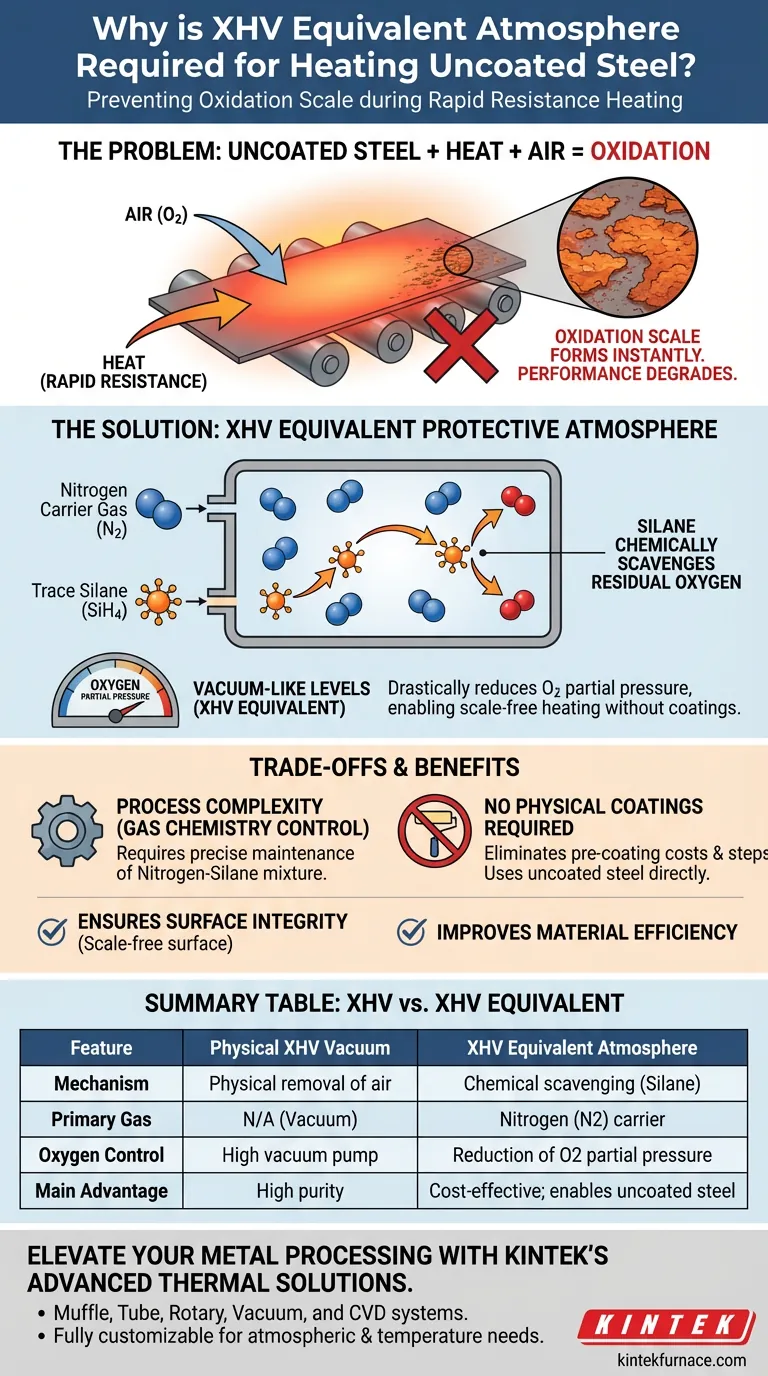
Uncoated steel sheets require an XHV (Extreme High Vacuum) equivalent atmosphere to completely prevent the rapid formation of oxidation scale during high-temperature resistance heating. Without this specialized environment, the steel reacts immediately with oxygen in the air, leading to surface degradation that compromises the final part's performance.

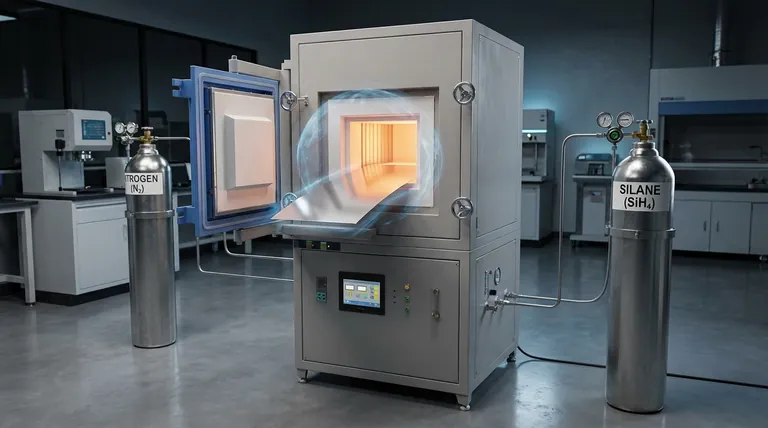
The core mechanism involves using trace silane (SiH4) within a nitrogen atmosphere to chemically scavenge residual oxygen. This reduces the oxygen partial pressure to levels comparable to an extreme high vacuum, enabling scale-free heating without the need for protective physical coatings.
Why is an XHV equivalent protective atmosphere required for heating uncoated steel? Achieve Scale-Free Surface Purity

The Chemistry of Oxidation Control

The Vulnerability of Uncoated Steel

When uncoated steel is subjected to rapid resistance heating, it is exposed to high temperatures in the presence of air. This environment causes oxidation scale to develop almost instantly on the surface of the sheet.

Why Scale Must Be Prevented

The formation of scale is not merely a cosmetic issue; it fundamentally degrades the performance of the manufactured part. To maintain the integrity of the steel, oxygen must be removed from the heating environment.

Achieving XHV Conditions Without a Vacuum

The Role of the "Equivalent" Atmosphere

Creating a physical Extreme High Vacuum (XHV) is mechanically complex and expensive. Instead, manufacturers can use an XHV equivalent protective atmosphere to achieve the same result chemically.

The Composition of the Atmosphere

This protective atmosphere consists primarily of nitrogen acting as a carrier gas. Crucially, it is mixed with trace amounts of silane (SiH4).

The Silane Reduction Mechanism

Silane is utilized for its strong chemical reduction properties. When introduced into the heating environment, the silane actively reacts with residual oxygen.

Lowering Oxygen Partial Pressure

This reaction drastically reduces the oxygen partial pressure within the chamber. By chemically eliminating the oxygen, the atmosphere mimics the purity of a physical vacuum, preventing oxidation from occurring.

Understanding the Trade-offs

Process Complexity vs. Physical Coatings

The primary trade-off in this approach is swapping the need for physical coatings for atmospheric control.

Eliminating Pre-Coating Requirements

Standard methods often require steel to be pre-coated to survive heating. Using an XHV equivalent atmosphere allows for the use of uncoated steel, streamlining material preparation.

Dependency on Gas Chemistry

Success relies entirely on the precise maintenance of the nitrogen-silane mixture. The process eliminates the vacuum pump but necessitates strict control over the chemical composition of the environment to ensure the reduction reaction is effective.

Making the Right Choice for Your Goal

This technology replaces physical barriers with chemical control to ensure surface purity.

  • If your primary focus is Surface Integrity: Utilizing an XHV equivalent atmosphere ensures a scale-free surface by chemically reducing oxygen partial pressure to negligible levels.
  • If your primary focus is Material Efficiency: This method allows you to process uncoated steel sheets directly, eliminating the costs and steps associated with applying protective physical coatings.

By leveraging the chemical reduction power of silane, you achieve the purity of a vacuum through the efficiency of atmospheric control.

Summary Table:

Feature Physical XHV Vacuum XHV Equivalent Atmosphere
Mechanism Physical removal of air molecules Chemical scavenging using trace Silane (SiH4)
Primary Gas N/A (Vacuum) Nitrogen (N2) carrier
Oxygen Control High vacuum pump extraction Reduction of oxygen partial pressure
Main Advantage High purity Cost-effective; enables scale-free uncoated steel
Material Prep None required Eliminates need for protective coatings

Elevate Your Metal Processing with KINTEK’s Advanced Thermal Solutions

Don't let oxidation compromise your material performance. KINTEK specializes in precision-engineered thermal systems designed for the most demanding industrial requirements. Backed by expert R&D and world-class manufacturing, we provide high-performance Muffle, Tube, Rotary, Vacuum, and CVD systems—all fully customizable to your specific atmospheric and temperature needs.

Whether you are processing uncoated steel sheets or developing advanced materials, our lab high-temp furnaces ensure the surface integrity your project demands. Contact KINTEK today to discuss your custom furnace requirements and see how our expertise can streamline your production and eliminate the need for costly pre-coatings.

Visual Guide
Why is an XHV equivalent protective atmosphere required for heating uncoated steel? Achieve Scale-Free Surface Purity Visual Guide

References

  1. Bernd‐Arno Behrens, Lorenz Albracht. Increasing the performance of hot forming parts by resistance heating in XHV-adequate atmosphere. DOI: 10.1051/matecconf/202540801025

This article is also based on technical information from Kintek Furnace Knowledge Base .

Related Products

People Also Ask

Related Products

1400℃ Controlled Inert Nitrogen Atmosphere Furnace

1400℃ Controlled Inert Nitrogen Atmosphere Furnace

KT-14A Controlled Atmosphere Furnace for labs & industry. 1400°C max temp, vacuum sealing, inert gas control. Customizable solutions available.

1700℃ Controlled Inert Nitrogen Atmosphere Furnace

1700℃ Controlled Inert Nitrogen Atmosphere Furnace

KT-17A Controlled Atmosphere Furnace: Precise 1700°C heating with vacuum & gas control. Ideal for sintering, research & material processing. Explore now!

1200℃ Controlled Inert Nitrogen Atmosphere Furnace

1200℃ Controlled Inert Nitrogen Atmosphere Furnace

KINTEK 1200℃ Controlled Atmosphere Furnace: Precision heating with gas control for labs. Ideal for sintering, annealing, and material research. Customizable sizes available.

Vacuum Heat Treat Furnace with Ceramic Fiber Liner

Vacuum Heat Treat Furnace with Ceramic Fiber Liner

KINTEK's Vacuum Furnace with Ceramic Fiber Lining offers precise high-temperature processing up to 1700°C, ensuring uniform heat distribution and energy efficiency. Ideal for labs and production.

Mesh Belt Controlled Atmosphere Furnace Inert Nitrogen Atmosphere Furnace

Mesh Belt Controlled Atmosphere Furnace Inert Nitrogen Atmosphere Furnace

KINTEK Mesh Belt Furnace: High-performance controlled atmosphere furnace for sintering, hardening & heat treatment. Customizable, energy-efficient, precise temperature control. Get a quote now!

Controlled Inert Nitrogen Hydrogen Atmosphere Furnace

Controlled Inert Nitrogen Hydrogen Atmosphere Furnace

Discover KINTEK's Hydrogen Atmosphere Furnace for precise sintering & annealing in controlled environments. Up to 1600°C, safety features, customizable.

High Pressure Laboratory Vacuum Tube Furnace Quartz Tubular Furnace

High Pressure Laboratory Vacuum Tube Furnace Quartz Tubular Furnace

KINTEK High Pressure Tube Furnace: Precision heating up to 1100°C with 15Mpa pressure control. Ideal for sintering, crystal growth, and lab research. Customizable solutions available.

Vacuum Heat Treat Sintering and Brazing Furnace

Vacuum Heat Treat Sintering and Brazing Furnace

KINTEK Vacuum Brazing Furnaces deliver precision, clean joints with superior temperature control. Customizable for diverse metals, ideal for aerospace, medical, and thermal applications. Get a quote!

1700℃ High Temperature Laboratory Tube Furnace with Quartz or Alumina Tube

1700℃ High Temperature Laboratory Tube Furnace with Quartz or Alumina Tube

KINTEK's Tube Furnace with Alumina Tube: Precision heating up to 1700°C for material synthesis, CVD, and sintering. Compact, customizable, and vacuum-ready. Explore now!

Vacuum Heat Treat Sintering Furnace Molybdenum Wire Vacuum Sintering Furnace

Vacuum Heat Treat Sintering Furnace Molybdenum Wire Vacuum Sintering Furnace

KINTEK's Vacuum Molybdenum Wire Sintering Furnace excels in high-temperature, high-vacuum processes for sintering, annealing, and material research. Achieve precise 1700°C heating with uniform results. Custom solutions available.

1700℃ High Temperature Muffle Oven Furnace for Laboratory

1700℃ High Temperature Muffle Oven Furnace for Laboratory

KT-17M Muffle Furnace: High-precision 1700°C lab furnace with PID control, energy efficiency, and customizable sizes for industrial & research applications.

Molybdenum Vacuum Heat Treat Furnace

Molybdenum Vacuum Heat Treat Furnace

High-performance molybdenum vacuum furnace for precise 1400°C heat treatment. Ideal for sintering, brazing, and crystal growth. Durable, efficient, and customizable.

Vacuum Heat Treat Sintering Furnace with Pressure for Vacuum Sintering

Vacuum Heat Treat Sintering Furnace with Pressure for Vacuum Sintering

KINTEK's Vacuum Pressure Sintering Furnace offers 2100℃ precision for ceramics, metals, and composites. Customizable, high-performance, and contamination-free. Get a quote now!

1400℃ Muffle Oven Furnace for Laboratory

1400℃ Muffle Oven Furnace for Laboratory

KT-14M Muffle Furnace: Precision 1400°C heating with SiC elements, PID control, and energy-efficient design. Ideal for labs.

600T Vacuum Induction Hot Press Vacuum Heat Treat and Sintering Furnace

600T Vacuum Induction Hot Press Vacuum Heat Treat and Sintering Furnace

600T Vacuum Induction Hot Press Furnace for precise sintering. Advanced 600T pressure, 2200°C heating, vacuum/atmosphere control. Ideal for research & production.

Laboratory Muffle Oven Furnace with Bottom Lifting

Laboratory Muffle Oven Furnace with Bottom Lifting

Boost lab efficiency with KT-BL Bottom Lifting Furnace: precise 1600℃ control, superior uniformity, and enhanced productivity for material science and R&D.

High Temperature Muffle Oven Furnace for Laboratory Debinding and Pre Sintering

High Temperature Muffle Oven Furnace for Laboratory Debinding and Pre Sintering

KT-MD Debinding & Pre-Sintering Furnace for ceramics - precise temperature control, energy-efficient design, customizable sizes. Boost your lab efficiency today!

1800℃ High Temperature Muffle Oven Furnace for Laboratory

1800℃ High Temperature Muffle Oven Furnace for Laboratory

KINTEK Muffle Furnaces: Precision 1800°C heating for labs. Energy-efficient, customizable, with PID control. Ideal for sintering, annealing, and research.

1400℃ High Temperature Laboratory Tube Furnace with Quartz and Alumina Tube

1400℃ High Temperature Laboratory Tube Furnace with Quartz and Alumina Tube

KINTEK's Tube Furnace with Alumina Tube: Precision high-temperature processing up to 2000°C for labs. Ideal for material synthesis, CVD, and sintering. Customizable options available.

1200℃ Split Tube Furnace Laboratory Quartz Tube Furnace with Quartz Tube

1200℃ Split Tube Furnace Laboratory Quartz Tube Furnace with Quartz Tube

Discover KINTEK's 1200℃ Split Tube Furnace with quartz tube for precise high-temperature lab applications. Customizable, durable, and efficient. Get yours now!


Leave Your Message