
The primary objective of using a high-power induction heating system for multi-stage melting is to manage the extreme thermal disparities between different elements in a high-entropy alloy. By utilizing high energy input to prepare intermediate alloys, the system exploits a dissolution mechanism that lowers the overall processing temperature, ensuring that refractory elements melt fully without causing volatile elements to evaporate.
Core Takeaway High-entropy alloys often combine elements with conflicting melting points and volatilities. A multi-stage induction strategy uses low-melting-point phases to dissolve high-melting-point elements, effectively lowering the thermal barrier of the process and preserving the precise chemical composition of the final ingot.
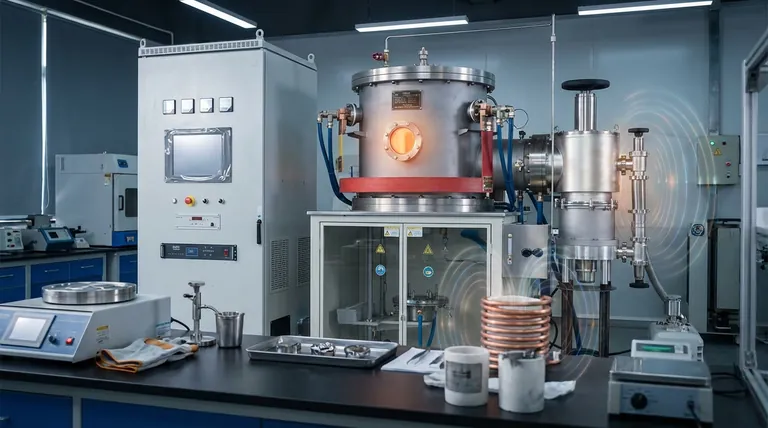
The Mechanics of Multi-Stage Melting
Overcoming Melting Point Disparities
High-entropy alloys (HEAs) frequently consist of elements with vastly different melting points. Trying to melt these simultaneously in a single batch often leads to complications.
A high-power induction system provides the necessary energy to first prepare intermediate alloys. These usually consist of the high-melting-point elements.
The Dissolution Mechanism
The core principle of this strategy is using liquid phases as a solvent.
Once the intermediate alloys are formed, other elements are added gradually. The system utilizes a mechanism where low-melting-point phases effectively "dissolve" the high-melting-point refractory elements.
This is distinct from simply applying enough heat to melt the most refractory element in isolation. It relies on chemical interaction to facilitate the phase change.
Lowering the Thermal Barrier
By relying on dissolution rather than brute-force heating, the overall melting temperature of the batch is significantly reduced.
This means the system does not need to maintain the peak temperature required to melt the most heat-resistant element in the mix for the entire duration of the process.
Preserving Compositional Integrity
Mitigating Evaporation Loss
One of the greatest risks in HEA preparation is the loss of volatile elements, such as chromium.
If the system were to heat the entire mixture to the melting point of the most refractory element, these volatile components would likely evaporate.
By lowering the overall processing temperature through multi-stage dissolution, the system suppresses this evaporation. This ensures the final alloy retains its intended compositional ratio.
Electromagnetic Stirring
While the primary goal is thermal management, the induction system offers a secondary benefit of intense electromagnetic stirring.
This forces the molten metal to move continuously, ensuring that the intermediate alloys and added elements mix into a highly uniform composition.
Understanding the Trade-offs
Process Complexity
Multi-stage melting is inherently more complex than single-step processing.
It requires precise timing and a calculated order of element addition. Errors in the sequencing of intermediate alloys can lead to incomplete melting or segregation.
Crucible Contamination Risks
High-power induction heating involves intense energy transfer. In standard setups, this can lead to interactions between the molten metal and the crucible.
However, advanced variations, such as vacuum magnetic levitation, can mitigate this by suspending the metal. Without such levitation features, the high power required for refractory elements increases the risk of crucible material contaminating the alloy.
Making the Right Choice for Your Goal
The use of high-power induction for multi-stage melting is a strategic choice for complex alloy systems.
- If your primary focus is compositional accuracy: Use this multi-stage approach to prevent the evaporation of volatile elements like chromium.
- If your primary focus is homogeneity: Rely on the dissolution mechanism and electromagnetic stirring to ensure refractory elements are fully integrated into the matrix.
Summary: By treating the melting process as a staged chemical dissolution rather than a simple thermal event, you can produce high-quality alloys that are both chemically accurate and structurally uniform.
Summary Table:
| Feature | Multi-Stage Induction Objective | Technical Benefit |
|---|---|---|
| Thermal Management | Manages extreme melting point disparities | Lower overall processing temperatures |
| Phase Control | Uses liquid phases as a solvent | Dissolves refractory elements without brute heat |
| Compositional Integrity | Mitigates evaporation of volatile elements | Preserves precise chemical ratios (e.g., Chromium) |
| Homogeneity | Intense electromagnetic stirring | Ensures uniform distribution of elements |
Elevate Your Material Research with KINTEK
Precision in high-entropy alloy preparation requires more than just heat—it requires specialized control. Backed by expert R&D and manufacturing, KINTEK offers high-performance Induction, Vacuum, CVD, and Muffle systems designed to handle the most demanding metallurgical workflows. Whether you need a customizable solution for multi-stage melting or a high-temp furnace for refractory materials, our equipment ensures compositional integrity and structural uniformity for your lab.
Ready to optimize your alloying process? Contact KINTEK today for a customized solution!
Visual Guide

References
- Laurent Peltier, Jérome Slowensky. Design of Multiphase Compositionally Complex Alloys for Enhanced Hardness at Elevated Temperatures and Machinability: Comparative Study with Inconel 718. DOI: 10.1002/adem.202501146
This article is also based on technical information from Kintek Furnace Knowledge Base .
Related Products
- Vacuum Induction Melting Furnace
- Multi Heating Zones CVD Tube Furnace Machine for Chemical Vapor Deposition Equipment
- 600T Vacuum Induction Hot Press Vacuum Heat Treat and Sintering Furnace
- High Temperature Muffle Oven Furnace for Laboratory Debinding and Pre Sintering
- Electric Rotary Kiln Continuous Working Small Rotary Furnace Kiln for Pyrolysis Plant Heating
People Also Ask
- What are the core functions of the High Vacuum Induction Melting (VIM) furnace? Optimize DD5 Superalloy Purification
- What are the technical advantages of using a Vacuum Induction Melting furnace in the development of advanced packaging steel?
- What is the role of VIM and directional solidification in aero-engine blade substrates? Engineering Extreme Durability
- What role does a Vacuum Induction Melting furnace play in the production of high-aluminum nickel-based superalloys?
- What are the advantages of using a VIM furnace to control residual oxygen pressure? Achieve Superior Metal Uniformity





