
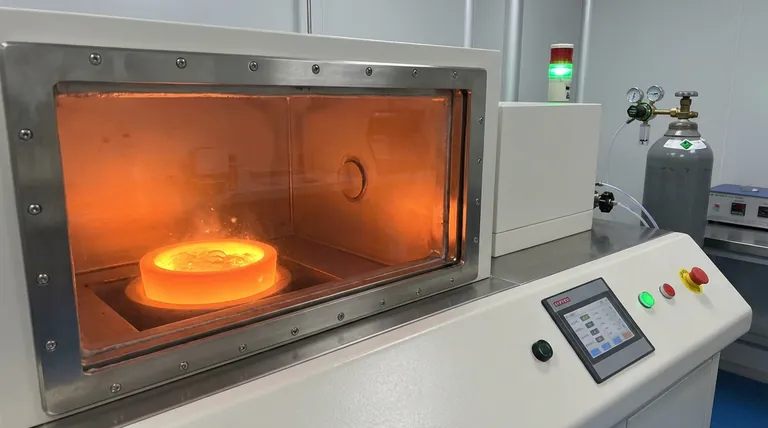
High-purity argon gas purging is the critical defense mechanism used to secure the chemical integrity of high-entropy alloys during the melting process. By subjecting the furnace chamber to multiple cycles of vacuum evacuation followed by argon refilling, the process effectively strips away residual air and moisture. This establishes an inert protective atmosphere specifically designed to prevent the oxidative loss of chemically active elements, such as manganese, aluminum, and hafnium.
Core Insight: The primary function of argon purging is to decouple the melt from atmospheric oxygen and nitrogen, ensuring that reactive elements remain dissolved in the alloy rather than forming brittle oxides or burning off as vapor.
Preserving Elemental Composition
Protecting Active Elements
High-entropy alloys often contain a mix of highly reactive elements like manganese, aluminum, and hafnium.
These elements have a high affinity for oxygen. Without a strictly controlled inert atmosphere, they rapidly oxidize and are lost to the slag or furnace walls, fundamentally altering the intended chemical ratio of the final alloy.
Suppressing Carbon Loss
For alloys containing carbon, the presence of oxygen triggers a carbon-oxygen reaction.
This reaction leads to excessive carbon loss in the form of gas. A high-purity argon environment balances the partial pressure above the melt, stabilizing the carbon content and preventing deviations from the target composition.
Preventing Nitrogen and Hydrogen Absorption
Beyond oxygen, elements like zirconium are highly sensitive to nitrogen and water vapor.
Purging eliminates these contaminants, which prevents the formation of unwanted nitrides or hydrides. This is particularly vital for hydrogen storage alloys, where purity directly correlates to absorption and desorption performance.
Ensuring Microstructural and Mechanical Integrity
Inhibiting Oxide Inclusion Formation
The presence of oxygen allows for secondary oxidation, creating ceramic-like particles within the metal.
In systems like Nickel-Aluminum Bronze, this manifests as brittle alumina (Al2O3) inclusions. These hard particles act as stress concentrators, significantly degrading the mechanical properties and surface quality of the cast alloy.
eliminating Surface Oxide Films
Oxidation often forms a tough, viscous film on the surface of the melt.
This film has a high apparent viscosity, which can interfere with fluid flow and obscure the true flow characteristics of the bulk metal. By excluding oxygen, argon purging ensures that physical property measurements—such as viscosity—reflect the metal itself, not a surface contaminant.
The Role in Data Accuracy
Reliability of Thermodynamic Data
For research-grade melting, the goal is often to establish phase diagrams or measure vapor pressures.
Any interference from impurities or oxidation introduces errors into these calculations. High-purity argon ensures that the resulting thermodynamic data is accurate and that phase boundary calculations are reliable.
Operational Considerations and Trade-offs
The Cost of Purity
While essential for quality, high-purity argon purging adds time and cost to the production cycle.
It requires specialized vacuum equipment capable of reaching extremely low pressures before the gas is introduced. Failing to reach a sufficient vacuum before backfilling will result in diluted air rather than a truly inert atmosphere.
Pressure Balancing
Maintaining the correct argon pressure (e.g., roughly 30,000 Pa in some contexts) is a balancing act.
While the gas protects against oxidation, the pressure level also influences the evaporation rate of volatile elements. Operators must calibrate pressure to suppress evaporation without introducing other processing variables.
Making the Right Choice for Your Goal
To maximize the quality of your high-entropy alloy, align your purging strategy with your specific objectives:
- If your primary focus is Mechanical Performance: Prioritize purging to eliminate oxygen, as this prevents the formation of brittle oxide inclusions that cause premature material failure.
- If your primary focus is Alloy Design & Research: Focus on the elimination of nitrogen and moisture to ensure that phase diagrams and thermodynamic data are not skewed by impurities.
- If your primary focus is Complex Chemistries: Ensure the argon atmosphere is established after a deep vacuum to protect highly reactive elements like Hafnium and Manganese from oxidative loss.
The rigorous application of argon purging is the difference between a theoretical design and a viable, high-performance material.
Summary Table:
| Protection Category | Impact of Argon Purging | Affected Elements |
|---|---|---|
| Chemical Integrity | Prevents oxidative loss & preserves target ratios | Mn, Al, Hf, C |
| Structural Quality | Inhibits formation of brittle ceramic inclusions | Ni-Al Bronze, Zr |
| Surface Properties | Eliminates viscous oxide films for better fluid flow | All bulk metals |
| Data Accuracy | Ensures reliable thermodynamic & phase boundary data | Research alloys |
| Contaminant Control | Removes nitrogen and moisture to avoid nitrides | Hydrogen storage alloys |
Elevate Your Material Research with KINTEK
Precise control over your melting atmosphere is the key to mastering high-entropy alloys. Backed by expert R&D and manufacturing, KINTEK offers high-performance Muffle, Tube, Rotary, Vacuum, and CVD systems, all customizable to meet your unique metallurgical needs.
Whether you need to eliminate oxygen inclusions or stabilize volatile elements, our lab high-temp furnaces provide the vacuum-tight environment necessary for high-purity argon purging.
Ready to optimize your alloy production? Contact KINTEK Today to Consult with Our Experts
References
- Yong Wang, Wangzhong Mu. Effect of hafnium and molybdenum addition on inclusion characteristics in Co-based dual-phase high-entropy alloys. DOI: 10.1007/s12613-024-2831-x
This article is also based on technical information from Kintek Furnace Knowledge Base .
Related Products
People Also Ask
- What are the advantages of using a condensing tube furnace for magnesium extraction? Achieve High Purity and Efficient Metal Recovery
- Why use a tube furnace instead of a muffle furnace for annealing? Achieve Superior Process Control
- Why is a specific nitrogen flow rate necessary within a tube furnace during the carbonization of PVDF?
- Why is an argon atmosphere protection critical during the selenization of CoO/CoSe? Key to High-Purity Heterostructures
- Why is aluminum foil used during selenization and carbonization? Unlock Superior ZnSe Nanoparticle Synthesis
