
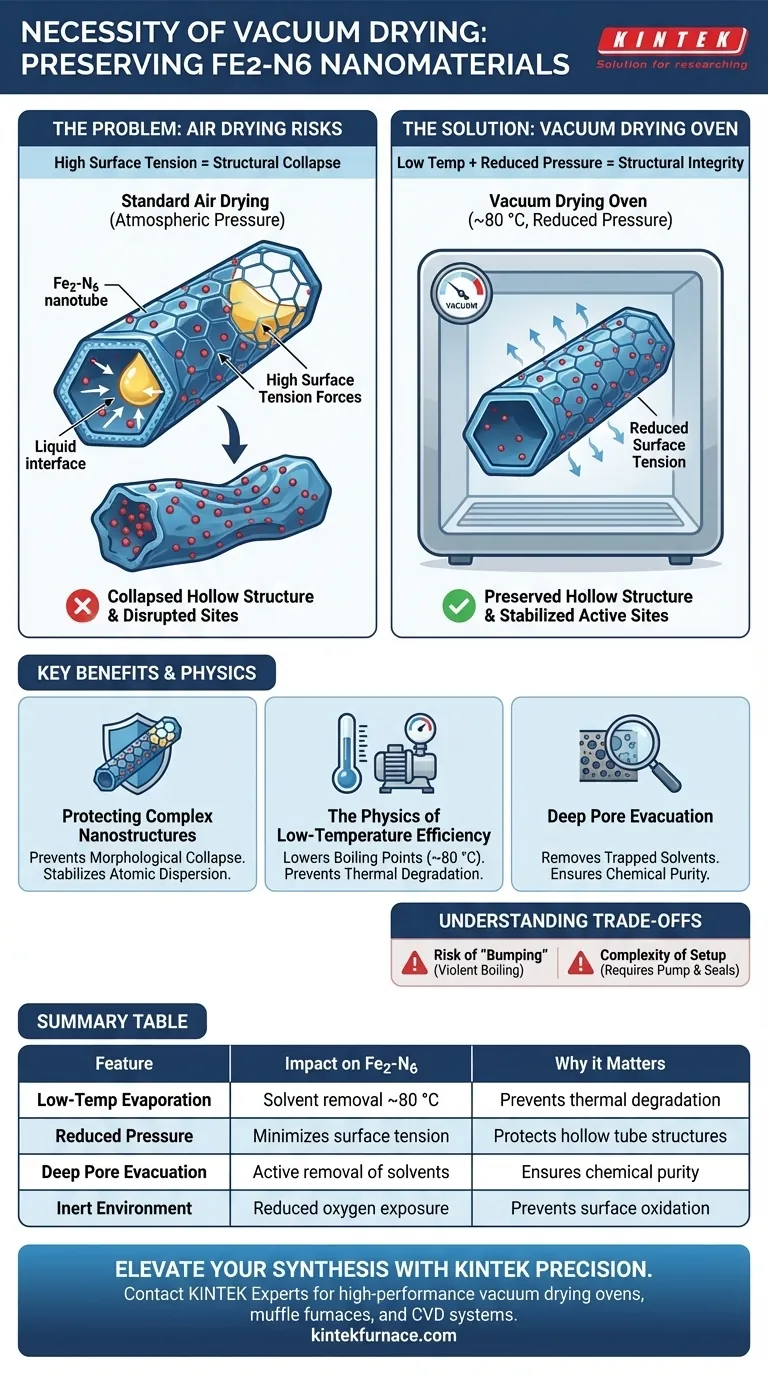
Preserving structural integrity is the primary necessity. For synthesized Fe2-N6 nanomaterials, the laboratory vacuum drying oven is essential to enable the rapid evaporation of residual water and solvents at low temperatures (approximately 80 °C) by reducing atmospheric pressure. This specific process prevents the collapse of hollow tube structures caused by surface tension, thereby safeguarding the spatial distribution stability of the atomically dispersed metal sites.
The vacuum environment fundamentally alters the evaporation kinetics, lowering solvent boiling points to bypass the high surface tension forces that typically destroy hollow nanostructures during standard air drying.
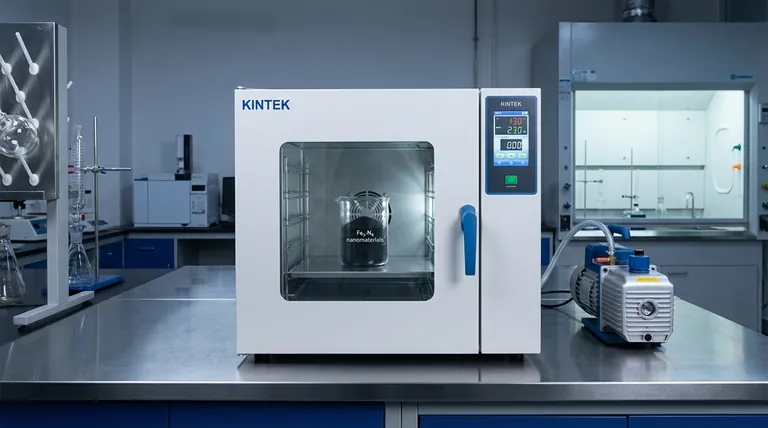
Protecting Complex Nanostructures
Preventing Morphological Collapse
The most critical function of vacuum drying for Fe2-N6 is mitigating surface tension. As liquids evaporate from the pores of nanomaterials under standard atmospheric pressure, the retreating liquid interface creates significant tension forces.
For delicate structures like the hollow tubes found in Fe2-N6, these forces can cause the walls to cave in. Vacuum drying accelerates evaporation at lower temperatures, minimizing the duration and intensity of these capillary forces to preserve the material's intended morphology.
Stabilizing Atomic Dispersion
Fe2-N6 nanomaterials rely on the precise arrangement of atomically dispersed metal sites. The physical stability of the support structure is directly linked to the stability of these active sites.
If the hollow tube structure collapses during drying, the spatial distribution of these metal sites can be disrupted or obscured. Maintaining the structural framework ensures these sites remain accessible and active for subsequent applications.
The Physics of Low-Temperature Efficiency
Lowering Boiling Points
By reducing the pressure within the oven, the boiling points of water and residual solvents are significantly lowered. This allows for thorough dehydration at approximately 80 °C.
This is critical because achieving the same level of dryness at atmospheric pressure would require much higher temperatures. Such high heat could lead to unwanted phase changes or thermal degradation of the material.
Deep Pore Evacuation
Standard drying often clears surface moisture but traps solvents deep within the nanopores. The vacuum environment creates a pressure differential that actively draws solvents out from these deep structures.
This ensures the removal of contaminants without requiring extended exposure to heat, which is vital for maintaining the "loose" powder consistency required for further processing.
Understanding the Trade-offs
The Risk of "Bumping"
While rapid evaporation is beneficial, applying a vacuum too aggressively to a slurry can cause the solvent to boil violently, known as bumping. This can physically displace the sample or splatter it within the chamber.
Complexity of Setup
Compared to a standard convection oven, vacuum drying requires more complex hardware, including a vacuum pump and airtight seals. Failure to maintain a consistent vacuum seal will negate the benefits and may lead to inconsistent drying rates across the sample batch.
Making the Right Choice for Your Goal
To maximize the quality of your Fe2-N6 nanomaterials, tailor your drying parameters to your specific objectives:
- If your primary focus is Structural Integrity: Maintain a steady temperature of 80 °C under vacuum to minimize surface tension and prevent the collapse of hollow tubes.
- If your primary focus is Chemical Purity: Ensure the vacuum phase is maintained long enough to fully evacuate solvents from deep pores, preventing interference in electrochemical testing.
- If your primary focus is Prevention of Oxidation: Utilize the vacuum to minimize oxygen exposure during the heating phase, protecting surface functional groups.
By controlling pressure and temperature simultaneously, you ensure the Fe2-N6 material retains the precise architecture required for peak performance.
Summary Table:
| Feature | Impact on Fe2-N6 Nanomaterials | Why it Matters |
|---|---|---|
| Low-Temp Evaporation | Solvent removal at ~80 °C | Prevents thermal degradation and phase changes |
| Reduced Pressure | Minimizes surface tension forces | Protects hollow tube structures from collapsing |
| Deep Pore Evacuation | Active removal of trapped solvents | Ensures chemical purity for electrochemical testing |
| Inert Environment | Reduced oxygen exposure | Prevents unwanted oxidation of surface functional groups |
Elevate Your Material Synthesis with KINTEK Precision
Maintaining the structural integrity of advanced nanomaterials like Fe2-N6 requires exact thermal and atmospheric control. KINTEK provides industry-leading laboratory solutions, including high-performance vacuum drying ovens, muffle furnaces, and CVD systems, all customizable to your specific research needs.
Backed by expert R&D and manufacturing, our systems ensure your atomically dispersed metal sites and delicate hollow structures remain intact through every processing phase. Don't compromise on your material's performance.
Contact KINTEK Experts Today to find the perfect high-temperature solution for your laboratory.
Visual Guide
References
- Yan Yan, Jie Zeng. General synthesis of neighboring dual-atomic sites with a specific pre-designed distance via an interfacial-fixing strategy. DOI: 10.1038/s41467-024-55630-y
This article is also based on technical information from Kintek Furnace Knowledge Base .
Related Products
- 1200℃ Muffle Oven Furnace for Laboratory
- High Temperature Muffle Oven Furnace for Laboratory Debinding and Pre Sintering
- 1700℃ High Temperature Muffle Oven Furnace for Laboratory
- Laboratory Vacuum Tilt Rotary Tube Furnace Rotating Tube Furnace
- High Pressure Laboratory Vacuum Tube Furnace
People Also Ask
- What is the primary function of a high-temperature laboratory muffle furnace in chemical synthesis? Achieve Precision.
- How does a high-temperature laboratory muffle furnace affect material properties? Transform Anodic Oxide Films Fast
- How is a laboratory muffle furnace used in 3D-printed PP-CF cross-linking? Achieve Thermal Stability at 150 °C
- What role does a muffle furnace play in plant bark mineral analysis? Essential for Precise Dry Ashing & Trace Extraction
- Why is a laboratory high-temperature muffle furnace required for LaNixFe1-xO3 catalysts? Optimize Two-Stage Synthesis











