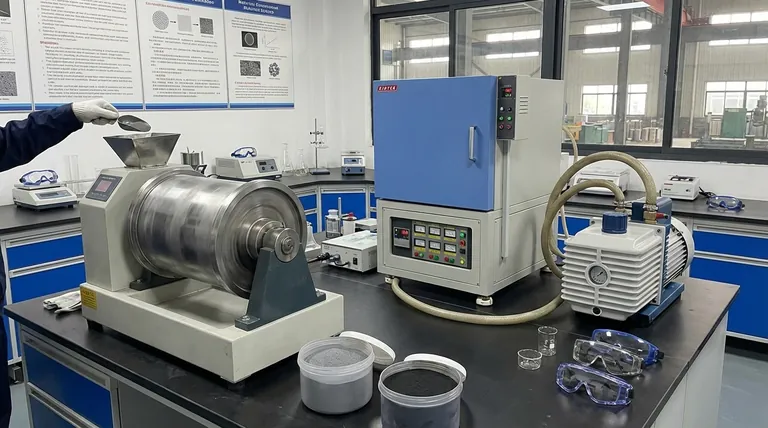
At its core, the primary role of a ball mill in preparing materials for vacuum carbothermic reduction is twofold: to finely grind the reactants and to mix them into a completely uniform powder. This high-energy mechanical process is not merely a preparatory step; it is essential for creating the ideal physical conditions that enable a rapid and complete chemical reaction at high temperatures.
The ball mill's function is to maximize the contact surface area between the magnesium oxide and the carbon reducing agent, which directly increases the material's reactivity and dictates the efficiency of the entire magnesium production process.
The Core Functions of the Ball Mill
The effectiveness of the subsequent high-temperature reaction is determined long before the material ever enters the furnace. The ball mill performs two foundational tasks that are mechanically simple but chemically critical.
Particle Size Reduction (Grinding)
The high-energy mechanical force of the ball mill pulverizes the magnesium oxide and carbonaceous reducing agent. This systematically breaks down larger particles into a much finer powder.
The goal is to dramatically increase the surface area-to-volume ratio of the materials. A solid block of material can only react on its surface, but a fine powder has an exponentially larger surface area available for chemical interaction.
Homogeneous Reactant Mixing
Simultaneously with grinding, the tumbling action of the mill ensures the reactants are intimately and uniformly mixed.
This process eliminates clumps of unreacted material, ensuring that every particle of magnesium oxide is in close proximity to a particle of the carbon reducing agent. This homogeneity is crucial for a consistent reaction throughout the entire batch.
How Mechanical Preparation Fuels Chemical Reaction
The work done by the ball mill directly translates into a more efficient chemical process inside the vacuum furnace. The physical changes to the powder create a more reactive and ready starting material.
Maximizing Contact Surface Area
By both grinding and mixing, the ball mill's ultimate goal is to maximize the contact surface area between the different reactants. More points of contact mean more opportunities for the reduction reaction to occur simultaneously when heated.
Enhancing Powder Reactivity
The intense mechanical action not only increases surface area but also enhances the intrinsic reactivity of the powder. This prepares the material to react more readily and at a lower energy state once the necessary heat is applied.
Setting the Stage for the Vacuum Furnace
The vacuum furnace provides the required high temperature (over 1350°C) and low pressure (around 40 Pa) for the reaction to proceed.
The ball mill's preparation ensures the material is perfectly conditioned to take full advantage of this environment. A well-prepared powder allows the reduction to happen quickly and completely, minimizing the time and energy consumed in the furnace stage.
The Critical Link Between Preparation and Reaction
Failing to properly prepare the raw materials has direct and negative consequences on the efficiency and success of the carbothermic reduction process.
The Consequence of Inadequate Mixing
If the mixing is not uniform, pockets of unreacted magnesium oxide will remain after the process is complete. This results in a lower yield and wastes both raw materials and the significant energy used to heat the furnace.
The Impact of Insufficient Grinding
If particles are too large, their low surface area will slow the reaction rate dramatically. This can make the process economically unviable, as it requires the expensive vacuum furnace to run for much longer periods to achieve the desired level of conversion.
Making the Right Choice for Your Goal
The specific focus of the ball milling process can be tuned depending on the primary objective for the reduction reaction.
- If your primary focus is reaction completeness: Prioritize achieving a perfectly uniform and homogeneous mix to ensure no unreacted material is left behind.
- If your primary focus is reaction speed: Prioritize fine grinding to maximize the surface area, which will accelerate the rate of magnesium vapor formation inside the furnace.
Ultimately, meticulous mechanical preparation in the ball mill is the non-negotiable foundation for a successful and efficient chemical reduction.
Summary Table:
| Function | Purpose | Impact on Reduction Process |
|---|---|---|
| Particle Size Reduction | Increases surface area of MgO and carbon | Accelerates reaction speed and improves yield |
| Homogeneous Mixing | Creates uniform distribution of reactants | Prevents unreacted material, ensuring complete reaction |
| Enhanced Reactivity | Prepares material for high-temperature furnace | Reduces energy consumption and process time in the vacuum furnace |
Optimize Your High-Temperature Material Preparation with KINTEK
The meticulous preparation of raw materials is the foundation of any successful high-temperature process. Just as a ball mill is critical for vacuum carbothermic reduction, having the right thermal processing equipment is essential for achieving your desired results.
Backed by expert R&D and manufacturing, KINTEK offers Muffle, Tube, Rotary, Vacuum, and CVD systems, and other lab high-temperature furnaces, all customizable for unique needs. Whether your goal is maximum reaction completeness or speed, our solutions are engineered for peak efficiency and performance.
Ready to enhance your lab's capabilities? Contact KINTEK today to discuss how our specialized furnaces can power your innovations.
Visual Guide

Related Products
- Electric Rotary Kiln Continuous Working Small Rotary Furnace Kiln for Pyrolysis Plant Heating
- Electric Rotary Kiln Pyrolysis Furnace Plant Machine Small Rotary Kiln Calciner
- High Temperature Muffle Oven Furnace for Laboratory Debinding and Pre Sintering
- Electric Rotary Kiln Small Rotary Furnace Biomass Pyrolysis Plant Rotating Furnace
- Vacuum Sealed Continuous Working Rotary Tube Furnace Rotating Tube Furnace
People Also Ask
- What are the advantages of electric rotary kilns compared to fuel-fired ones? Boost Precision and Efficiency in Your Process
- What materials can be processed in an electric rotary kiln? Versatile Solutions for Advanced Materials
- What advantages do electric rotary kilns offer over fuel-based kilns? Boost Efficiency and Purity in Your Process
- What are the primary applications of electric rotary kilns? Precision Thermal Processing for High-Value Materials
- How do electric rotary kilns achieve high thermal efficiency? Unlock Over 95% Thermal Efficiency