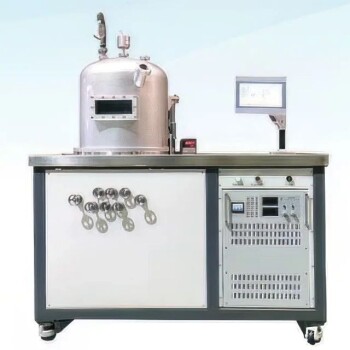
The core difference between CVD and CVI is not the chemistry, but the destination of the solid deposit. Chemical Vapor Deposition (CVD) grows a dense, external coating on a substrate surface, while Chemical Vapor Infiltration (CVI) builds a solid matrix deep inside a porous preform. Both rely on gas-phase precursor reactions inside precisely controlled high-temperature furnaces, but the process goals are opposite: CVD seals a surface, CVI fills interior voids without blocking them.
The fundamental technical distinction is that CVD is a surface-finishing process, whereas CVI is a bulk densification process. Mastering ceramic processing in laboratory furnaces means understanding that CVI must balance deposition kinetics with gas diffusion to avoid sealing the very pore network you are trying to fill.
The Surface-Level Distinction: Coating vs. Infiltration
CVD: Building a Ceramic Skin
CVD uses thermally activated chemical reactions to deposit a solid layer directly onto a substrate. Gaseous precursors flow into the furnace, decompose or react, and form a dense, continuous thin film on any exposed surface. For ceramics like silicon carbide (SiC), this happens at temperatures far lower than traditional sintering—typically 600–1200 °C instead of 1800–2000 °C. The result is a protective, wear-resistant, or functional coating that bonds tightly to the exterior.
CVI: Growing a Ceramic Skeleton from Within
CVI takes the same chemical principles but targets the interior of a porous preform, such as a fiber-reinforced ceramic-matrix composite (CMC). Precursor gases must diffuse through tortuous pore networks and react internally to slowly fill the voids with solid ceramic. The process avoids coating the outer surface too quickly, which would choke off further gas entry and leave unforgivable internal porosity. CVI is fundamentally a race between mass transport inward and surface deposition outward.
The Critical Role of Furnace Control in Each Process
Temperature and Kinetics: Lower Thresholds, Higher Precision
High-temperature laboratory furnaces enable both CVD and CVI to synthesize refractory ceramics at significantly lower temperatures than powder sintering. For example, SiC can form from methyltrichlorosilane at around 1000–1200 °C. This lower thermal budget protects sensitive substrate materials and reduces energy demand. However, multi-zone temperature uniformity is critical: even minor cold spots shift reaction kinetics and can lead to uneven coating thickness or incomplete infiltration.
Pressure and Gas Dynamics: Preventing “Crusting Over” in CVI
CVI demands low-pressure operation and carefully controlled gas flows to enhance the diffusion rate of precursor molecules. Specialized furnace architectures use leak-tight vacuum flanges, integrated gas distribution manifolds, and programmable pressure regulators. A slight overpressure or a surge in reactant concentration can instantly seal surface pores with a crust of ceramic, halting all further infiltration. CVD, by contrast, tolerates a wider range of pressures because its only objective is uniform surface coverage.
Understanding the Trade-offs and Pitfalls
The Infiltration Challenge: Uniformity vs. Speed
CVI is inherently slow because it must operate under conditions that favor internal deposition over surface capping. Rushing the process leads to “can-in-a-can” defects—a dense shell around a hollow, unfilled core. While CVD can run at higher rates to build thick coatings, CVI practitioners must accept cycle times that can stretch into weeks to achieve full densification. The pay-off is a near-net-shape composite part with minimal thermal mismatch and no need for high-pressure liquid infiltration.
Common Mistakes in Furnace Setup
- Assuming identical parameters: A temperature profile optimized for CVD will almost certainly ruin a CVI run by accelerating surface reaction rates too aggressively.
- Neglecting precursor depletion: In long CVI cycles, uneven gas composition along the flow path creates density gradients. Zone-specific flow injection or forced-flow CVI variants compensate for this.
- Ignoring the PVD confusion: Physical Vapor Deposition (PVD) is a line-of-sight technique that vaporizes solid material, while CVD and CVI rely on chemical reactions from a gaseous state. Conflating these leads to flawed furnace selection—you need seamless gas handling for CVD/CVI, not just a high-vacuum PVD chamber.
Making the Right Choice for Your Ceramic Goal
Decide based on whether your priority is surface function or internal structural integrity.
- If your primary focus is a protective or functional coating on a dense substrate: Use CVD. It delivers fast, dense, and adherent layers with outstanding surface uniformity even on complex shapes.
- If your primary focus is densifying a fiber preform to create a tough ceramic-matrix composite: CVI is your only viable gas-phase route. Accept the slower process to avoid premature pore closure and ensure the matrix grows from the inside out.
- If you are setting up a shared laboratory furnace: Invest in a system with flexible multi-zone heating, low-pressure mass-flow control, and vacuum integrity capable of handling both film and infiltration chemistries.
By matching the process to the structural depth you intend to affect, you unlock the full potential of high-temperature chemistry without destroying the very component you seek to create.
Summary Table:
| Feature | Chemical Vapor Deposition (CVD) | Chemical Vapor Infiltration (CVI) |
|---|---|---|
| Deposit Destination | External substrate surface | Internal porous preform network |
| Primary Goal | Protective/functional surface coating | Bulk matrix densification |
| Critical Furnace Control | Temperature uniformity & surface kinetics | Low pressure & controlled gas diffusion kinetics |
| Risk Factor | Non-uniform film thickness | Premature surface pore sealing ("can-in-a-can") |
| Cycle Time | Relatively fast (hours) | Extended/Slow (days to weeks) |
| Primary Application | Functional ceramic films & surface skins | Fiber-reinforced Ceramic-Matrix Composites (CMCs) |
Ready to optimize your advanced ceramic processing? KINTEK specializes in premium laboratory equipment and consumables, delivering a comprehensive range of high-temperature furnaces—including specialized CVD, vacuum, atmosphere, tube, muffle, and rotary furnaces. All our systems are fully customizable to meet your precise deposition, infiltration, and thermal processing requirements. Contact us today to consult with our experts and discover how KINTEK can enhance your lab's performance and operational efficiency!
Related Products
- Multi Heating Zones CVD Tube Furnace Machine for Chemical Vapor Deposition Equipment
- Custom Made Versatile CVD Tube Furnace Chemical Vapor Deposition CVD Equipment Machine
- High Temperature Muffle Oven Furnace for Laboratory Debinding and Pre Sintering
- 1400℃ High Temperature Laboratory Tube Furnace with Alumina Tube
- 1700℃ High Temperature Laboratory Tube Furnace with Alumina Tube
People Also Ask
- What is the function of a multi-zone tube furnace in CVD synthesis? Master 2D In2Se3 Nanosheet Precision
- Why are multi zone tube furnaces particularly useful for nanomaterial research? Unlock Precise Thermal Control for Advanced Synthesis
- What role do multi zone tube furnaces play in new energy research? Unlock Precise Thermal Control for Innovation
- What temperature-related capabilities make multi zone tube furnaces valuable for research? Unlock Precision Thermal Control
- What environmental protection applications utilize multi zone tube furnaces? Unlock Precision in Waste Treatment and Green Tech