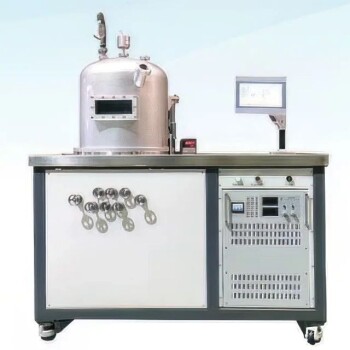
In the DLI-PP-CVD process, high-purity Hydrogen (H2) acts fundamentally as a reducing agent. It serves a dual purpose: assisting in the thermal decomposition of precursor molecules and actively stripping away residual carbon impurities during the growth phase.
The introduction of Hydrogen is critical for synthesizing Molybdenum Disulfide (MoS2) nanosheets with optimized crystalline quality and a precise stoichiometric ratio.
The Chemical Mechanism of Hydrogen
Facilitating Precursor Breakdown
The primary function of H2 in this context is to assist in thermal decomposition.
By acting as a reducing agent, Hydrogen promotes the efficient breakdown of the liquid precursors injected into the system. This ensures the necessary chemical components are available for the nucleation and growth of the material.
Eliminating Carbon Contamination
A major challenge in Chemical Vapor Deposition (CVD) is the inclusion of unintended elements.
Hydrogen addresses this by reacting with residual carbon generated during the precursor breakdown. It effectively "scavenges" these impurities, removing them from the growth environment before they can incorporate into the MoS2 lattice.
Impact on MoS2 Nanosheet Properties
Enhancing Crystalline Structure
The removal of impurities directly correlates to the structural integrity of the final material.
By preventing carbon defects, high-purity H2 allows the MoS2 nanosheets to form a more perfect, optimized crystalline structure. This reduces disorder within the material's atomic lattice.
Balancing the Mo/S Ratio
Beyond structural purity, Hydrogen influences the chemical composition of the nanosheets.
The reducing environment helps achieve a better stoichiometric ratio. It ensures the balance between Molybdenum (Mo) and Sulfur (S) atoms approaches the ideal theoretical values required for high-performance applications.
Understanding the Trade-offs
The Necessity of High Purity
While Hydrogen is beneficial, the process is highly sensitive to the quality of the gas used.
The reference specifically mandates high-purity Hydrogen. Using Hydrogen with even trace contaminants can introduce new impurities or disrupt the precise reduction reactions required for stoichiometry, effectively negating the benefits of carbon removal.
Optimizing Your DLI-PP-CVD Strategy
To maximize the quality of your Molybdenum Disulfide nanosheets, align your gas flow strategy with your specific material goals:
- If your primary focus is electronic purity: Ensure sufficient H2 flow to maximize carbon scavenging and reduce defect density.
- If your primary focus is chemical stoichiometry: Calibrate the H2 concentration to precisely modulate the Mo/S ratio during the growth phase.
High-purity Hydrogen is not just a carrier gas; it is an active reactant essential for high-quality MoS2 synthesis.
Summary Table:
| Function | Description | Impact on MoS2 |
|---|---|---|
| Reducing Agent | Facilitates thermal decomposition of liquid precursors | Promotes efficient nucleation and growth |
| Carbon Scavenging | Reacts with and removes residual carbon impurities | Enhances crystalline structure and reduces defects |
| Stoichiometric Control | Balances the Molybdenum to Sulfur (Mo/S) ratio | Ensures ideal chemical composition for performance |
| Purity Management | High-purity H2 prevents secondary contamination | Minimizes lattice disorder and electronic noise |
Elevate Your Thin-Film Research with KINTEK
Precision in DLI-PP-CVD requires more than just high-purity gases—it demands superior thermal control and reliable equipment. KINTEK provides industry-leading CVD systems, Vacuum furnaces, and customizable high-temperature lab solutions designed to help researchers achieve perfect stoichiometric ratios and high-purity crystalline growth. Backed by expert R&D and world-class manufacturing, we tailor our systems to meet your unique material synthesis needs.
Ready to optimize your MoS2 synthesis? Contact our technical experts today to find the perfect furnace solution for your laboratory.
References
- Felipe Wasem Klein, Matthieu Paillet. Determining by Raman spectroscopy the average thickness and <i>N</i>-layer-specific surface coverages of MoS<sub>2</sub> thin films with domains much smaller than the laser spot size. DOI: 10.3762/bjnano.15.26
This article is also based on technical information from Kintek Furnace Knowledge Base .
Related Products
- Custom Made Versatile CVD Tube Furnace Chemical Vapor Deposition CVD Equipment Machine
- MPCVD Machine System Reactor Bell-jar Resonator for Lab and Diamond Growth
- Cylindrical Resonator MPCVD Machine System for Lab Diamond Growth
- RF PECVD System Radio Frequency Plasma Enhanced Chemical Vapor Deposition
- Multi Heating Zones CVD Tube Furnace Machine for Chemical Vapor Deposition Equipment
People Also Ask
- Why are CVD tube furnace sintering systems indispensable for 2D material research and production? Unlock Atomic-Scale Precision
- What is a CVD tube furnace and what is its primary function? Discover Precision Thin-Film Deposition
- Which industries and research fields benefit from CVD tube furnace sintering systems for 2D materials? Unlock Next-Gen Tech Innovations
- How does CVD tube furnace sintering enhance graphene growth? Achieve Superior Crystallinity and High Electron Mobility
- What customization options are available for CVD tube furnaces? Tailor Your System for Superior Material Synthesis