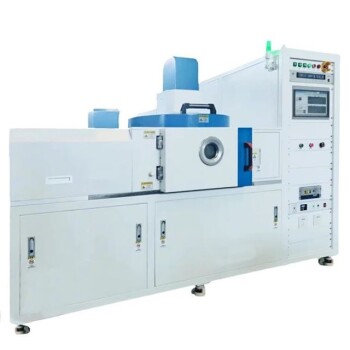
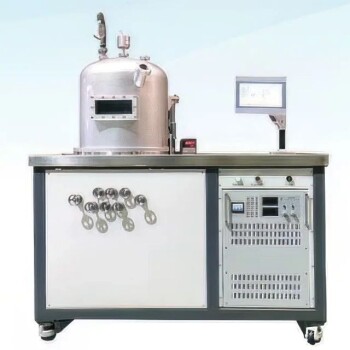
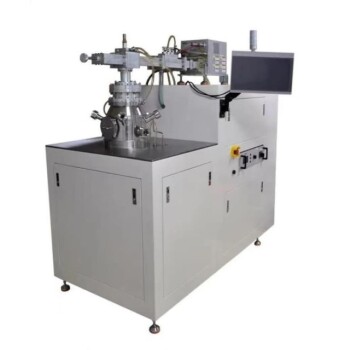
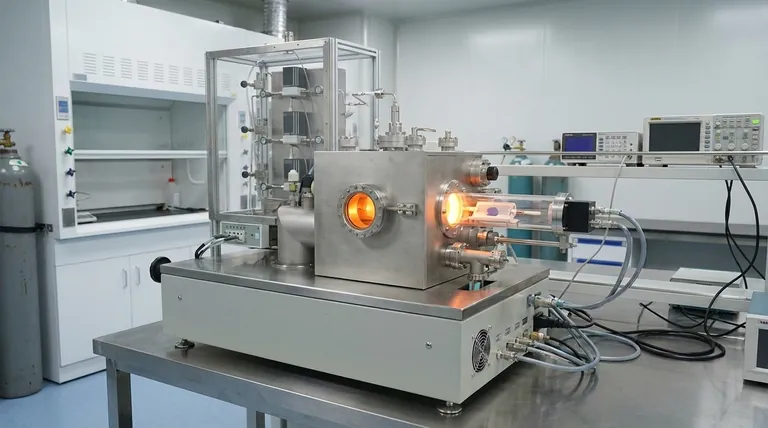
The Chemical Vapor Deposition (CVD) system functions as a precision thermal reactor designed to synthesize high-quality molybdenum disulfide (MoS2) from solid precursors. Its primary role is to provide a strictly controlled high-temperature environment where solid sulfur and molybdenum sources can vaporize, react, and deposit onto a sapphire substrate to form uniform atomic layers.
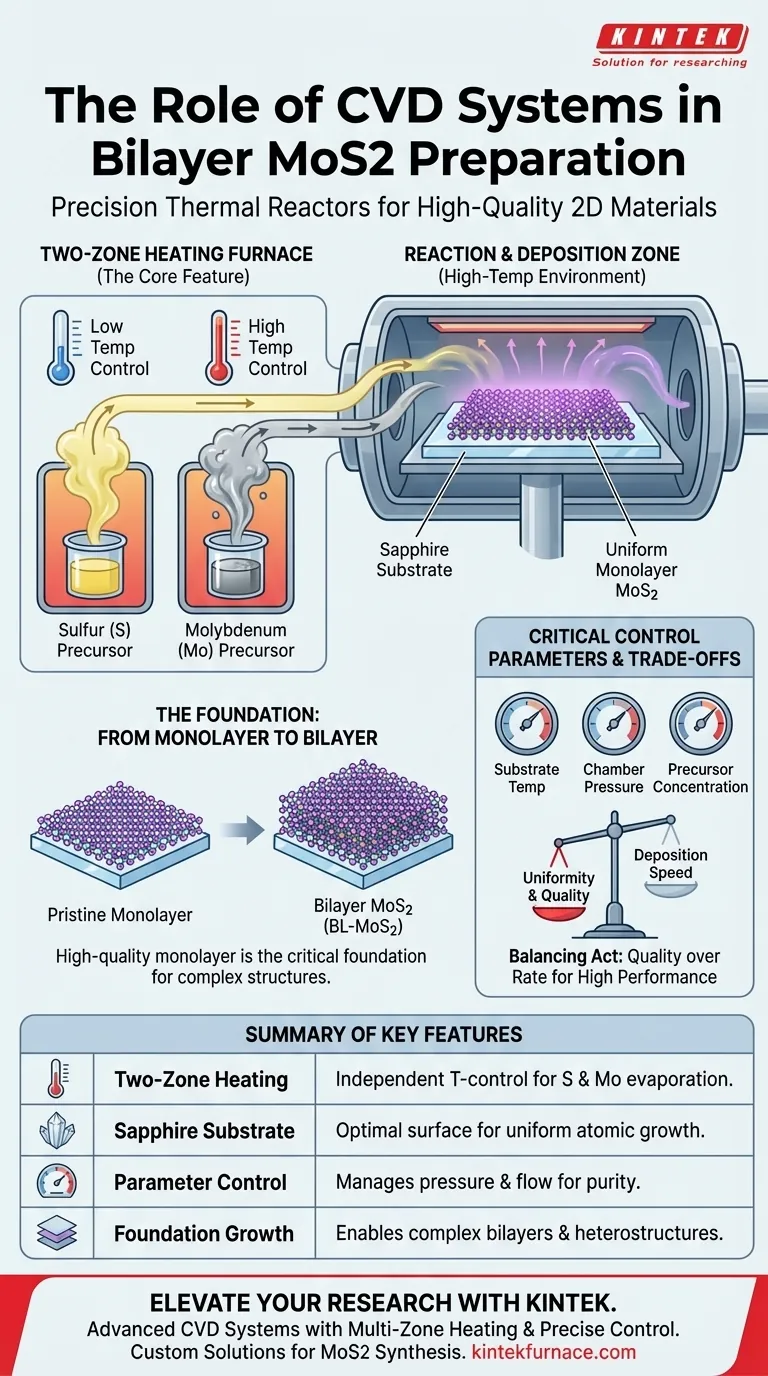
Core Takeaway The CVD system’s defining feature in this process is its two-zone heating furnace, which allows for independent temperature control over the evaporation of different source materials. This isolation ensures the growth of large-area, high-quality MoS2 layers, serving as the critical structural foundation necessary for creating bilayers and complex heterostructures.
The Mechanics of MoS2 Synthesis
Precision via Two-Zone Heating
The central challenge in growing MoS2 is that sulfur and molybdenum have vastly different melting and evaporation points. A standard single-zone furnace cannot optimally manage both simultaneously.
The CVD system solves this by utilizing a two-zone heating furnace. This configuration allows the system to independently control the evaporation temperatures of the solid sulfur and molybdenum precursors.
Reaction on the Substrate
Once evaporated, the gaseous precursors travel to the deposition zone. Here, the CVD system maintains a specific high-temperature environment that facilitates the chemical reaction.
The precursors react specifically on sapphire substrates. The result is the formation of molybdenum disulfide layers with uniform atomic thickness.
Establishing the Material Foundation
While the ultimate goal may be a bilayer (BL-MoS2) or a complex heterostructure, the quality of the final device is dictated by the quality of the initial growth.
The CVD system is responsible for growing the high-quality, large-area monolayers that serve as the foundation. Without the uniformity and purity achieved by the CVD process, constructing a functional bilayer with consistent electronic properties is impossible.
Critical Control Parameters and Trade-offs
The Necessity of Parameter Tuning
CVD is not a "set it and forget it" process. The quality of the resulting MoS2 coating is highly sensitive to several variables.
Operators must strictly control substrate temperature, chamber pressure, and precursor concentration. Fluctuations in gas flow rates or the surface condition of the substrate can lead to structural defects.
Balancing Uniformity and Speed
There is often a trade-off between the deposition rate and the structural integrity of the crystal.
Proper control is essential to achieve desired properties such as thickness uniformity and correct microstructure. If the parameters are not optimized, the MoS2 may fail to achieve the aspect ratios or graphitization degrees required for high-performance applications.
Making the Right Choice for Your Goal
To maximize the effectiveness of a CVD system for MoS2 preparation, consider your specific objectives:
- If your primary focus is material quality: Prioritize the precise calibration of the two-zone furnace temperatures to ensure the molybdenum and sulfur evaporate at rates that allow for stoichiometric reaction without impurities.
- If your primary focus is structural complexity: Ensure your CVD process produces a pristine monolayer foundation first, as defects at this stage will propagate through to the bilayer or heterostructure.
Success in creating bilayer MoS2 relies on utilizing the CVD system's ability to decouple precursor control from substrate reaction conditions.
Summary Table:
| Feature | Role in BL-MoS2 Synthesis |
|---|---|
| Two-Zone Heating | Enables independent temperature control for sulfur and molybdenum evaporation. |
| Sapphire Substrate | Provides the optimal surface for uniform atomic layer deposition and growth. |
| Parameter Control | Manages chamber pressure and gas flow to ensure thickness uniformity and purity. |
| Foundation Growth | Produces high-quality monolayers required for building complex bilayers. |
Elevate Your 2D Material Research with KINTEK
Precision is the difference between a defect-free monolayer and a failed experiment. KINTEK provides industry-leading CVD systems, engineered with advanced multi-zone heating and precise pressure controls to meet the rigorous demands of MoS2 synthesis.
Backed by expert R&D and manufacturing, KINTEK offers Muffle, Tube, Rotary, Vacuum, and CVD systems, all fully customizable for your unique lab requirements. Whether you are developing bilayer MoS2 or complex heterostructures, our equipment ensures the uniformity and scalability you need.
Ready to optimize your thin-film deposition? Contact our specialists today to find the perfect thermal solution for your research.
Visual Guide
References
- Louisa Scholz, Norbert Koch. Atomic-Scale Electric Potential Landscape across Molecularly Gated Bilayer MoS<sub>2</sub> Resolved by Photoemission. DOI: 10.1021/acsnano.5c10363
This article is also based on technical information from Kintek Furnace Knowledge Base .
Related Products
- 915MHz MPCVD Diamond Machine Microwave Plasma Chemical Vapor Deposition System Reactor
- Custom Made Versatile CVD Tube Furnace Chemical Vapor Deposition CVD Equipment Machine
- RF PECVD System Radio Frequency Plasma Enhanced Chemical Vapor Deposition
- MPCVD Machine System Reactor Bell-jar Resonator for Lab and Diamond Growth
- HFCVD Machine System Equipment for Drawing Die Nano Diamond Coating
People Also Ask
- What is the MPCVD method and why is it considered effective for diamond deposition? Superior Purity & High Growth Rates
- What factors influence the quality of diamond deposition in the MPCVD method? Master the Critical Parameters for High-Quality Diamond Growth
- What are some key features and benefits of the microwave plasma chemical vapor deposition system? Achieve Unmatched Material Synthesis
- What is the purpose of a microwave plasma chemical vapor deposition system? Grow High-Purity Diamonds and Advanced Materials
- What is the basic principle of operation for the microwave plasma chemical vapor deposition system? Unlock High-Purity Material Growth