
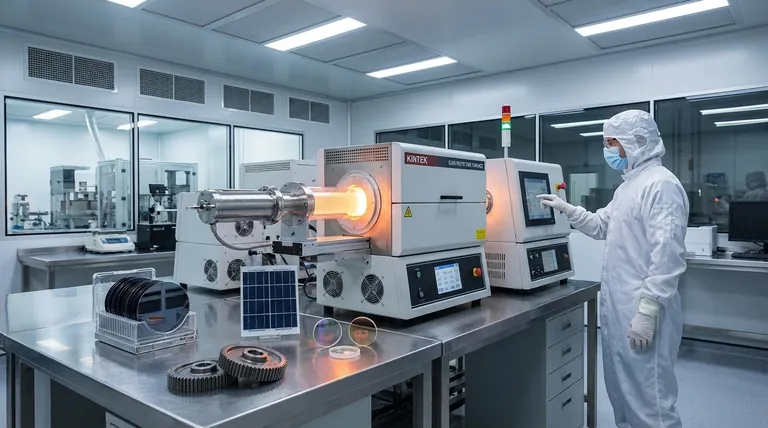
At its core, Chemical Vapor Deposition (CVD) is a foundational technology used across a surprisingly diverse range of high-tech industries. Its primary applications are found in semiconductor manufacturing, aerospace and automotive coatings, solar cell production, and the creation of advanced optical and biomedical devices. The process is valued for its ability to create exceptionally pure, high-performance thin films on various surfaces, fundamentally altering their properties.
The widespread adoption of CVD isn't accidental; it stems from its remarkable versatility. By manipulating temperature, pressure, and precursor materials, different CVD methods can be precisely tailored to deposit a vast array of materials, from ultra-hard coatings to complex semiconductor layers.
The Engine of Modern Electronics
The most significant use of CVD is in the electronics and semiconductor industry. It is the process that enables the fabrication of the microchips that power our world.
Creating Integrated Circuits
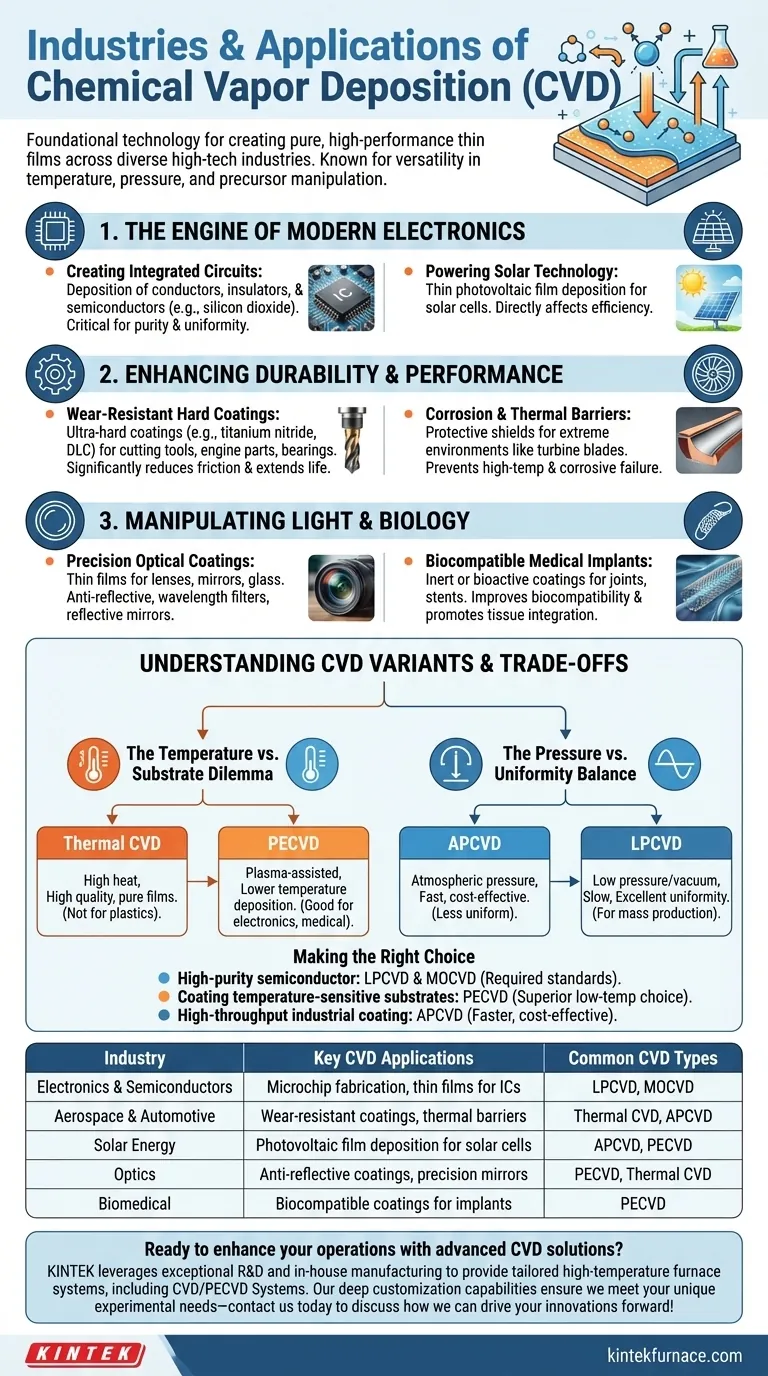
CVD is used to build the intricate, layered structures of a modern microchip. It deposits thin films of materials like polysilicon, silicon nitride, and silicon dioxide, which act as conductors, insulators, and semiconductors.
The exceptional purity and uniformity of films grown via CVD are critical for the performance and reliability of these microscopic electronic devices.
Powering Solar Technology
In the production of solar cells, CVD is used to deposit the thin silicon or other photovoltaic films that convert sunlight into electricity. The efficiency of a solar panel is directly tied to the quality of these deposited layers.
Enhancing Durability and Performance
Beyond electronics, CVD is a go-to process for surface modification, dramatically improving the lifespan and function of mechanical parts across various sectors.
Wear-Resistant Hard Coatings
In the manufacturing, automotive, and aerospace industries, CVD is used to apply ultra-hard coatings like titanium nitride and diamond-like carbon onto cutting tools, engine components, and bearings.
These coatings significantly reduce friction and increase resistance to wear, extending the component's operational life by orders of magnitude.
Corrosion and Thermal Barriers
For components exposed to extreme environments, such as jet engine turbine blades, CVD provides essential protective barriers. These coatings shield the underlying metal from high temperatures and corrosive gases, preventing failure.
Manipulating Light and Biology
The precision of CVD allows it to create films with highly specific optical or biological properties, opening up applications in advanced optics and medicine.
Precision Optical Coatings
CVD is used to apply thin films to lenses, mirrors, and glass. These coatings can create anti-reflective surfaces, filter specific wavelengths of light, or form highly reflective mirrors for lasers and telescopes.
Biocompatible Medical Implants
In the biomedical field, CVD applies inert or bioactive coatings to medical implants like artificial joints and stents. These surfaces improve biocompatibility, reduce the risk of rejection, and can even promote integration with surrounding tissue.
Understanding the Trade-offs: Why So Many CVD Variants Exist
The sheer number of industries using CVD is possible because it is not one single process, but a family of techniques. The choice of method involves critical trade-offs based on the desired outcome.
The Temperature vs. Substrate Dilemma
Thermal CVD, the original method, uses high heat to initiate the chemical reaction. This produces very high-quality, pure films but cannot be used on temperature-sensitive materials like plastics.
Plasma-Enhanced CVD (PECVD) solves this by using an energy-rich plasma to drive the reaction. This allows for deposition at much lower temperatures, making it ideal for coating electronics or medical devices that would be damaged by high heat.
The Pressure vs. Uniformity Balance
Atmospheric Pressure CVD (APCVD) is fast and relatively inexpensive because it doesn't require a vacuum chamber. However, it often results in less uniform films.
Low-Pressure CVD (LPCVD) operates in a vacuum. This slows the process down but dramatically improves the uniformity of the coating across many parts at once, which is critical for mass-producing semiconductor wafers.
The Precursor Material Challenge
Different materials require different gaseous precursors. Metal-Organic CVD (MOCVD), for instance, uses specialized metal-organic compounds to deposit high-quality crystalline films needed for advanced LEDs and high-frequency electronics. These precursors can be complex, expensive, and require careful handling.
Making the Right Choice for Your Application
The specific CVD process you choose is dictated entirely by your material, substrate, and performance goals.
- If your primary focus is high-purity semiconductor fabrication: LPCVD and MOCVD are the required standards for achieving device-quality uniformity and composition.
- If your primary focus is coating temperature-sensitive substrates: PECVD is the superior choice, as its plasma assistance allows for deposition at much lower temperatures.
- If your primary focus is high-throughput, cost-effective industrial coating: APCVD can provide a faster solution where perfect uniformity is not the overriding goal.
Ultimately, the power of CVD lies in its adaptability, allowing engineers to select the precise method required to solve a specific material science challenge.
Summary Table:
| Industry | Key CVD Applications | Common CVD Types |
|---|---|---|
| Electronics & Semiconductors | Microchip fabrication, thin films for ICs | LPCVD, MOCVD |
| Aerospace & Automotive | Wear-resistant coatings, thermal barriers | Thermal CVD, APCVD |
| Solar Energy | Photovoltaic film deposition for solar cells | APCVD, PECVD |
| Optics | Anti-reflective coatings, precision mirrors | PECVD, Thermal CVD |
| Biomedical | Biocompatible coatings for implants | PECVD |
Ready to enhance your operations with advanced CVD solutions? KINTEK leverages exceptional R&D and in-house manufacturing to provide diverse laboratories with tailored high-temperature furnace systems, including Muffle, Tube, Rotary Furnaces, Vacuum & Atmosphere Furnaces, and CVD/PECVD Systems. Our deep customization capabilities ensure we meet your unique experimental needs—contact us today to discuss how we can drive your innovations forward!
Visual Guide
Related Products
- Custom Made Versatile CVD Tube Furnace Chemical Vapor Deposition CVD Equipment Machine
- Split Chamber CVD Tube Furnace with Vacuum Station CVD Machine
- Multi Heating Zones CVD Tube Furnace Machine for Chemical Vapor Deposition Equipment
- Slide PECVD Tube Furnace with Liquid Gasifier PECVD Machine
- Controlled Inert Nitrogen Hydrogen Atmosphere Furnace
People Also Ask
- Why are CVD tube furnace sintering systems indispensable for 2D material research and production? Unlock Atomic-Scale Precision
- What is a CVD tube furnace and what is its primary function? Discover Precision Thin-Film Deposition
- Which industries and research fields benefit from CVD tube furnace sintering systems for 2D materials? Unlock Next-Gen Tech Innovations
- How does CVD tube furnace sintering enhance graphene growth? Achieve Superior Crystallinity and High Electron Mobility
- What customization options are available for CVD tube furnaces? Tailor Your System for Superior Material Synthesis



















