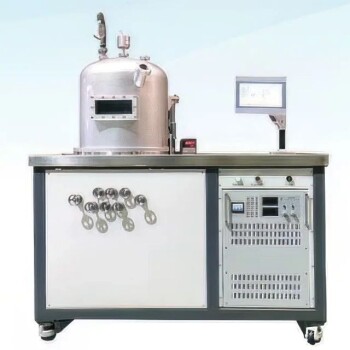
The primary function of an industrial-grade four-cathode system in High Power Impulse Magnetron Sputtering (HIPIMS) is to generate a dense, multi-directional plasma environment capable of coating complex geometries uniformly. By utilizing multiple targets—typically materials like chromium or niobium—simultaneously, the system overcomes the line-of-sight limitations of standard sputtering. When synchronized with a planetary rotating base, these cathodes ensure every surface of a three-dimensional workpiece receives consistent ion bombardment, enabling high-efficiency mass production.
The four-cathode system bridges the gap between precision laboratory coating and mass manufacturing. Its core value lies in creating a multi-source plasma environment that guarantees uniform surface treatment on complex parts, regardless of their orientation within the chamber.
The Mechanics of Multi-Source Plasma Generation
To understand the value of a four-cathode system, one must look beyond simple deposition rates. The system is engineered to solve the geometry and density challenges inherent in industrial surface engineering.
Creating High-Density Ion Fluxes
The system employs four distinct magnetron targets acting as the primary plasma generation sources.
These targets facilitate the ionization of metal and gas species, producing high-density ion fluxes. This density is critical for HIPIMS processes, as it directly influences the adhesion, hardness, and density of the resulting nitride layer.
Material Versatility
These systems are designed to accommodate various target materials to suit specific industrial needs.
Common configuration examples include chromium or niobium targets. By using multiple cathodes, the system can maintain high output levels of these metal ions, ensuring the process atmosphere remains rich in the necessary coating species.
Achieving Uniformity on Complex Geometries
In single-source systems, "shadowing" is a major failure point; parts of a workpiece facing away from the target receive thinner coatings or none at all. The four-cathode design eliminates this.
The Role of the Planetary Rotating Base
The four cathodes do not work in isolation; their function is intimately tied to a planetary rotating base.
As workpieces rotate on this base, they are continuously exposed to plasma from multiple angles. The four-cathode arrangement surrounds the workload, ensuring that complex three-dimensional shapes are coated evenly from all sides.
Elimination of Dead Zones
By distributing the plasma sources around the chamber, the system creates a uniform field of operation.
This ensures that even recessed areas, edges, and intricate details of the workpiece experience the same plasma exposure as flat surfaces. This uniformity is non-negotiable for high-performance industrial parts.
Operational Considerations and Trade-offs
While the four-cathode system offers superior uniformity and throughput, it introduces specific operational complexities that must be managed.
Complexity of Process Synchronization
Moving from a single source to a four-source system increases the complexity of the plasma environment.
Operators must ensure that all four targets degrade evenly and maintain consistent power levels. If the interaction between the rotating base and the four cathodes is not perfectly synchronized, it could theoretically lead to localized variations in coating thickness, negating the system's primary benefit.
Energy and Thermal Management
HIPIMS is inherently an energetic process. Running four cathodes simultaneously generates significant heat and requires robust power supplies.
The cooling systems and power distribution networks must be industrial-grade to handle the cumulative load of generating high-density metal ion fluxes from four distinct sources continuously.
Making the Right Choice for Your Goal
The four-cathode system is a tool designed for scale and complexity. Here is how to determine if it aligns with your production objectives:
- If your primary focus is Complex Geometry: Rely on the combination of the four-cathode layout and the planetary rotating base to eliminate shadowing on intricate 3D parts.
- If your primary focus is Industrial Throughput: Leverage the multi-source plasma environment to maintain high deposition rates and process large batches efficiently.
In summary, the four-cathode system transforms HIPIMS from a line-of-sight process into a volumetric solution, delivering the consistency required for large-scale industrial manufacturing.
Summary Table:
| Feature | Function in HIPIMS Nitriding | Impact on Production |
|---|---|---|
| Four-Cathode Layout | Creates a multi-source, multi-directional plasma field | Eliminates line-of-sight shadowing for uniform coverage |
| High-Density Ion Flux | Concentrates metal/gas ions from multiple targets | Improves coating adhesion, hardness, and layer density |
| Planetary Rotating Base | Synchronizes workpiece rotation with plasma sources | Ensures consistent treatment of complex 3D geometries |
| Material Versatility | Supports multiple targets like Chromium or Niobium | Enables high-throughput and diverse industrial coatings |
Maximize Your Coating Precision with KINTEK
Elevate your industrial nitriding processes with a system built for complexity and scale. Backed by expert R&D and manufacturing, KINTEK offers high-performance CVD systems and lab high-temp furnaces, alongside customizable solutions for advanced surface engineering like HIPIMS.
Our industrial-grade systems ensure uniform plasma distribution and superior adhesion for even the most intricate three-dimensional workpieces. Whether you need Muffle, Tube, Rotary, or Vacuum systems, our technology is designed to meet your unique production needs with efficiency and reliability.
Ready to transform your manufacturing throughput?
Contact KINTEK experts today to discuss your customized solution!
Visual Guide

References
- Arutiun P. Ehiasarian, P.Eh. Hovsepian. Novel high-efficiency plasma nitriding process utilizing a high power impulse magnetron sputtering discharge. DOI: 10.1116/6.0003277
This article is also based on technical information from Kintek Furnace Knowledge Base .
Related Products
- Controlled Inert Nitrogen Hydrogen Atmosphere Furnace
- HFCVD Machine System Equipment for Drawing Die Nano Diamond Coating
People Also Ask
- What are the characteristics and uses of hydrogen atmosphere in furnaces? Achieve Superior Surface Purity and Bonding
- What are the characteristics and uses of hydrogen atmospheres in furnaces? Unlock Clean Metal Processing
- Mechanism of Fe81Ga19 Secondary Recrystallization? High-Precision Furnace Control for Goss Grain Growth
- How does a controlled atmosphere furnace contribute to energy efficiency? Lower Costs with Advanced Thermal Management
- Why is controlled atmosphere capability important in an atmosphere furnace? Unlock Precise Material Processing