
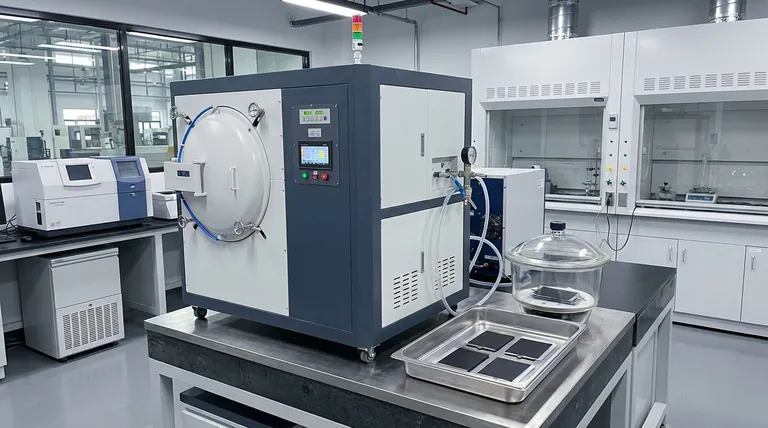
The vacuum drying oven serves as a critical stabilization mechanism in the final processing of supercapacitor electrode sheets. Its primary function is to execute a long-duration thermal treatment that removes persistent organic solvents, specifically N-Methyl-2-pyrrolidone (NMP), while simultaneously curing the binder to mechanically secure the active material to the substrate under oxygen-free conditions.
The core purpose of this phase is to transform a chemically vulnerable, solvent-rich coating into a physically robust and electrochemically stable interface by eliminating contaminants without degrading the active material.
Eliminating Contaminants for Purity
Deep Extraction of Organic Solvents
The most immediate function of the oven is the removal of N-Methyl-2-pyrrolidone (NMP). Because NMP has a high boiling point, the vacuum environment is essential to lower the evaporation threshold, ensuring complete removal without requiring destructively high temperatures.
Removal of Trace Moisture and Air
Beyond organic solvents, the negative pressure extracts trapped air and residual moisture from the deep micropores of the electrode material. Eliminating moisture is vital because its presence can trigger electrolyte decomposition during later cycling, severely impacting the device's lifespan.
Ensuring Pore Accessibility
By evacuating these fluids and gases, the oven prepares the porous structure of the electrode. This "clearing" of the micropores ensures that electrolytes (such as PVA-KOH gel) can effectively wet and infiltrate the material later, rather than being blocked by trapped gas pockets.
Preserving Material Integrity
Prevention of Oxidation
The vacuum environment creates an oxygen-free condition during thermal treatment. This allows the material to undergo high-temperature processing without the risk of oxidizing sensitive active components, a common issue with conventional air-drying ovens.
Activation of the Binder
The thermal energy provided by the oven facilitates the "setting" of the PVDF binder. This process creates a robust mechanical bond between the active materials (like carbon nanofibers) and the current collector substrate.
Structural Stabilization
Proper drying ensures the active layer maintains a tight contact interface with the conductive framework. This prevents the detachment of active substances during electrochemical testing and ensures long-term mechanical stability.
Understanding the Trade-offs
Evaporation Rate vs. Structural Defects
While a high vacuum accelerates drying, it must be balanced carefully; overly rapid evaporation can lead to coating cracks or uneven surfaces. Controlled vacuum levels ensure the solvent evaporates at a rate that maintains the structural uniformity of the electrode layer.
Temperature Sensitivity
The vacuum allows for drying at lower absolute temperatures (e.g., 60-70°C for sensitive materials) compared to atmospheric drying. However, operators must still precisely calibrate thermal input, as excessive heat—even in a vacuum—can degrade specific binders or delicate nanostructures like MXenes.
Making the Right Choice for Your Goal
To optimize your electrode preparation, align the drying parameters with your specific performance metrics:
- If your primary focus is Cycle Life (Longevity): Prioritize the duration of the vacuum phase to ensure the absolute removal of trace moisture, which is the primary cause of electrolyte decomposition and long-term degradation.
- If your primary focus is Power Density (Low Resistance): Focus on the depth of the vacuum to fully evacuate air from micropores, ensuring maximum electrolyte infiltration and minimizing interfacial impedance.
Ultimately, the vacuum drying oven functions not just as a dryer, but as a bridge between a raw chemical mixture and a functional electrochemical component.
Summary Table:
| Key Process | Role in Electrode Preparation | Final Performance Benefit |
|---|---|---|
| Solvent Extraction | Removes high-boiling NMP and moisture | Increases cycle life and stability |
| Binder Curing | Mechanically secures active material | Enhances structural integrity |
| Vacuum Environment | Prevents oxidation of sensitive materials | Maintains high electrochemical purity |
| Pore Clearing | Evacuates trapped air for electrolyte wetting | Minimizes interfacial impedance |
Elevate Your Electrode Preparation with KINTEK Precision
Ready to optimize your supercapacitor research? High-performance electrodes require the precise thermal control and contamination-free environments that only expert-engineered systems can provide.
KINTEK offers a comprehensive range of laboratory high-temperature solutions, including:
- Vacuum Drying Ovens for superior solvent removal.
- Muffle & Tube Furnaces for precise heat treatment.
- Rotary & CVD Systems for advanced material synthesis.
All our systems are backed by expert R&D and manufacturing, ensuring they are fully customizable for your unique laboratory needs. Contact us today to discuss how KINTEK can enhance your lab's efficiency and material performance!
References
- Meruyert Nazhipkyzy, Dana D. Assylkhanova. Synthesis of Lignin/PAN Fibers from Sawdust. DOI: 10.3390/fib12030027
This article is also based on technical information from Kintek Furnace Knowledge Base .
Related Products
- Vacuum Heat Treat Sintering and Brazing Furnace
- Vacuum Heat Treat Sintering Furnace Molybdenum Wire Vacuum Sintering Furnace
- Dental Porcelain Zirconia Sintering Ceramic Vacuum Press Furnace
- Vacuum Hot Press Furnace Machine for Lamination and Heating
- Vacuum Hot Press Furnace Machine Heated Vacuum Press
People Also Ask
- What are the benefits of using vacuum heat treating furnaces for metal alloys? Achieve Superior Metal Properties and Performance
- How does vacuum heat treating affect the grain structure of metal alloys? Achieve Precise Microstructure Control
- What is one of the most important uses of vacuum heat treating furnaces in aerospace? Achieve Superior Strength in Aircraft Alloys
- What is the temperature of a vacuum furnace brazing? Optimize Your Joint Strength and Cleanliness
- What are the steps involved in a typical vacuum brazing treatment? Master the Process for Strong, Clean Joints







