
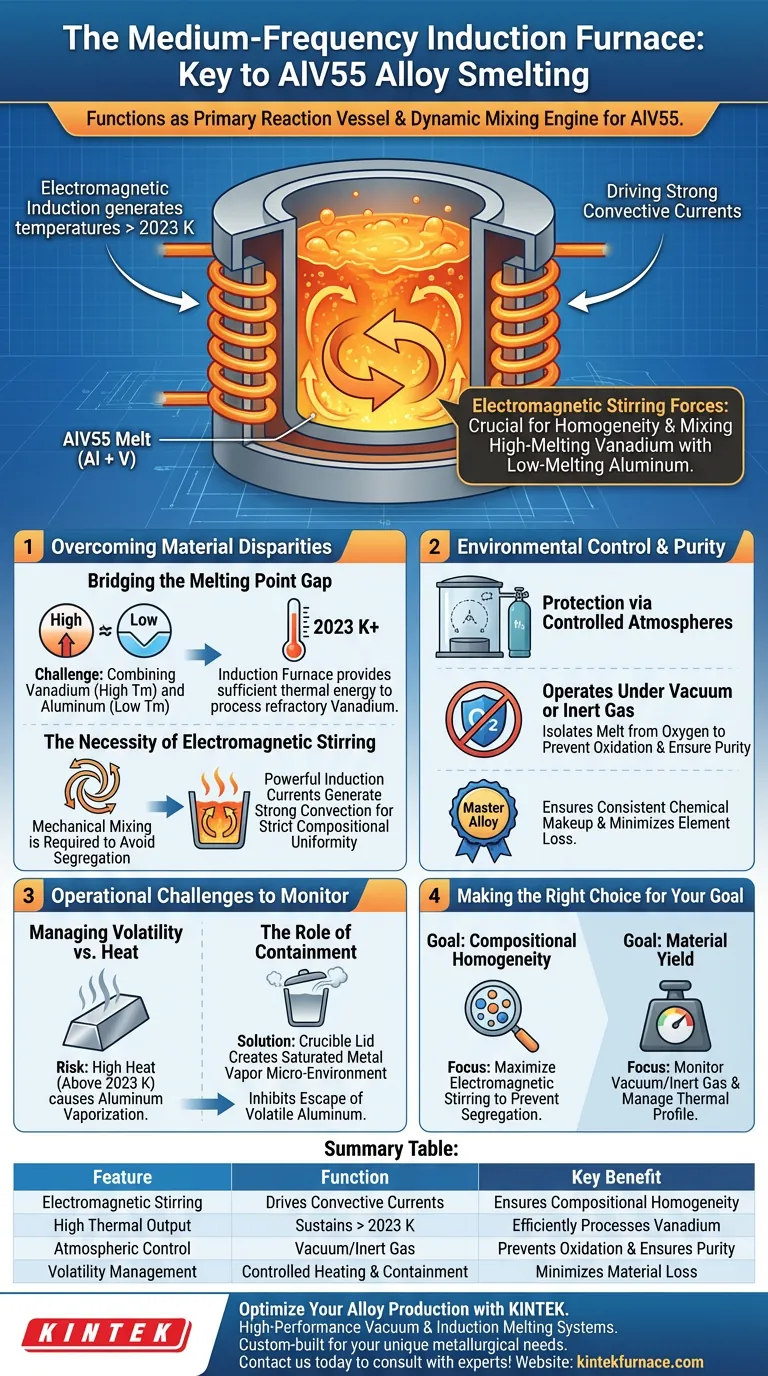
The medium-frequency induction furnace functions as the primary reaction vessel in the AlV55 smelting process, serving not just as a heat source, but as a dynamic mixing engine. It utilizes electromagnetic induction to generate temperatures exceeding 2023 K while simultaneously driving strong convective currents to blend materials with vastly different physical properties.
The furnace’s critical role is generating electromagnetic stirring forces to homogenize high-melting-point vanadium with low-melting-point aluminum. It bridges the gap between these disparate metals while maintaining the vacuum or controlled atmosphere necessary to prevent oxidation.
Overcoming Material Disparities
Bridging the Melting Point Gap
The fundamental challenge in AlV55 production is combining vanadium, which has a very high melting point, with aluminum powder, which melts at a much lower temperature.
Standard heating methods often result in segregation, where the heavy vanadium sinks or fails to fully dissolve.
The induction furnace addresses this by providing an environment capable of sustaining temperatures exceeding 2023 K, ensuring the thermal energy is sufficient to process the refractory vanadium component.
The Necessity of Electromagnetic Stirring
Temperature alone is insufficient for high-performance master alloys; mechanical mixing is required.
The induction currents within the furnace generate a powerful electromagnetic stirring force.
This force induces strong convection within the melt pool, physically agitating the mixture. This ensures the thorough mixing of the vanadium and aluminum, achieving the strict compositional uniformity required for the final alloy.
Environmental Control and Purity
Protection via Controlled Atmospheres
AlV55 smelting involves reactive metals that can easily degrade if exposed to oxygen at high temperatures.
The medium-frequency induction furnace is designed to operate under vacuum or controlled atmospheres (such as inert gases).
This capability isolates the melt from the ambient environment, preventing the oxidation of the aluminum and ensuring the vanadium is not compromised by impurities.
Ensuring Alloy Performance
By combining rapid heating with atmospheric isolation, the furnace minimizes the loss of alloying elements.
This precise control is essential for producing "master alloys"—materials that must possess a highly specific and consistent chemical makeup to be useful in downstream applications.
Operational Challenges to Monitor
Managing Volatility vs. Heat
While the furnace provides the necessary heat to melt vanadium, that same heat creates a risk for the aluminum component.
At temperatures above 2023 K, aluminum becomes highly volatile and prone to vaporization.
The Role of Containment
To act as a counterbalance to the furnace's intense heat, specific operational measures—such as the use of a crucible lid—are often required.
This creates a saturated metal vapor micro-environment to inhibit the escape of volatile aluminum. Without managing this trade-off, the furnace's heat could alter the alloy's composition by evaporating the aluminum before the process is complete.
Making the Right Choice for Your Goal
To maximize the effectiveness of a medium-frequency induction furnace in AlV55 production, align your operational parameters with your specific quality targets:
- If your primary focus is Compositional Homogeneity: Maximize the utilization of electromagnetic stirring to prevent the segregation of high-density vanadium within the aluminum matrix.
- If your primary focus is Material Yield: Strictly monitor the vacuum or inert gas levels to prevent oxidation loss and manage the thermal profile to minimize aluminum volatilization.
Mastering the induction furnace requires viewing it as a tool for both thermal energy and kinetic mixing, ensuring the refractory and volatile elements combine into a unified, high-performance alloy.
Summary Table:
| Feature | Function in AlV55 Smelting | Key Benefit |
|---|---|---|
| Electromagnetic Stirring | Drives convective currents to mix vanadium & aluminum | Ensures compositional homogeneity |
| High Thermal Output | Sustains temperatures exceeding 2023 K | Efficiently processes high-melting-point vanadium |
| Atmospheric Control | Operates under vacuum or inert gas | Prevents oxidation and ensures material purity |
| Volatility Management | Controlled heating with crucible containment | Minimizes aluminum vaporization and material loss |
Optimize Your Alloy Production with KINTEK
Achieving the perfect balance of homogeneity and purity in AlV55 smelting requires specialized equipment. Backed by expert R&D and manufacturing, KINTEK offers high-performance Vacuum and Induction melting systems that are fully customizable to your unique metallurgical needs. Whether you are processing refractory metals or volatile aluminum alloys, our systems provide the precise electromagnetic control and atmospheric isolation necessary for superior results.
Ready to elevate your lab's smelting efficiency? Contact us today to consult with our experts on the ideal high-temp furnace for your application!
Visual Guide
References
- Bin Sun, Lanjie Li. Study on Al Evaporation during AlV55 Melting and Alloy Preparation. DOI: 10.3390/met14040466
This article is also based on technical information from Kintek Furnace Knowledge Base .
Related Products
- 600T Vacuum Induction Hot Press Vacuum Heat Treat and Sintering Furnace
- Vacuum Induction Melting Furnace
- Multi Heating Zones CVD Tube Furnace Machine for Chemical Vapor Deposition Equipment
- 1200℃ Controlled Inert Nitrogen Atmosphere Furnace
- Spark Plasma Sintering SPS Furnace
People Also Ask
- Why use Vacuum Hot Press (VHP) for ZnS Ceramics? Achieve Superior IR Transparency and Mechanical Strength
- How does a vacuum hot press sintering furnace mitigate copper sintering swelling? Solve Fe-Cu Expansion Issues
- What are the benefits of using a vacuum hot press sintering furnace for the preparation of SiCw/2024 aluminum matrix composites? Achieve High-Performance Aerospace Materials
- What are the key advantages of vacuum hot press sintering furnaces? Achieve Superior Density and Purity in Materials
- How does the vacuum environment in a vacuum hot press sintering furnace protect chromium-containing ceramics? Find out.



















