
Vacuum arc melting (VAM) equipment acts as the definitive processing tool for synthesizing high-purity Ti-33Al based alloy button ingots. Its primary role is to generate high-temperature arcs within a high-vacuum environment, allowing for the complete melting of raw metal materials while strictly preventing oxidative contamination. This process ensures the final ingot achieves precise chemical composition ratios and a uniform distribution of elements.
Core Takeaway By combining a protective vacuum atmosphere with high-energy electromagnetic stirring, VAM equipment solves the dual challenge of preventing oxidation in reactive metals (Titanium) and ensuring atomic-level homogeneity in the final alloy structure.
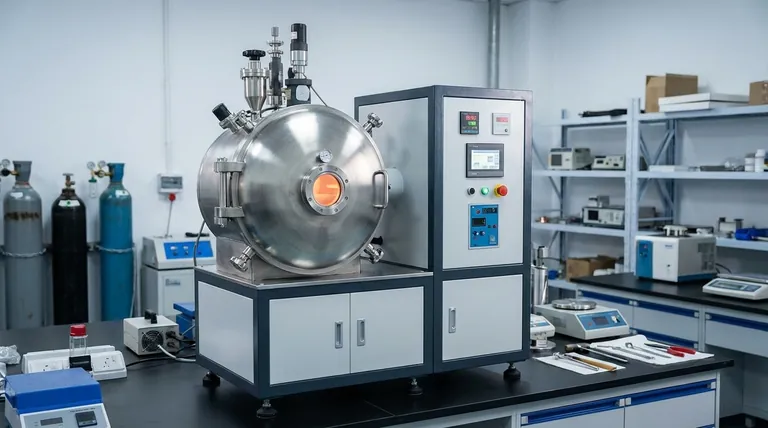
The Critical Functions of VAM Equipment
1. Guaranteeing Chemical Purity
The primary challenge in processing Titanium-based alloys is reactivity. Titanium (Ti) and Aluminum (Al) are highly susceptible to oxidation when exposed to air at elevated temperatures.
The Role of High Vacuum
The VAM equipment creates a high-vacuum environment prior to the introduction of heat. This effectively isolates the raw materials from oxygen and nitrogen found in the atmosphere.
Preventing Contamination
By eliminating these atmospheric gases, the equipment prevents the formation of brittle oxides or nitrides within the melt. This ensures the resulting Ti-33Al ingots maintain high purity, which is essential for accurate material characterization.
Mechanisms for Structural Homogeneity
2. Achieving Complete Melting
Alloying cannot occur without a complete phase transition. The equipment utilizes high-temperature arcs to deliver intense, focused thermal energy to the raw materials.
Overcoming Melting Point Differences
This high-energy input ensures that all raw components, regardless of their individual melting points, are brought to a fully liquid state. This is critical for Ti-33Al alloys, where incomplete melting would result in segregation of the base elements.
3. Ensuring Uniform Distribution
Melting alone does not guarantee a uniform alloy. The physics of the electric arc provides a secondary benefit beyond heat: electromagnetic stirring.
The Mixing Effect
The current flowing through the melt creates forces that vigorously agitate the molten pool. This stirring action drives the uniform chemical distribution of the Titanium and Aluminum atoms throughout the ingot matrix.
Operational Trade-offs and Best Practices
The Necessity of Remelting
While VAM equipment is powerful, a single melt cycle is rarely sufficient to achieve perfect homogeneity. Because the bottom of the ingot is in contact with a water-cooled copper hearth, it stays cooler and may not mix as thoroughly.
The Standard Protocol
To counteract this, the ingot must be flipped and remelted multiple times (typically a minimum of three). This iterative process ensures that any segregation is eliminated and that the precise alloy composition ratios are consistent throughout the entire volume of the button ingot.
Making the Right Choice for Your Goal
To maximize the utility of vacuum arc melting for your Ti-33Al experiments:
- If your primary focus is compositional accuracy: Ensure the vacuum level is stable before initiating the arc to prevent the loss of volatile elements or oxidation.
- If your primary focus is microstructural homogeneity: Implement a strict protocol of flipping and remelting the button ingot at least three times to leverage the electromagnetic stirring effect fully.
Success in preparing Ti-33Al alloys relies not just on melting the metal, but on utilizing the vacuum and arc dynamics to engineer a defect-free, homogeneous microstructure.
Summary Table:
| Function | Mechanism | Benefit to Ti-33Al Alloy |
|---|---|---|
| Purity Control | High-vacuum environment | Prevents brittle oxide/nitride formation in reactive Titanium |
| Phase Transition | Focused high-temp electric arc | Ensures complete melting of components with different melting points |
| Homogeneity | Electromagnetic stirring | Eliminates element segregation for uniform chemical distribution |
| Consistency | Iterative flipping & remelting | Guarantees defect-free microstructure throughout the ingot volume |
Elevate Your Materials Research with KINTEK
Precision in Ti-33Al alloy preparation demands equipment that masters both vacuum integrity and thermal control. KINTEK provides industry-leading Vacuum Arc Melting (VAM) systems, backed by expert R&D and specialized manufacturing. Whether you require standard lab setups or customizable Muffle, Tube, Rotary, Vacuum, or CVD systems, our high-temperature furnaces are engineered to meet your unique metallurgical needs.
Ready to achieve atomic-level homogeneity and high-purity results?
References
- Lukas Haußmann, Mathias Göken. Interdiffusion Coefficients and Strengthening Effects of Nb, Ta, and Zr in the α2-Ti3Al Phase. DOI: 10.1007/s11669-024-01105-y
This article is also based on technical information from Kintek Furnace Knowledge Base .
Related Products
- Vacuum Induction Melting Furnace
- Vacuum Hot Press Furnace Machine for Lamination and Heating
- Small Vacuum Heat Treat and Tungsten Wire Sintering Furnace
- Vacuum Heat Treat Sintering and Brazing Furnace
- Vacuum Heat Treat Sintering Furnace Molybdenum Wire Vacuum Sintering Furnace
People Also Ask
- What are the core functions of the High Vacuum Induction Melting (VIM) furnace? Optimize DD5 Superalloy Purification
- What are the advantages of using a VIM furnace to control residual oxygen pressure? Achieve Superior Metal Uniformity
- What is the role of VIM and directional solidification in aero-engine blade substrates? Engineering Extreme Durability
- What are the technical advantages of using a Vacuum Induction Melting furnace in the development of advanced packaging steel?
- What role does a Vacuum Induction Melting furnace play in the production of high-aluminum nickel-based superalloys?



















