
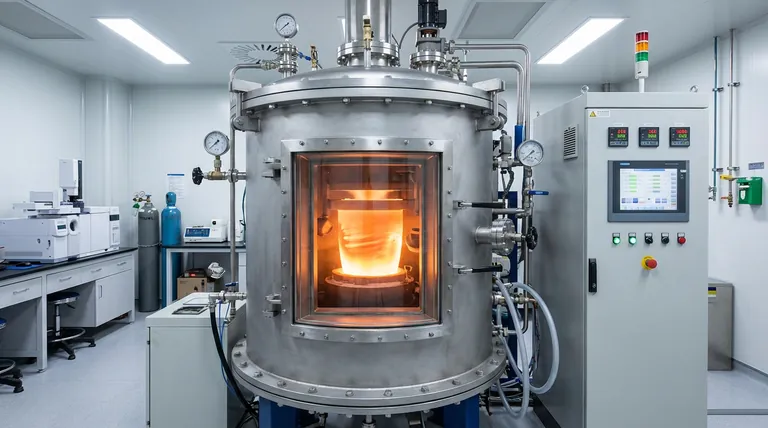
The role of a vacuum induction melting (VIM) furnace in producing Fe-C-B-Cr-W alloys is twofold: it creates a controlled vacuum environment to prevent the oxidative loss of active alloying elements, and it utilizes electromagnetic induction to physically stir the melt. This dual function ensures that components with vastly different densities—specifically heavy tungsten (W) and lightweight boron (B)—are thoroughly mixed and chemically preserved within the iron matrix.
The VIM furnace is not merely a heating device; it is a precision instrument that establishes the chemical purity and compositional homogeneity necessary for a valid analysis of the alloy's microstructure.
Preserving Chemical Integrity
Preventing Oxidative Loss
The production of Fe-C-B-Cr-W alloys requires high temperatures where active elements are prone to rapid oxidation. The VIM furnace mitigates this by operating under a controlled vacuum or low-pressure atmosphere.
Maintaining Elemental Ratios
By removing oxygen and other impurity gases from the chamber, the furnace prevents the burning off of critical alloying additions. This ensures that the final chemical composition of the laboratory casting matches the intended calculation, particularly for reactive elements like boron and chromium.
Achieving Structural Homogeneity
Overcoming Density Differences
A major challenge in this specific alloy system is the disparity in density between the components. Tungsten (W) is significantly denser than the base iron, while boron (B) is much lighter, leading to a natural tendency for the elements to segregate or settle.
The Power of Electromagnetic Stirring
The VIM furnace solves this segregation issue through the electromagnetic induction stirring effect. The magnetic field used to heat the metal generates internal currents that vigorously agitate the molten pool.
Ensuring Uniform Distribution
This continuous stirring action forces the heavy tungsten and light boron to distribute uniformly throughout the melt. The result is a compositionally homogenized ingot, which provides a stable and reliable foundation for subsequent microstructure analysis.
Operational Considerations and Trade-offs
Balancing Vacuum and Inert Gas
While a high vacuum is excellent for degassing and preventing oxidation, strictly maintaining a vacuum is not always the sole operational mode. As noted in broader applications, a controlled argon atmosphere (e.g., at 500 mbar) is often employed to minimize the evaporation of volatile elements while still protecting the melt.
Thermal Management
Precise temperature control is essential to prevent overheating the melt, which could damage the furnace lining or alter the alloy's properties. The system relies on a dedicated cooling system to regulate the internal temperature of the coil and chamber during these high-energy cycles.
Making the Right Choice for Your Goal
When setting up your laboratory production for Fe-C-B-Cr-W alloys, prioritize your process parameters based on the specific defect you are trying to avoid:
- If your primary focus is Chemical Precision: Ensure the vacuum system is capable of removing impurity gases effectively to prevent the loss of active elements like Chromium and Boron.
- If your primary focus is Microstructural Uniformity: Maximize the use of the induction stirring capability to prevent gravity segregation of the high-concentration Tungsten components.
By leveraging the vacuum environment and induction stirring simultaneously, you ensure the production of high-purity, homogeneous laboratory castings ready for advanced analysis.
Summary Table:
| Feature | Role in Fe-C-B-Cr-W Production | Impact on Alloy Quality |
|---|---|---|
| Vacuum Environment | Prevents oxidation of reactive Boron (B) and Chromium (Cr) | Maintains precise chemical integrity and elemental ratios |
| Induction Stirring | Physically mixes heavy Tungsten (W) and lightweight Boron (B) | Eliminates density segregation for a homogeneous microstructure |
| Atmosphere Control | Allows for inert gas (Argon) backfilling | Minimizes evaporation of volatile elements during melting |
| Thermal Precision | Regulates high-energy heating cycles | Protects furnace lining and ensures consistent material properties |
Elevate Your Materials Research with KINTEK Precision
Ready to achieve unmatched chemical purity and structural homogeneity in your specialty alloys? KINTEK provides industry-leading Vacuum Induction Melting (VIM) systems, backed by expert R&D and manufacturing. Our range includes Muffle, Tube, Rotary, Vacuum, and CVD systems, all fully customizable to meet the rigorous demands of laboratory alloy production.
Don't let density segregation or oxidation compromise your results. Partner with KINTEK for high-temp furnace solutions designed for precision. Contact our experts today to discuss your unique needs!
References
- H. SCHAEFER, Jonathan Lentz. Phase Analysis and Measurement of Local Carbon Contents in Hypoeutectic Alloys in the System Fe-C-B-Cr-W. DOI: 10.1007/s00501-024-01436-w
This article is also based on technical information from Kintek Furnace Knowledge Base .
Related Products
- Vacuum Induction Melting Furnace
- 600T Vacuum Induction Hot Press Vacuum Heat Treat and Sintering Furnace
- Small Vacuum Heat Treat and Tungsten Wire Sintering Furnace
- Vacuum Heat Treat Sintering and Brazing Furnace
- Vacuum Heat Treat Sintering Furnace Molybdenum Wire Vacuum Sintering Furnace
People Also Ask
- What are the core functions of the High Vacuum Induction Melting (VIM) furnace? Optimize DD5 Superalloy Purification
- Why is a Vacuum Induction Melting furnace (VIM) used for Cu-Zn-Al-Sn alloys? Achieve Precision Composition Control
- What are the technical advantages of using a Vacuum Induction Melting furnace in the development of advanced packaging steel?
- What role does a Vacuum Induction Melting furnace play in the production of high-aluminum nickel-based superalloys?
- What is the role of VIM and directional solidification in aero-engine blade substrates? Engineering Extreme Durability



















