Knowledge How does VIM compare to DIM for LTES composites? Unlock Superior Thermal Storage and Stability
Author avatar

Tech Team · Kintek Furnace

Updated 23 hours ago

How does VIM compare to DIM for LTES composites? Unlock Superior Thermal Storage and Stability


The Vacuum Impregnation Method (VIM) creates a superior composite material compared to the Direct Impregnation Method (DIM) by fundamentally changing how the Phase Change Material (PCM) enters the support structure. While DIM relies on passive absorption, VIM uses low-pressure environments to actively evacuate air and moisture, resulting in higher thermal storage density and greater structural stability.

The core difference lies in pore accessibility: VIM creates a vacuum that physically forces liquid PCM into microscopic pores that DIM leaves empty. This maximizes the material's energy storage capacity and significantly strengthens the bond between the PCM and its support matrix.
How does VIM compare to DIM for LTES composites? Unlock Superior Thermal Storage and Stability

The Mechanics of Impregnation

Overcoming Air Resistance

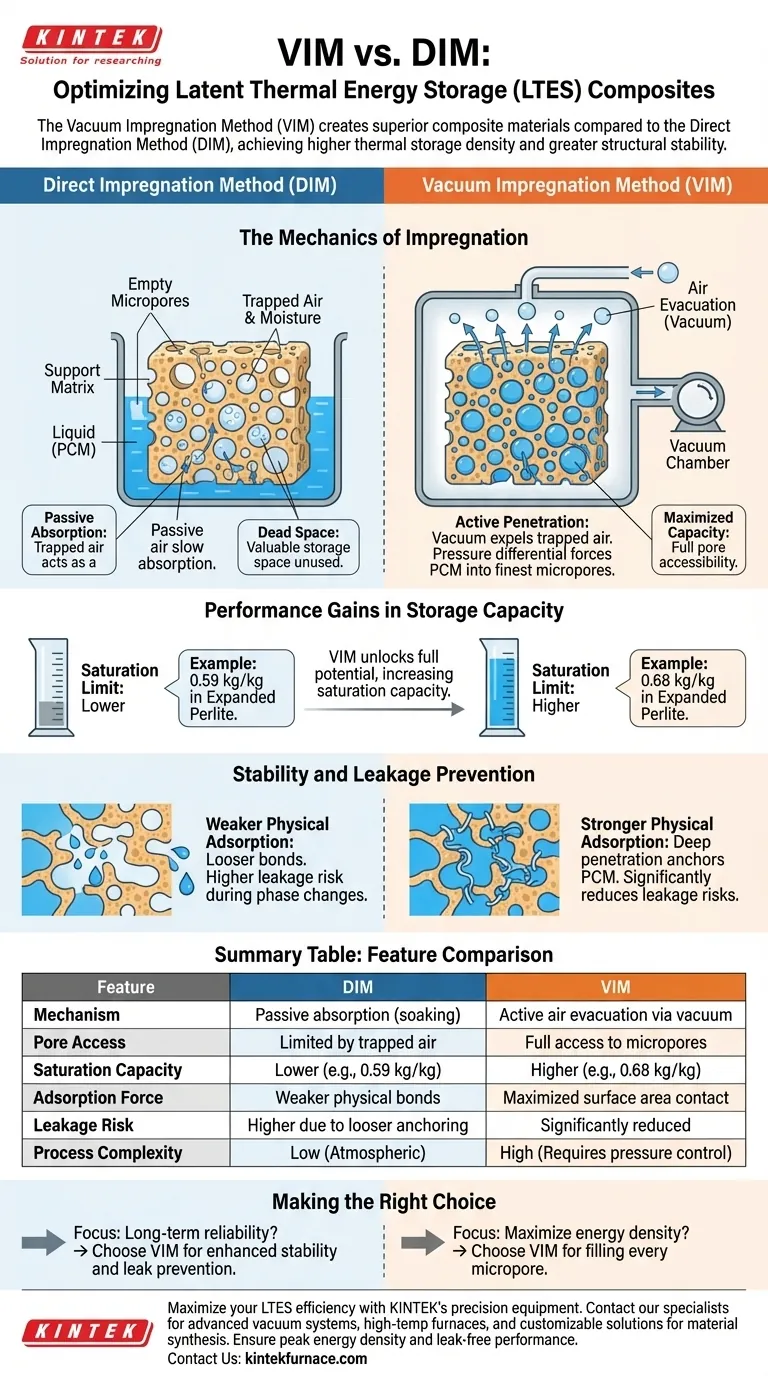
In Direct Impregnation, air trapped inside the pores of the support material acts as a barrier. This prevents the liquid PCM from fully penetrating the matrix, leaving valuable storage space unused.

The Power of Pressure Differentials

VIM processes the porous support material under extremely low-pressure conditions. This creates a vacuum that forcibly expels the trapped air and moisture residing within the pores.

Active Penetration

Once the air is removed, a pressure differential is created. This differential acts as a driving force, pushing the liquid PCM deep into the finest micropores that standard soaking methods cannot reach.

Performance Gains in Storage Capacity

Increased Adsorption Rates

By removing the resistance caused by trapped gases, VIM significantly accelerates the adsorption rate. The porous matrix absorbs the PCM more rapidly and thoroughly than it does under atmospheric conditions.

Higher Saturation Limits

VIM unlocks the full potential of the support material. For example, in large-pore Expanded Perlite, VIM increases the saturation capacity to 0.68 kg/kg, compared to only 0.59 kg/kg achieved by DIM.

Stability and Leakage Prevention

Stronger Physical Adsorption

Because VIM drives the PCM into deeper, smaller pores, the surface area contact between the liquid and the solid matrix is maximized. This results in stronger physical adsorption forces holding the material together.

Reducing Leakage Risks

Leakage is a critical failure mode in LTES composites during phase change cycles (melting and freezing). By anchoring the PCM more securely within the micropores, VIM significantly reduces leakage risks compared to the looser bonds formed by DIM.

Understanding the Trade-offs

The Limitations of Direct Impregnation (DIM)

While DIM is a simpler process, it inherently results in "dead space" within the composite. The inability to displace deep-seated air pockets limits the total energy density the material can hold.

The Necessity of Process Control

VIM is an active process requiring specific environmental controls (vacuum). However, this processing requirement is necessary to achieve the saturation capacities required for high-performance thermal storage applications.

Making the Right Choice for Your Goal

The choice between these methods defines the efficiency and lifespan of your thermal storage system.

  • If your primary focus is maximizing energy density: Use VIM to ensure every available micropore is filled, achieving capacities such as 0.68 kg/kg in expanded perlite composites.
  • If your primary focus is long-term reliability: Choose VIM to enhance physical adsorption, ensuring the PCM remains trapped within the matrix to prevent leakage during repeated thermal cycles.

VIM transforms impregnation from a passive absorption process into a precision engineering step, ensuring your LTES composites deliver maximum capacity and stability.

Summary Table:

Feature Direct Impregnation Method (DIM) Vacuum Impregnation Method (VIM)
Mechanism Passive absorption (soaking) Active air evacuation via vacuum
Pore Access Limited by trapped air/moisture Full access to micropores
Saturation Capacity Lower (e.g., 0.59 kg/kg in Perlite) Higher (e.g., 0.68 kg/kg in Perlite)
Adsorption Force Weaker physical bonds Maximized surface area contact
Leakage Risk Higher due to looser anchoring Significantly reduced via deep penetration
Process Complexity Low (Atmospheric) High (Requires pressure control)

Maximize the efficiency of your Latent Thermal Energy Storage (LTES) projects with KINTEK's precision equipment. Backed by expert R&D and manufacturing, KINTEK offers advanced vacuum systems and lab high-temp furnaces—including Muffle, Tube, and CVD systems—all customizable for your unique material synthesis needs. Ensure your composites achieve peak energy density and leak-free performance. Contact our specialists today to find the perfect solution for your lab!

Visual Guide
How does VIM compare to DIM for LTES composites? Unlock Superior Thermal Storage and Stability Visual Guide

References

  1. Chrysa Politi, I.P. Koronaki. Mechanistic Modelling for Optimising LTES-Enhanced Composites for Construction Applications. DOI: 10.3390/buildings15030351

This article is also based on technical information from Kintek Furnace Knowledge Base .

Related Products

People Also Ask

Related Products

Vacuum Heat Treat Sintering Furnace with Pressure for Vacuum Sintering

Vacuum Heat Treat Sintering Furnace with Pressure for Vacuum Sintering

KINTEK's Vacuum Pressure Sintering Furnace offers 2100℃ precision for ceramics, metals, and composites. Customizable, high-performance, and contamination-free. Get a quote now!

Vacuum Hot Press Furnace Machine for Lamination and Heating

Vacuum Hot Press Furnace Machine for Lamination and Heating

KINTEK Vacuum Lamination Press: Precision bonding for wafer, thin-film & LCP applications. 500°C max temp, 20-ton pressure, CE certified. Custom solutions available.

Vacuum Heat Treat Sintering and Brazing Furnace

Vacuum Heat Treat Sintering and Brazing Furnace

KINTEK Vacuum Brazing Furnaces deliver precision, clean joints with superior temperature control. Customizable for diverse metals, ideal for aerospace, medical, and thermal applications. Get a quote!

Laboratory Vacuum Tilt Rotary Tube Furnace Rotating Tube Furnace

Laboratory Vacuum Tilt Rotary Tube Furnace Rotating Tube Furnace

KINTEK Laboratory Rotary Furnace: Precision heating for calcination, drying, sintering. Customizable solutions with vacuum & controlled atmosphere. Enhance research now!

Ultra High Vacuum CF Flange Stainless Steel Sapphire Glass Observation Sight Window

Ultra High Vacuum CF Flange Stainless Steel Sapphire Glass Observation Sight Window

CF sapphire viewing window for ultra-high vacuum systems. Durable, clear, and precise for semiconductor and aerospace applications. Explore specs now!

Ultra High Vacuum Observation Window Stainless Steel Flange Sapphire Glass Sight Glass for KF

Ultra High Vacuum Observation Window Stainless Steel Flange Sapphire Glass Sight Glass for KF

KF flange observation window with sapphire glass for ultra-high vacuum. Durable 304 stainless steel, 350℃ max temperature. Ideal for semiconductor and aerospace.

9MPa Air Pressure Vacuum Heat Treat and Sintering Furnace

9MPa Air Pressure Vacuum Heat Treat and Sintering Furnace

Achieve superior ceramic densification with KINTEK's advanced air pressure sintering furnace. High-pressure up to 9MPa, precise 2200℃ control.

1700℃ Controlled Inert Nitrogen Atmosphere Furnace

1700℃ Controlled Inert Nitrogen Atmosphere Furnace

KT-17A Controlled Atmosphere Furnace: Precise 1700°C heating with vacuum & gas control. Ideal for sintering, research & material processing. Explore now!

Vacuum Hot Press Furnace Machine Heated Vacuum Press Tube Furnace

Vacuum Hot Press Furnace Machine Heated Vacuum Press Tube Furnace

Discover KINTEK's advanced Vacuum Tube Hot Press Furnace for precise high-temperature sintering, hot pressing, and material bonding. Customizable solutions for labs.

Vacuum Heat Treat Sintering Furnace Molybdenum Wire Vacuum Sintering Furnace

Vacuum Heat Treat Sintering Furnace Molybdenum Wire Vacuum Sintering Furnace

KINTEK's Vacuum Molybdenum Wire Sintering Furnace excels in high-temperature, high-vacuum processes for sintering, annealing, and material research. Achieve precise 1700°C heating with uniform results. Custom solutions available.

High Temperature Muffle Oven Furnace for Laboratory Debinding and Pre Sintering

High Temperature Muffle Oven Furnace for Laboratory Debinding and Pre Sintering

KT-MD Debinding & Pre-Sintering Furnace for ceramics - precise temperature control, energy-efficient design, customizable sizes. Boost your lab efficiency today!

Electric Rotary Kiln Small Rotary Furnace Biomass Pyrolysis Plant Rotating Furnace

Electric Rotary Kiln Small Rotary Furnace Biomass Pyrolysis Plant Rotating Furnace

KINTEK's Rotary Biomass Pyrolysis Furnace converts biomass to biochar, bio-oil, and syngas efficiently. Customizable for research or production. Get your solution now!

High Performance Vacuum Bellows for Efficient Connection and Stable Vacuum in Systems

High Performance Vacuum Bellows for Efficient Connection and Stable Vacuum in Systems

KF ultra-high vacuum observation window with high borosilicate glass for clear viewing in demanding 10^-9 Torr environments. Durable 304 stainless steel flange.

Ultra High Vacuum CF Observation Window Flange with High Borosilicate Glass Sight Glass

Ultra High Vacuum CF Observation Window Flange with High Borosilicate Glass Sight Glass

CF Ultra-High Vacuum Observation Window Flange with high borosilicate glass for precise UHV applications. Durable, clear, and customizable.

Multi Heating Zones CVD Tube Furnace Machine for Chemical Vapor Deposition Equipment

Multi Heating Zones CVD Tube Furnace Machine for Chemical Vapor Deposition Equipment

KINTEK's Multi-Zone CVD Tube Furnaces offer precision temperature control for advanced thin film deposition. Ideal for research and production, customizable for your lab needs.

Spark Plasma Sintering SPS Furnace

Spark Plasma Sintering SPS Furnace

Discover KINTEK's advanced Spark Plasma Sintering (SPS) Furnace for rapid, precise material processing. Customizable solutions for research and production.

Ultra-High Vacuum Flange Aviation Plug Glass Sintered Airtight Circular Connector for KF ISO CF

Ultra-High Vacuum Flange Aviation Plug Glass Sintered Airtight Circular Connector for KF ISO CF

Ultra-High Vacuum Flange Aviation Plug Connector for aerospace & labs. KF/ISO/CF compatible, 10⁻⁹ mbar airtight, MIL-STD certified. Durable & customizable.

Ultra High Vacuum Observation Window KF Flange 304 Stainless Steel High Borosilicate Glass Sight Glass

Ultra High Vacuum Observation Window KF Flange 304 Stainless Steel High Borosilicate Glass Sight Glass

KF Ultra-High Vacuum Observation Window with borosilicate glass for clear viewing in demanding vacuum environments. Durable 304 stainless steel flange ensures reliable sealing.

Stainless Steel Quick Release Vacuum Chain Three Section Clamp

Stainless Steel Quick Release Vacuum Chain Three Section Clamp

Stainless steel quick release vacuum clamps ensure leak-free connections for high vacuum systems. Durable, corrosion-resistant, and easy to install.

Vacuum Dental Porcelain Sintering Furnace for Dental Laboratories

Vacuum Dental Porcelain Sintering Furnace for Dental Laboratories

KinTek Vacuum Porcelain Furnace: Precision dental lab equipment for high-quality ceramic restorations. Advanced firing control & user-friendly operation.


Leave Your Message