
Precise temperature control in an induction furnace is essential for gold melting because it directly prevents the two most significant threats to value: oxidation and vaporization. By maintaining the metal at its exact melting point without overshooting, this technology ensures maximum purity, eliminates contamination from the heating source, and minimizes the loss of valuable material.
For professionals working with gold, the benefit of induction heating is not just melting metal—it's preserving its value. Precise temperature control transforms the process from an uncontrolled approximation into an exact science, minimizing waste and maximizing the quality of the final product.
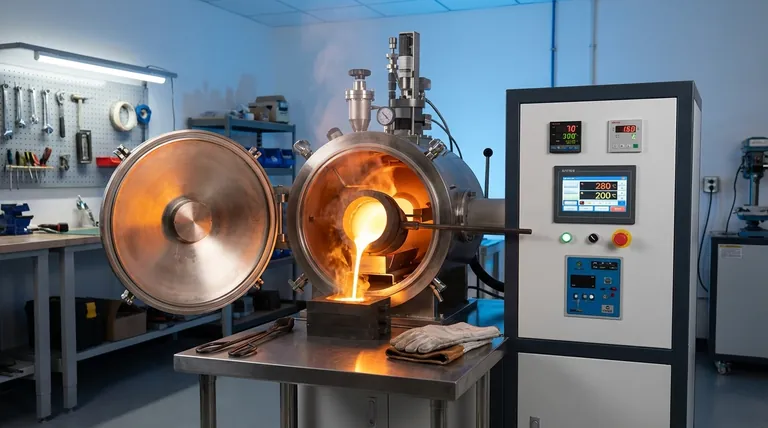
Preserving Gold's Value and Purity
The primary benefit of precision temperature control is its direct impact on the quality and quantity of the gold you recover. Every degree above the ideal melting point introduces risk.
Preventing Oxidation and Contamination
Gold has a melting point of 1064°C (1948°F). Exceeding this temperature unnecessarily increases the rate of oxidation, creating impurities that degrade the gold's purity and must be removed later.
Induction furnaces provide exact, adjustable temperature settings, allowing you to hold the melt at the perfect temperature. This prevents the formation of oxides and ensures a cleaner final product.
Furthermore, because induction heating occurs in a sealed environment without open flames, it eliminates contamination from combustion byproducts, which is a common issue with traditional torch or fuel-fired methods.
Minimizing Vaporization Loss
Even small temperature overshoots can cause a portion of your valuable gold to vaporize into the air. This is a direct, irreversible financial loss.
Precise control, often managed by modern IGBT technology, keeps the metal just above its liquidus state without the temperature fluctuations common in other methods. This drastically reduces vaporization, ensuring more of your gold ends up in the final cast.
Optimizing Operational Efficiency and Cost
Beyond material quality, precise temperature control streamlines the entire melting workflow, leading to significant gains in speed, energy use, and safety.
Achieving Unmatched Speed
Induction systems can heat metal to over 2,000°F in seconds, virtually eliminating the pre-heating and wait times associated with traditional furnaces.
This rapid heating and cooling cycle allows for a continuous workflow. You can perform melts on demand directly on the work floor, rather than moving materials to a dedicated, high-heat furnace area and processing in slow batches.
Maximizing Energy Efficiency
Precise control means energy is only used when and where it is needed. Optimized frequency control and the lack of standby heat loss contribute to energy savings of 30% to 80% compared to conventional methods.
This efficiency also lowers operational costs by eliminating the need to purchase, store, and handle fuel or replace electrodes.
Enhancing Workplace Safety
The controlled, enclosed nature of induction melting fundamentally improves safety. With no open flames or exposed heating elements, the risks of fires and burns are significantly reduced.
This also leads to a cleaner work environment with less exposure to the toxic fumes that can be generated by fuel-based heating.
Understanding the Trade-offs
While the benefits are clear, adopting induction technology requires a strategic assessment of its costs and requirements against the long-term gains.
Initial Investment vs. Long-Term ROI
Induction furnace systems represent a higher initial capital investment compared to a simple gas-and-torch setup. This is the primary trade-off.
However, this cost must be weighed against the return on investment. The significant reduction in material loss, lower energy bills, and increased production throughput often provide a clear and rapid payback period for professional operations.
System Complexity and Requirements
Unlike a simple torch, an induction system is a sophisticated piece of equipment that requires a stable and sufficient electrical supply. It is not as portable and demands a more planned-out installation.
Making the Right Choice for Your Operation
To determine if an induction furnace is the correct choice, align its benefits with your primary operational goal.
- If your primary focus is maximum purity and minimizing loss: The exact temperature regulation of an induction furnace is non-negotiable to prevent oxidation and vaporization.
- If your primary focus is high-volume production and speed: The rapid heating cycles and continuous workflow of induction systems offer a significant competitive advantage over traditional batch methods.
- If your primary focus is long-term cost reduction: The dramatic energy savings and documented reduction in material waste provide a clear financial justification for the initial investment.
By mastering temperature, you ultimately master the quality, efficiency, and profitability of your gold melting operations.
Summary Table:
| Benefit | Key Feature | Impact on Gold Melting |
|---|---|---|
| Purity Preservation | Exact temperature settings | Prevents oxidation, eliminates contamination |
| Material Loss Reduction | No temperature overshoots | Minimizes vaporization, maximizes yield |
| Operational Efficiency | Rapid heating cycles | Speeds up workflow, reduces energy costs |
| Safety & Cleanliness | Enclosed, flame-free heating | Lowers risks, improves work environment |
Master Your Gold Melting Process with KINTEK's Advanced Induction Furnaces
Leveraging exceptional R&D and in-house manufacturing, KINTEK provides diverse laboratories with advanced high-temperature furnace solutions. Our induction furnaces are engineered for precise temperature control, ensuring maximum gold purity and minimal material loss—directly boosting your profitability.
Our product line, including Muffle, Tube, Rotary Furnaces, Vacuum & Atmosphere Furnaces, and CVD/PECVD Systems, is complemented by our strong deep customization capability to precisely meet unique experimental requirements.
Ready to enhance your gold melting efficiency and preserve your material's value? Contact us today to discuss your specific needs and discover a tailored solution!
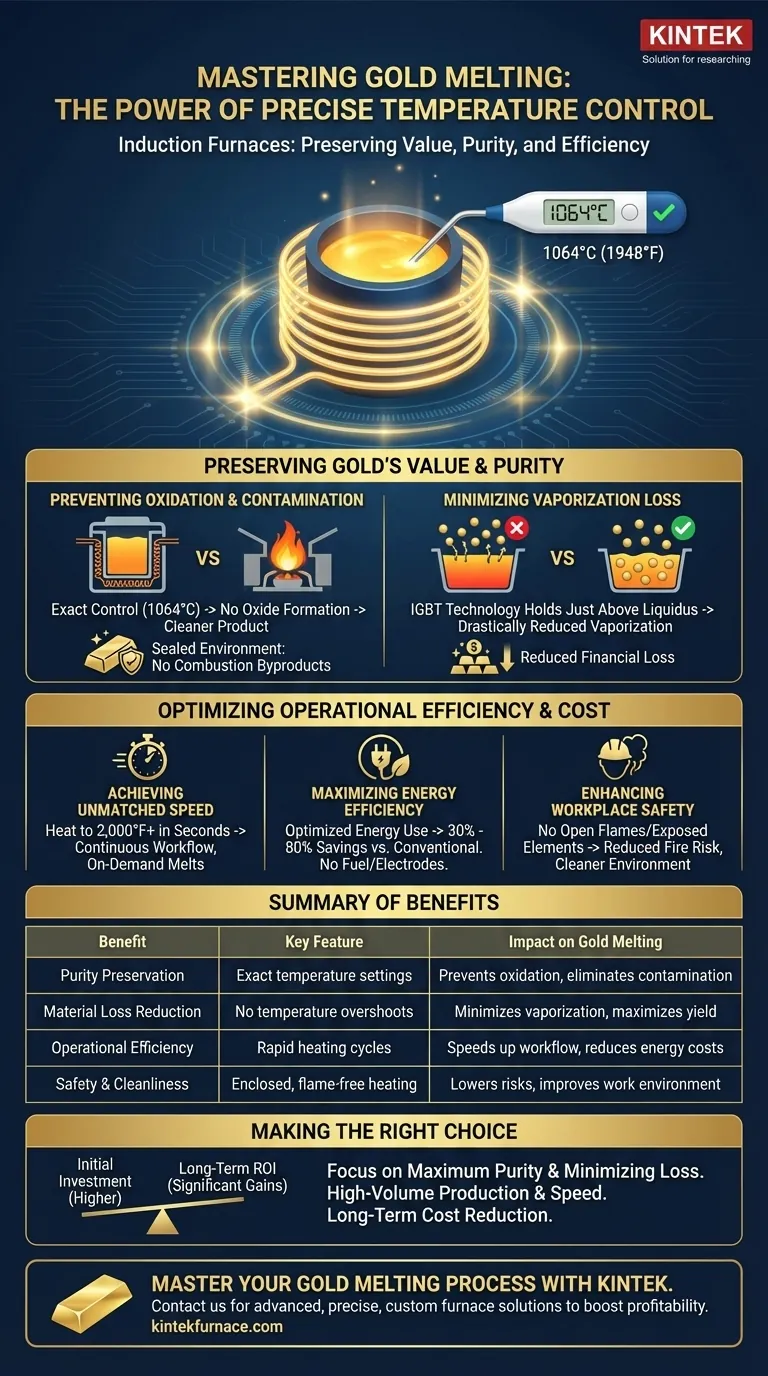
Visual Guide
Related Products
- 600T Vacuum Induction Hot Press Vacuum Heat Treat and Sintering Furnace
- Vacuum Induction Melting Furnace
- 1200℃ Controlled Inert Nitrogen Atmosphere Furnace
- 1700℃ Controlled Inert Nitrogen Atmosphere Furnace
- Vacuum Heat Treat Sintering Furnace with Pressure for Vacuum Sintering
People Also Ask
- Why use Vacuum Hot Press (VHP) for ZnS Ceramics? Achieve Superior IR Transparency and Mechanical Strength
- How does a vacuum hot press sintering furnace mitigate copper sintering swelling? Solve Fe-Cu Expansion Issues
- What are the key advantages of vacuum hot press sintering furnaces? Achieve Superior Density and Purity in Materials
- What are the benefits of using a vacuum hot press sintering furnace for the preparation of SiCw/2024 aluminum matrix composites? Achieve High-Performance Aerospace Materials
- How does the vacuum environment in a vacuum hot press sintering furnace protect chromium-containing ceramics? Find out.



















