Knowledge What role does a stainless steel impeller play in magnesium-based composite synthesis? Optimize Vortex Incorporation
Author avatar

Tech Team · Kintek Furnace

Updated 1 day ago

What role does a stainless steel impeller play in magnesium-based composite synthesis? Optimize Vortex Incorporation


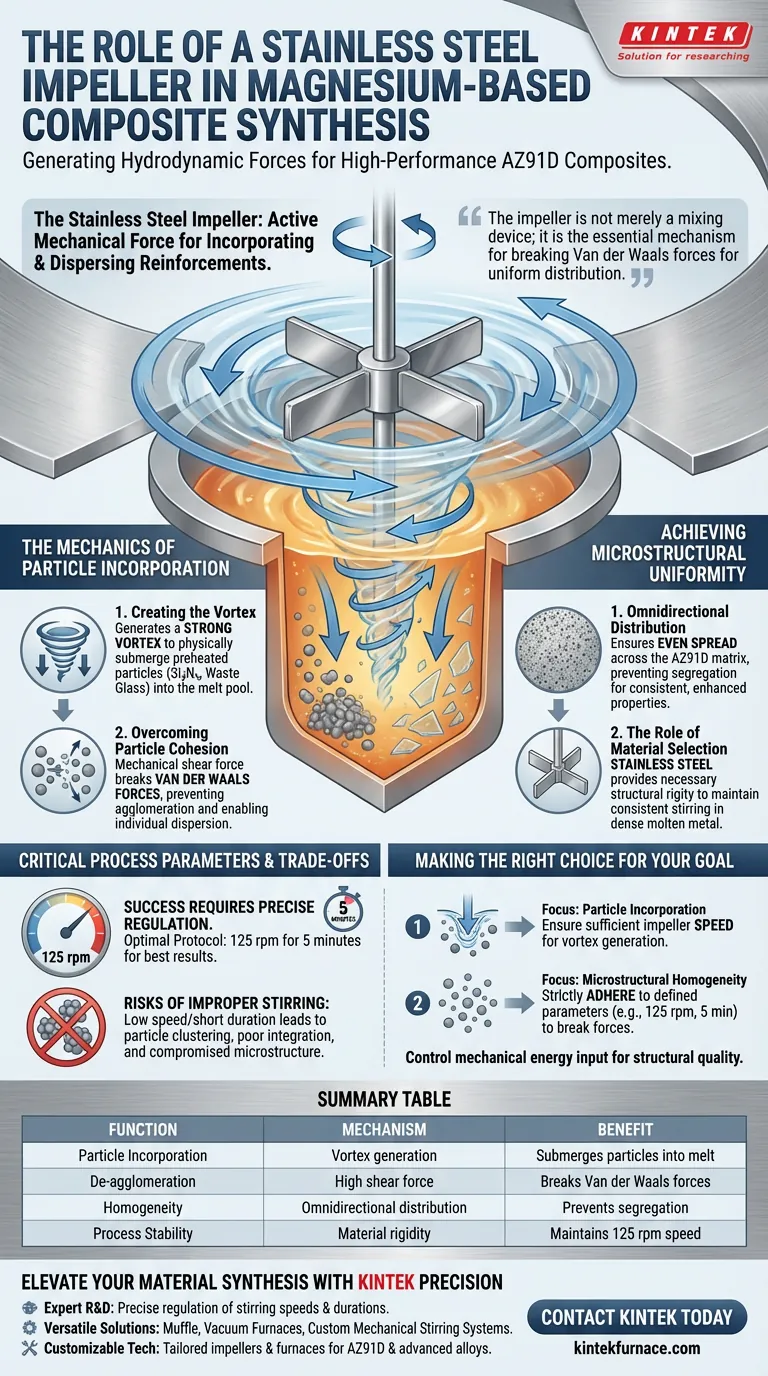
The stainless steel impeller serves as the active mechanical force required to successfully incorporate and disperse solid reinforcements into a liquid magnesium matrix. By generating a hydrodynamic vortex, the impeller physically submerges preheated particles—specifically silicon nitride and waste glass—into the melt pool while actively shearing apart particle clusters.

The impeller is not merely a mixing device; it is the essential mechanism for breaking Van der Waals forces between particles to ensure the uniform, omnidirectional distribution required for high-performance AZ91D composites.

The Mechanics of Particle Incorporation

Creating the Vortex

The primary function of the impeller is to generate a strong vortex within the molten magnesium.

Without this vortex, lightweight reinforcement particles would likely float on the surface rather than mixing with the alloy.

The mechanical action forces preheated silicon nitride and waste glass particles directly into the melt pool, initiating the composite synthesis.

Overcoming Particle Cohesion

At the microscopic level, particles naturally attract one another due to Van der Waals forces.

If left unchecked, these forces cause particles to agglomerate, leading to weak spots in the final material.

The mechanical stirring action provides the shear force necessary to break these bonds, separating the particles for individual dispersion.

Achieving Microstructural Uniformity

Omnidirectional Distribution

For a magnesium-based composite to perform well, the reinforcement phases must be spread evenly throughout the material.

The impeller ensures an omnidirectional distribution of particles within the AZ91D matrix.

This uniformity prevents segregation, ensuring that the enhanced properties of the composite are consistent in all directions.

The Role of Material Selection

The use of a stainless steel impeller is specific to this environment.

It provides the necessary structural rigidity to maintain consistent stirring speeds within the dense, molten metal environment.

This durability is essential for sustaining the mechanical action throughout the duration of the synthesis.

Critical Process Parameters and Trade-offs

The Necessity of Precise Regulation

Success in this process is not guaranteed simply by turning on the mixer; it requires precise regulation of stirring parameters.

The mechanical action is highly sensitive to variables such as stirring speed and duration.

Optimal results, as indicated by specific synthesis protocols, often require a speed of 125 rpm maintained for a duration of 5 minutes.

Risks of Improper Stirring

If the stirring speed is too low or the duration too short, the Van der Waals forces may not be fully overcome.

This results in particle clustering and poor integration with the matrix.

Conversely, while not explicitly detailed in the source, deviating significantly from established parameters like the 125 rpm benchmark risks compromising the high-performance microstructure.

Making the Right Choice for Your Goal

To ensure the successful synthesis of magnesium-based composites, you must treat the stirring process as a precise science rather than a general mixing step.

  • If your primary focus is Particle Incorporation: Ensure the impeller speed is sufficient to create a vortex that physically pulls preheated silicon nitride and waste glass particles below the surface of the melt.
  • If your primary focus is Microstructural Homogeneity: Strictly adhere to defined parameters, such as 125 rpm for 5 minutes, to effectively break Van der Waals forces and achieve uniform distribution in the AZ91D matrix.

Control the mechanical energy input with precision to dictate the structural quality of your final composite.

Summary Table:

Function Mechanism Benefit
Particle Incorporation Vortex generation Submerges particles (Si3N4, waste glass) into melt
De-agglomeration High shear force Breaks Van der Waals forces between particles
Homogeneity Omnidirectional distribution Prevents segregation in the AZ91D matrix
Process Stability Material rigidity Maintains 125 rpm speed in dense molten metal

Elevate Your Material Synthesis with KINTEK Precision

Achieving the perfect microstructural uniformity in magnesium-based composites requires more than just mixing—it requires engineering excellence. KINTEK provides high-performance stirring systems designed to withstand the rigors of molten metal synthesis.

Why partner with KINTEK?

  • Expert R&D: Our systems are engineered for precise regulation of stirring speeds and durations.
  • Versatile Solutions: From Muffle and Vacuum furnaces to custom Mechanical Stirring Systems, we support your entire high-temp workflow.
  • Customizable Tech: Tailor your impeller and furnace specs to meet the unique demands of AZ91D and other advanced alloys.

Contact KINTEK today to discover how our advanced lab furnaces and stirring solutions can enhance your composite research and production!

Visual Guide
What role does a stainless steel impeller play in magnesium-based composite synthesis? Optimize Vortex Incorporation Visual Guide

References

  1. Shubham Sharma, Emad A. A. Ismail. Enhancing tribo-mechanical, microstructural morphology, and corrosion performance of AZ91D-magnesium composites through the synergistic reinforcements of silicon nitride and waste glass powder. DOI: 10.1038/s41598-024-52804-y

This article is also based on technical information from Kintek Furnace Knowledge Base .

Related Products

People Also Ask

Related Products

304 316 Stainless Steel High Vacuum Ball Stop Valve for Vacuum Systems

304 316 Stainless Steel High Vacuum Ball Stop Valve for Vacuum Systems

KINTEK's 304/316 stainless steel vacuum ball valves and stop valves ensure high-performance sealing for industrial and scientific applications. Explore durable, corrosion-resistant solutions.

Stainless Steel Quick Release Vacuum Chain Three Section Clamp

Stainless Steel Quick Release Vacuum Chain Three Section Clamp

Stainless steel quick release vacuum clamps ensure leak-free connections for high vacuum systems. Durable, corrosion-resistant, and easy to install.

High Temperature Muffle Oven Furnace for Laboratory Debinding and Pre Sintering

High Temperature Muffle Oven Furnace for Laboratory Debinding and Pre Sintering

KT-MD Debinding & Pre-Sintering Furnace for ceramics - precise temperature control, energy-efficient design, customizable sizes. Boost your lab efficiency today!

Laboratory Quartz Tube Furnace RTP Heating Tubular Furnace

Laboratory Quartz Tube Furnace RTP Heating Tubular Furnace

KINTEK's RTP Rapid Heating Tube Furnace delivers precise temperature control, rapid heating up to 100°C/sec, and versatile atmosphere options for advanced lab applications.

1200℃ Split Tube Furnace Laboratory Quartz Tube Furnace with Quartz Tube

1200℃ Split Tube Furnace Laboratory Quartz Tube Furnace with Quartz Tube

Discover KINTEK's 1200℃ Split Tube Furnace with quartz tube for precise high-temperature lab applications. Customizable, durable, and efficient. Get yours now!

Vacuum Hot Press Furnace Machine Heated Vacuum Press Tube Furnace

Vacuum Hot Press Furnace Machine Heated Vacuum Press Tube Furnace

Discover KINTEK's advanced Vacuum Tube Hot Press Furnace for precise high-temperature sintering, hot pressing, and material bonding. Customizable solutions for labs.

1400℃ High Temperature Laboratory Tube Furnace with Quartz and Alumina Tube

1400℃ High Temperature Laboratory Tube Furnace with Quartz and Alumina Tube

KINTEK's Tube Furnace with Alumina Tube: Precision high-temperature processing up to 2000°C for labs. Ideal for material synthesis, CVD, and sintering. Customizable options available.

1700℃ High Temperature Laboratory Tube Furnace with Quartz or Alumina Tube

1700℃ High Temperature Laboratory Tube Furnace with Quartz or Alumina Tube

KINTEK's Tube Furnace with Alumina Tube: Precision heating up to 1700°C for material synthesis, CVD, and sintering. Compact, customizable, and vacuum-ready. Explore now!

Laboratory Muffle Oven Furnace with Bottom Lifting

Laboratory Muffle Oven Furnace with Bottom Lifting

Boost lab efficiency with KT-BL Bottom Lifting Furnace: precise 1600℃ control, superior uniformity, and enhanced productivity for material science and R&D.

Small Vacuum Heat Treat and Tungsten Wire Sintering Furnace

Small Vacuum Heat Treat and Tungsten Wire Sintering Furnace

Compact vacuum tungsten wire sintering furnace for labs. Precise, mobile design with superior vacuum integrity. Ideal for advanced material research. Contact us!

600T Vacuum Induction Hot Press Vacuum Heat Treat and Sintering Furnace

600T Vacuum Induction Hot Press Vacuum Heat Treat and Sintering Furnace

600T Vacuum Induction Hot Press Furnace for precise sintering. Advanced 600T pressure, 2200°C heating, vacuum/atmosphere control. Ideal for research & production.

Vacuum Sealed Continuous Working Rotary Tube Furnace Rotating Tube Furnace

Vacuum Sealed Continuous Working Rotary Tube Furnace Rotating Tube Furnace

Precision rotary tube furnace for continuous vacuum processing. Ideal for calcination, sintering, and heat treatment. Customizable up to 1600℃.

Vacuum Dental Porcelain Sintering Furnace for Dental Laboratories

Vacuum Dental Porcelain Sintering Furnace for Dental Laboratories

KinTek Vacuum Porcelain Furnace: Precision dental lab equipment for high-quality ceramic restorations. Advanced firing control & user-friendly operation.

Vacuum Heat Treat Furnace with Ceramic Fiber Liner

Vacuum Heat Treat Furnace with Ceramic Fiber Liner

KINTEK's Vacuum Furnace with Ceramic Fiber Lining offers precise high-temperature processing up to 1700°C, ensuring uniform heat distribution and energy efficiency. Ideal for labs and production.

Vacuum Heat Treat Sintering and Brazing Furnace

Vacuum Heat Treat Sintering and Brazing Furnace

KINTEK Vacuum Brazing Furnaces deliver precision, clean joints with superior temperature control. Customizable for diverse metals, ideal for aerospace, medical, and thermal applications. Get a quote!

Vacuum Hot Press Furnace Machine for Lamination and Heating

Vacuum Hot Press Furnace Machine for Lamination and Heating

KINTEK Vacuum Lamination Press: Precision bonding for wafer, thin-film & LCP applications. 500°C max temp, 20-ton pressure, CE certified. Custom solutions available.

Chairside Dental Porcelain Zirconia Sintering Furnace with Transformer for Ceramic Restorations

Chairside Dental Porcelain Zirconia Sintering Furnace with Transformer for Ceramic Restorations

Dental Porcelain Speedy Sintering Furnace: Fast 9-minute zirconia sintering, 1530°C precision, SiC heaters for dental labs. Boost productivity today!

Vacuum Heat Treat Sintering Furnace with Pressure for Vacuum Sintering

Vacuum Heat Treat Sintering Furnace with Pressure for Vacuum Sintering

KINTEK's Vacuum Pressure Sintering Furnace offers 2100℃ precision for ceramics, metals, and composites. Customizable, high-performance, and contamination-free. Get a quote now!

Laboratory Vacuum Tilt Rotary Tube Furnace Rotating Tube Furnace

Laboratory Vacuum Tilt Rotary Tube Furnace Rotating Tube Furnace

KINTEK Laboratory Rotary Furnace: Precision heating for calcination, drying, sintering. Customizable solutions with vacuum & controlled atmosphere. Enhance research now!

High Pressure Laboratory Vacuum Tube Furnace Quartz Tubular Furnace

High Pressure Laboratory Vacuum Tube Furnace Quartz Tubular Furnace

KINTEK High Pressure Tube Furnace: Precision heating up to 1100°C with 15Mpa pressure control. Ideal for sintering, crystal growth, and lab research. Customizable solutions available.


Leave Your Message