
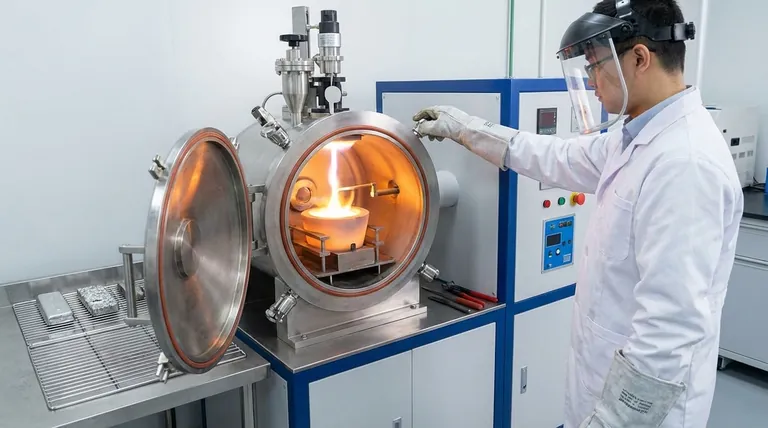
To guarantee chemical homogeneity and structural integrity, repeated flipping and remelting is a non-negotiable step in the arc melting process. Because arc melting generates intense, localized heat while the bottom of the ingot rests against a water-cooled copper mold, the material cools unevenly. By flipping and remelting the Sm-Co-Fe ingot multiple times, you force the constituent elements to mix thoroughly in the liquid state, eliminating the segregation that naturally occurs during a single melt.
Core Takeaway Arc melting inherently creates thermal gradients that lead to compositional segregation, particularly in alloys with different melting points like Sm-Co-Fe. Multiple remelting cycles utilize liquid-state diffusion and electromagnetic stirring to ensure a uniform macro-composition and a consistent microstructure.
The Physics of Arc Melting Inconsistency
To understand why remelting is required, one must first understand the inherent limitations of the arc melting environment.
Localized Heating
The electric arc provides an intense heat source, but it is highly localized at the top of the ingot.
This creates a significant temperature gradient across the material. The top is molten and active, while areas further away from the arc receive less direct energy.
Rapid Cooling at the Interface
The bottom of the ingot sits directly on a water-cooled copper hearth (mold).
This contact causes the bottom layer of the alloy to cool and solidify much faster than the rest of the melt. This rapid solidification "freezes" the local composition before it has a chance to mix with the bulk liquid.
Compositional Segregation
Samarium, Cobalt, and Iron have distinct atomic radii and melting points.
Without intervention, these differences lead to segregation, where heavier or higher-melting-point elements separate from the rest. A single melt results in an ingot that is chemically different at the bottom than it is at the top.
How Remelting Solves the Problem
Flipping and remelting is not merely a repetition; it is an active mixing process.
Promoting Liquid State Diffusion
By flipping the ingot, the previously cooled bottom surface is exposed directly to the arc.
Remelting ensures that the entire mass returns to a liquid state multiple times. This provides the Samarium, Cobalt, and Iron sufficient opportunity to diffuse, moving from areas of high concentration to low concentration.
Leveraging Electromagnetic Stirring
The high current used in arc melting generates magnetic fields that interact with the molten metal.
This creates an electromagnetic stirring effect within the melt pool. Multiple cycles maximize this effect, physically churning the elements together to eliminate macro-segregation.
Ensuring Microstructural Consistency
Research and application depend on a reliable baseline.
A uniform alloy ingot ensures that the microstructure is consistent throughout the volume. This eliminates variables caused by inhomogeneity, making subsequent characterization or processing valid.
Understanding the Trade-offs
While flipping and remelting is essential, it is important to view it as a controlled process rather than an indefinite one.
Diminishing Returns vs. Efficiency
There is a balance between achieving homogeneity and process efficiency. While a single melt is insufficient, flipping an ingot dozens of times yields diminishing returns on uniformity while increasing energy consumption and processing time.
Volatility Risks
Samarium is a rare earth element, which can be volatile under intense heat.
While remelting is necessary for mixing, excessive exposure to the arc without control could potentially lead to slight evaporative losses of volatile components. The goal is to melt just enough times (typically four) to achieve mixing without degrading the alloy's stoichiometry.
Making the Right Choice for Your Goal
The rigorous application of this technique depends on your specific requirements for the Sm-Co-Fe alloy.
- If your primary focus is material characterization: Perform at least four flip-and-remelt cycles to guarantee that any microstructural observations are intrinsic to the alloy, not artifacts of segregation.
- If your primary focus is rapid prototyping: You may be tempted to reduce cycles, but acknowledge that any mechanical or magnetic data collected will likely be unreliable due to macro-segregation.
Consistency in the melt stage is the absolute foundation for reliable material performance.
Summary Table:
| Factor | Impact on Sm-Co-Fe Alloy | Benefit of Flipping & Remelting |
|---|---|---|
| Temperature Gradient | Top is molten while bottom is cooled by copper hearth | Ensures the entire mass reaches a liquid state for mixing |
| Element Segregation | Sm, Co, and Fe separate due to density and melting points | Promotes liquid-state diffusion to equalize composition |
| Solidification Rate | Rapid cooling at the mold interface freezes impurities | Breaks down "frozen" layers to integrate into the bulk melt |
| Microstructure | Inconsistent grain structure throughout the ingot | Uses electromagnetic stirring for a uniform, reliable microstructure |
Elevate Your Material Research with KINTEK
Achieving perfect chemical homogeneity in complex alloys like Sm-Co-Fe requires more than just technique—it requires precision equipment. KINTEK provides high-performance lab solutions, including advanced Arc Melting, Vacuum, and CVD systems, specifically designed to handle the rigorous demands of rare-earth alloy production.
Backed by expert R&D and manufacturing, our systems are customizable to meet your unique metallurgical needs, ensuring consistent results for material characterization and high-tech prototyping.
Ready to optimize your alloying process? Contact us today to find the perfect high-temp furnace for your lab!
References
- Zhi Hong Zhu, Jiashuo Zhang. Effect of Fe Content on Phase Behavior of Sm–Co–Fe Alloys During Solidification and Aging. DOI: 10.3390/ma18081854
This article is also based on technical information from Kintek Furnace Knowledge Base .
Related Products
People Also Ask
- How do the different types of silicon carbide heating elements compare in terms of applications? Find the Best Fit for Your High-Temp Needs
- What are the temperature capabilities and mounting options for silicon carbide heating elements? Unlock High-Temp Flexibility and Durability
- How do silicon carbide heating elements enhance the heat treatment of alloys? Achieve Superior Temperature Control
- What is the recommended surface load for silicon carbide heating elements at different furnace temperatures? Maximize Lifespan & Performance
- What are the advantages of using silicon carbide heating elements in industrial furnaces? Boost Efficiency and Durability
