
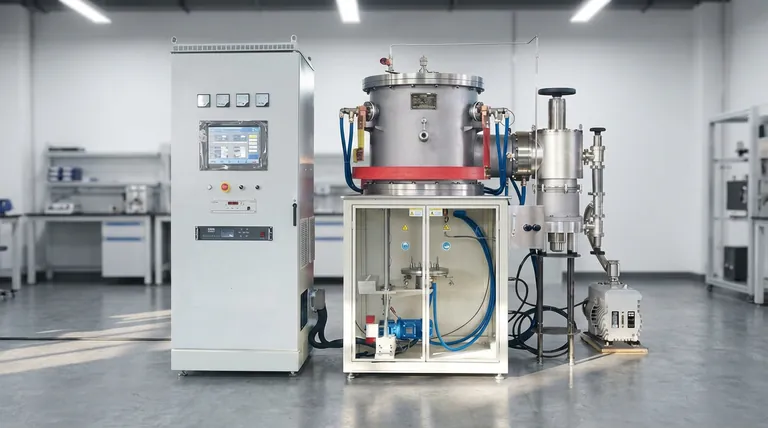
A vacuum induction furnace establishes a rigorous experimental environment defined by deep vacuum extraction followed by high-purity inert gas shielding. Specifically for HRB400 steel, the system utilizes a mechanical pump to reduce chamber pressure to below 15 Pa, then backfills the space with argon gas exceeding 99.999% purity to strictly limit oxygen exposure.
Core Takeaway The vacuum induction furnace does more than simply melt metal; it creates a "clean slate" thermodynamic system. By eliminating atmospheric interference and utilizing electromagnetic forces for mixing, it provides the precise kinetic conditions necessary to study inclusion evolution and control steel composition.
Controlling the Chemical Atmosphere
Achieving Ultra-Low Oxygen Levels
The primary function of this environment is the absolute minimization of oxygen. By pumping the chamber to a vacuum of less than 15 Pa, the system effectively removes ambient air and volatile impurities before heating begins.
The Role of High-Purity Inert Gas
Once the vacuum is established, the chamber is backfilled with high-purity argon (>99.999%). This acts as a protective shield, preventing re-oxidation of the melt and ensuring that any chemical changes are driven by experimental design, not atmospheric contamination.
Prevention of Alloy Loss
This controlled atmosphere is critical for maintaining the precise chemical composition of HRB400 steel. It prevents the oxidative loss of reactive alloying elements, ensuring that the final ingot matches the intended formulation.
Simulating Kinetic Conditions
Electromagnetic Stirring
Unlike resistance heating, the induction mechanism generates an electromagnetic field that physically stirs the molten steel. This naturally occurring "eddy current" effect promotes rapid chemical and thermal homogeneity throughout the crucible.
Modeling Inclusion Evolution
The stirring action is not merely for mixing; it simulates the kinetic conditions found in larger-scale industrial processing. This allows researchers to accurately observe how non-metallic inclusions evolve, collide, and float out during the melting of HRB400 steel.
Operational Constraints and Trade-offs
Sensitivity to Gas Purity
The integrity of the experiment relies entirely on the quality of inputs. If the argon purity drops even slightly below 99.999%, the baseline oxygen content will rise, compromising the study of inclusion modification.
Volatile Impurity Removal limits
While the vacuum effectively removes gaseous impurities like nitrogen and oxygen, the process relies on the initial vacuum stage. If the mechanical pump fails to reach the <15 Pa threshold prior to backfilling, residual gases will remain trapped in the melt.
Making the Right Choice for Your Goal
To maximize the utility of a vacuum induction furnace for HRB400 steel, align your operational parameters with your specific research objectives:
- If your primary focus is strict composition control: Prioritize the vacuum phase to ensure pressure drops below 15 Pa to effectively strip volatile impurities before introducing argon.
- If your primary focus is studying inclusion evolution: Focus on the electromagnetic stirring parameters to ensure the kinetic energy in the crucible accurately simulates your target industrial conditions.
Precision in the atmospheric setup is the single greatest determinant of data reliability in HRB400 melting experiments.
Summary Table:
| Feature | Parameter | Benefit |
|---|---|---|
| Vacuum Threshold | < 15 Pa | Removes air and volatile impurities |
| Gas Purity | > 99.999% Argon | Prevents oxidation and alloy loss |
| Heating Method | Electromagnetic Induction | Homogeneous mixing and thermal stability |
| Kinetic Simulation | Eddy Current Stirring | Models inclusion evolution and collisions |
Elevate Your Material Research with KINTEK
Don't let atmospheric contamination compromise your HRB400 steel studies. KINTEK provides industry-leading high-temperature lab solutions, including Vacuum, CVD, Tube, and Muffle systems, all backed by expert R&D and precision manufacturing. Our furnaces are fully customizable to meet your specific pressure and purity requirements, ensuring you achieve the 'clean slate' thermodynamic system your research demands.
Ready to optimize your melting environment? Contact our technical experts today to discuss your custom furnace needs.
References
- Yuhao Zhao, Hui Kong. The comparative study of Ti-bearing oxides introduced by different methods. DOI: 10.1515/htmp-2024-0002
This article is also based on technical information from Kintek Furnace Knowledge Base .
Related Products
- 600T Vacuum Induction Hot Press Vacuum Heat Treat and Sintering Furnace
- Vacuum Induction Melting Furnace
- Small Vacuum Heat Treat and Tungsten Wire Sintering Furnace
- Vacuum Hot Press Furnace Machine Heated Vacuum Press Tube Furnace
- High Pressure Laboratory Vacuum Tube Furnace
People Also Ask
- Why use Vacuum Hot Press (VHP) for ZnS Ceramics? Achieve Superior IR Transparency and Mechanical Strength
- How does a vacuum hot press sintering furnace mitigate copper sintering swelling? Solve Fe-Cu Expansion Issues
- How does the vacuum environment in a vacuum hot press sintering furnace protect chromium-containing ceramics? Find out.
- What are the key advantages of vacuum hot press sintering furnaces? Achieve Superior Density and Purity in Materials
- What is the core function of a vacuum hot press sintering furnace in the preparation of high-density RuTi alloys? Achieve Maximum Density and Purity



















