
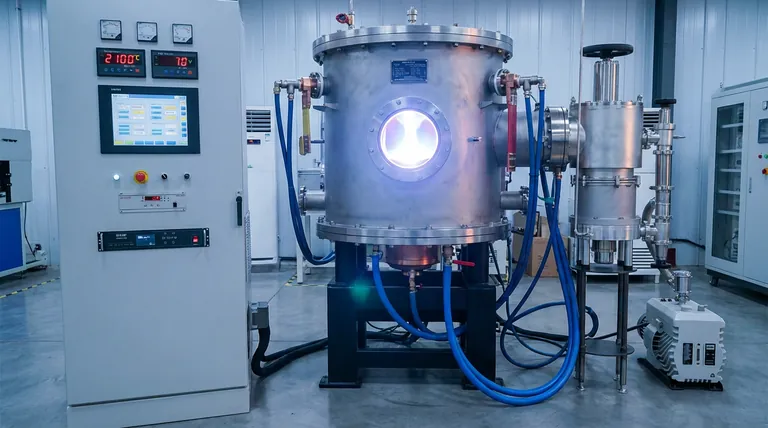
The primary role of a vacuum arc melting furnace in preparing Ti-6Al-7Nb-xTa alloys is to create a controlled, ultra-high temperature environment capable of melting refractory elements while preventing chemical contamination. Specifically, it generates temperatures exceeding 2100 °C to fully dissolve Tantalum (Ta) into the alloy matrix, while the vacuum atmosphere shields the reactive Titanium from oxygen and nitrogen.
Core Takeaway The vacuum arc melting furnace is not merely a heat source; it is a purification and homogenization tool. It solves the dual challenge of melting high-melting-point additives (like Tantalum) and preventing the embrittlement of Titanium by shielding it from atmospheric gases during the critical liquid phase.
Overcoming Thermal Barriers
The synthesis of Ti-6Al-7Nb-xTa alloys presents a significant thermal challenge due to the disparity in melting points between the base metal and the alloying elements.
Achieving Ultra-High Temperatures
Standard melting equipment often struggles to reach the temperatures necessary to fully fuse refractory metals. Tantalum (Ta), a critical component in this alloy, has an exceptionally high melting point.
The vacuum arc melting furnace generates temperatures exceeding 2100 °C. This extreme heat is non-negotiable for ensuring that the Tantalum is completely melted and integrated into the Titanium base, rather than remaining as unmelted inclusions.
Eliminating Compositional Segregation
When alloying elements with vastly different densities and melting points are combined, segregation is a common risk.
By achieving complete liquefaction of the Tantalum, the furnace ensures the formation of a homogeneous solid solution. This foundational step is critical for the material's final mechanical performance.
Chemical Protection and Purity
Titanium is highly reactive, particularly when in a molten state. The furnace’s environment is the primary defense against material degradation.
Preventing Gas-Metal Reactions
At high temperatures, Titanium reacts aggressively with oxygen and nitrogen found in the air. These reactions lead to the formation of oxides and nitrides, which cause severe embrittlement.
The furnace operates under a high vacuum to remove these reactive gases. By eliminating the presence of air, the furnace effectively prevents the Titanium alloy from reacting with oxygen and nitrogen, preserving the ductility and integrity of the material.
Minimizing Impurities
Beyond atmospheric gases, the vacuum environment aids in the removal of volatile impurities. This results in a final ingot with higher chemical purity compared to alloys processed in non-vacuum environments.
Structural Integrity via Cooling
The physical components of the furnace play a role equal to that of the vacuum and the arc.
Rapid Solidification
The furnace is equipped with a water-cooled copper crucible. This component is not just a container; it is an active part of the thermal management system.
The water cooling facilitates the rapid solidification of the molten alloy. Rapid cooling rates are essential for controlling the microstructure of the alloy, preventing grain growth that could weaken the material.
Ensuring Casting Quality
The combination of rapid cooling and a contaminant-free environment directly translates to high casting quality. The process yields samples with compositional uniformity, ensuring that the properties of the alloy are consistent throughout the ingot.
Understanding the Trade-offs
While vacuum arc melting is the standard for high-performance reactive alloys, it requires precise operational management.
Energy and Complexity
Reaching temperatures above 2100 °C under vacuum requires significant energy input and complex equipment maintenance. The process is generally more resource-intensive than melting lower-temperature, non-reactive metals.
Scale Limitations
Vacuum arc melting in this context is often used for creating ingots or "buttons." It is generally not a near-net-shape casting process. The resulting material typically requires subsequent processing (such as forging or machining) to achieve the final component shape.
Making the Right Choice for Your Goal
The use of a vacuum arc melting furnace is dictated by the specific chemical and thermal requirements of your alloy.
- If your primary focus is Compositional Accuracy: Rely on the furnace’s ability to exceed 2100 °C to ensure refractory elements like Tantalum are fully dissolved.
- If your primary focus is Mechanical Ductility: Prioritize the vacuum integrity of the furnace to prevent oxygen embrittlement, which is the leading cause of failure in Titanium alloys.
- If your primary focus is Microstructural Consistency: Utilize the water-cooled crucible feature to drive rapid solidification, ensuring a fine and uniform grain structure.
Success in preparing Ti-6Al-7Nb-xTa relies on leveraging the furnace not just to melt metal, but to strictly control the chemical and thermal history of the alloy.
Summary Table:
| Feature | Function in Ti-6Al-7Nb-xTa Preparation | Benefit |
|---|---|---|
| Temperatures >2100 °C | Dissolves refractory Tantalum (Ta) | Ensures zero unmelted inclusions |
| High Vacuum Environment | Shields molten Titanium from O2 and N2 | Prevents embrittlement and degradation |
| Water-Cooled Copper Crucible | Facilitates rapid solidification | Controls microstructure and grain growth |
| Arc Melting Process | Intensive energy for high-density elements | Achieves compositional uniformity |
Elevate Your Material Research with KINTEK
Precision is paramount when working with reactive Titanium and refractory Tantalum alloys. KINTEK provides industry-leading vacuum furnace technology designed to meet the most rigorous thermal and purity requirements. Backed by expert R&D and manufacturing, we offer high-performance Muffle, Tube, Rotary, Vacuum, and CVD systems, all fully customizable for your unique lab needs.
Ready to achieve superior homogenization and chemical purity? Contact us today to discuss your custom furnace solution and see how our expertise can drive your next breakthrough.
Visual Guide

References
- M. El-Batran, Mohamed El‐Shazly. Influence of Alloying with Tantalum on the Mechanical Properties and Corrosion Behavior of Ti-6Al-7Nb-xTa Cast Alloys. DOI: 10.1007/s40962-024-01481-8
This article is also based on technical information from Kintek Furnace Knowledge Base .
Related Products
- Vacuum Induction Melting Furnace
- Vacuum Heat Treat Sintering and Brazing Furnace
- Small Vacuum Heat Treat and Tungsten Wire Sintering Furnace
- Vacuum Heat Treat Sintering Furnace Molybdenum Wire Vacuum Sintering Furnace
- Vacuum Hot Press Furnace Machine Heated Vacuum Press Tube Furnace
People Also Ask
- What are the core functions of the High Vacuum Induction Melting (VIM) furnace? Optimize DD5 Superalloy Purification
- What role does a Vacuum Induction Melting furnace play in the production of high-aluminum nickel-based superalloys?
- Why is a Vacuum Induction Melting furnace (VIM) used for Cu-Zn-Al-Sn alloys? Achieve Precision Composition Control
- What are the advantages of using a VIM furnace to control residual oxygen pressure? Achieve Superior Metal Uniformity
- What is the role of VIM and directional solidification in aero-engine blade substrates? Engineering Extreme Durability



















