
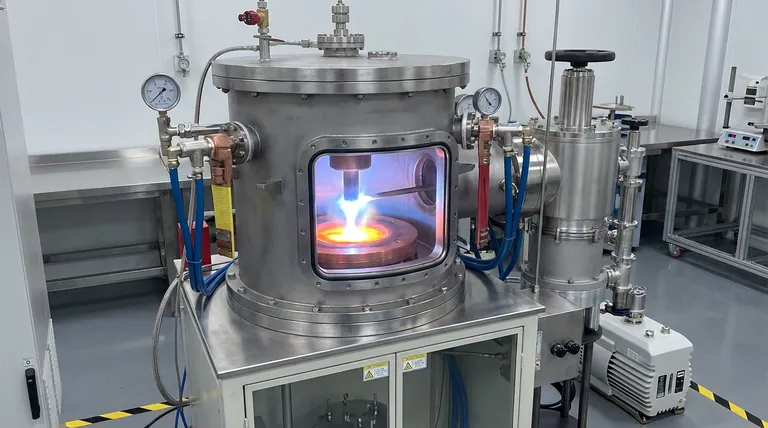
The vacuum arc furnace serves as the definitive synthesis platform for TixNbMoTaW refractory high-entropy alloys. By utilizing high-voltage arcs to generate extreme temperatures between 5000 and 6000 K, it solves the dual challenge of melting highly refractory metals while rigorously protecting reactive elements from environmental contamination.
The vacuum arc furnace is the critical link between raw material and a viable alloy. It provides the extreme energy density required to melt tungsten and tantalum, while simultaneously creating a vacuum and inert gas shield to prevent the catastrophic oxidation of titanium and niobium.
Achieving Extreme Thermal Conditions
Overcoming High Melting Points
The primary challenge in synthesizing TixNbMoTaW is the "refractory" nature of its components. Elements like Tungsten (W), Tantalum (Ta), and Molybdenum (Mo) possess exceptionally high melting points that conventional furnaces cannot easily reach.
The Role of High-Voltage Arcs
The vacuum arc furnace addresses this by employing high-voltage arcs. These arcs generate localized temperatures ranging from 5000 to 6000 K.
Rapid Melting Capability
This extreme thermal environment allows for the rapid melting of even the most stubborn raw metals in the mix. This ensures that the entire charge transitions to a liquid state, which is the prerequisite for forming a unified solid solution alloy.
Preserving Chemical Integrity
The Threat of Oxidation
The TixNbMoTaW alloy system contains Titanium (Ti) and Niobium (Nb). These are highly reactive metals that will instantaneously oxidize or react with nitrogen if exposed to air at elevated temperatures.
Establishing the Vacuum
Before melting occurs, the system utilizes a laboratory vacuum pump to evacuate the furnace chamber. This step removes air, moisture, and nitrogen, creating a high-vacuum baseline.
Inert Gas Shielding
Once the vacuum is established, the chamber is typically backfilled or shielded with argon gas. This inert atmosphere acts as a protective blanket during the high-heat melting phase.
Preventing Embrittlement
By eliminating oxygen and nitrogen, the furnace prevents the formation of brittle impurity phases. This ensures the chemical accuracy and purity of the final alloy, preventing the degradation of its mechanical properties.
Managing Composition and Uniformity
Handling Density Discrepancies
High-entropy alloys like TixNbMoTaW involve elements with vastly different densities (e.g., Titanium vs. Tungsten). The vacuum arc melting process must facilitate the mixing of these disparate elements.
Mixing via the Melt Pool
While the primary focus is melting, the liquid state achieved in the furnace allows for the preliminary mixing of these components. The inputs suggest that effective melting is essential for obtaining high-purity alloy ingots with accurate compositions, overcoming the natural tendency of heavy elements to settle.
Understanding the Trade-offs
The Limit of Initial Melting
While the vacuum arc furnace is excellent for melting and purity, it does not guarantee perfect microstructural homogeneity immediately upon solidification.
Rapid Solidification Effects
The cooling process in an arc furnace can be rapid, potentially leading to dendritic segregation (uneven distribution of elements at the microscopic level).
The Need for Post-Processing
Often, the alloy produced in the vacuum arc furnace is a "button" or ingot that requires subsequent treatment. As noted in supplementary contexts, a high-temperature tube furnace is often required afterward to perform homogenization annealing (e.g., at 1150 °C) to eliminate segregation and stabilize the microstructure.
Making the Right Choice for Your Goal
To ensure the successful preparation of TixNbMoTaW alloys, consider how the vacuum arc furnace fits into your broader workflow:
- If your primary focus is Elemental Purity: Rely on the vacuum arc furnace's argon-shielding capabilities to prevent the oxidation of Titanium and Niobium.
- If your primary focus is Melting Refractory Metals: Leverage the 5000–6000 K arc temperature to ensure Tungsten and Tantalum are fully liquified.
- If your primary focus is Microstructural Homogeneity: Do not rely solely on the arc furnace; plan for a subsequent annealing stage in a tube furnace to resolve dendritic segregation.
The vacuum arc furnace is the indispensable "first step" machine, transforming raw, disparate elements into a clean, unified alloy ready for thermal treatment.
Summary Table:
| Feature | Function in TixNbMoTaW Synthesis | Benefit |
|---|---|---|
| High-Voltage Arc | Generates 5000 - 6000 K temperatures | Melts refractory Tungsten (W) and Tantalum (Ta) |
| Vacuum System | Removes air, moisture, and nitrogen | Prevents oxidation of Titanium (Ti) and Niobium (Nb) |
| Inert Gas Shield | Argon gas backfilling | Protects chemical purity and prevents embrittlement |
| Melt Pool | Rapid transition to liquid state | Facilitates mixing of metals with disparate densities |
Elevate Your Material Synthesis with KINTEK
Precision in high-entropy alloy preparation starts with the right thermal environment. Backed by expert R&D and manufacturing, KINTEK offers high-performance Vacuum Arc Melters, Tube Furnaces, and CVD systems tailored for the rigorous demands of refractory metal research. Whether you need the extreme heat of an arc furnace for TixNbMoTaW or post-melt homogenization in a customizable high-temp tube furnace, our equipment ensures the chemical purity and microstructural stability your project requires.
Ready to optimize your lab's workflow? Contact us today to find your custom solution!
References
- Ruisheng Zhao, Chao Chang. Microstructure and Mechanical Properties of TixNbMoTaW Refractory High-Entropy Alloy for Bolt Coating Applications. DOI: 10.3390/coatings15020120
This article is also based on technical information from Kintek Furnace Knowledge Base .
Related Products
- Vacuum Hot Press Furnace Machine Heated Vacuum Press Tube Furnace
- Vacuum Sealed Continuous Working Rotary Tube Furnace Rotating Tube Furnace
- Vacuum Hot Press Furnace Machine Heated Vacuum Press
- Vacuum Heat Treat Furnace with Ceramic Fiber Liner
- Vacuum Heat Treat Sintering Furnace with Pressure for Vacuum Sintering
People Also Ask
- Why use Vacuum Hot Press (VHP) for ZnS Ceramics? Achieve Superior IR Transparency and Mechanical Strength
- What are the benefits of the vacuum environment system in a vacuum hot press furnace? Unlock High-Density Sintering
- What safety features are incorporated in vacuum hot press furnaces? Ensure Operator and Equipment Protection
- Why is a high vacuum environment crucial when preparing copper-carbon nanotube composites in a vacuum hot press furnace? Achieve Superior Composite Integrity
- How have vacuum hot press furnaces transformed material processing? Achieve Superior Density and Purity



















