
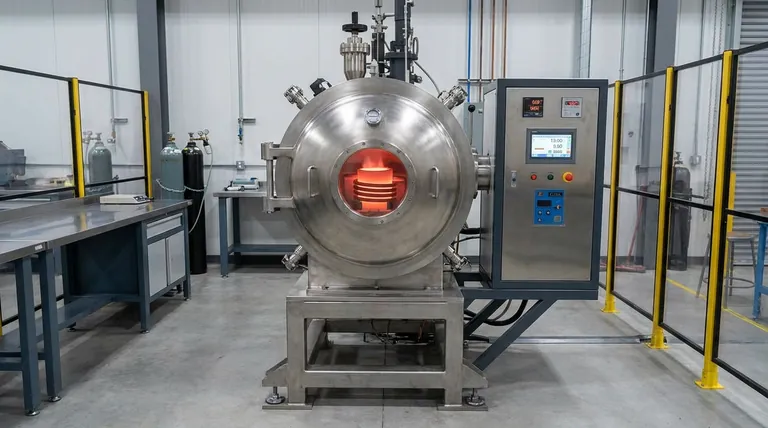
The Vacuum Induction Melting (VIM) furnace serves as the foundational purification stage in the manufacturing of C1023 nickel-based superalloys. Its primary function is to create a highly controlled vacuum environment that prevents the oxidation of reactive alloying elements, specifically aluminum and titanium, while simultaneously removing gaseous impurities from the melt. Through precise temperature control and induction mechanics, the furnace ensures a uniform chemical composition, producing the high-purity ingots required for aerospace engine hot-section components.
The VIM furnace is not merely a heating vessel; it is a chemical processing tool that utilizes vacuum pressure to eliminate volatile impurities and electromagnetic physics to homogenize complex alloy mixtures.
The Critical Necessity of Vacuum Environments
Preventing Elemental Loss
C1023 superalloys rely heavily on active elements, particularly aluminum and titanium, to achieve their high-temperature strength. These elements are highly reactive and will instantly oxidize if exposed to air during melting.
Protecting the Melt
The VIM furnace eliminates atmospheric oxygen, preventing these active elements from turning into oxide inclusions (impurities) or burning off as slag. This ensures the final alloy retains the exact chemical ratio necessary for its intended mechanical properties.
Active Degassing
Beyond preventing oxidation, the vacuum environment actively cleans the metal. The low-pressure atmosphere forces dissolved gaseous impurities to escape from the molten liquid, significantly refining the material's purity.
Mechanisms of Homogeneity
Electromagnetic Stirring
Melting uniform superalloys is difficult due to the varying densities of the raw materials. VIM technology addresses this through the physics of induction heating, which generates strong electromagnetic stirring forces within the crucible.
Ensuring Uniform Distribution
This stirring action acts as an invisible mixer, circulating the molten metal continuously. It ensures that the main matrix and critical active elements are perfectly blended, preventing segregation.
Precise Thermal Regulation
The VIM furnace provides exact control over the melt temperature. This thermal precision allows operators to maintain the metal at optimal conditions for alloying and refining, ensuring a consistent, high-quality ingot structure upon solidification.
Understanding the Trade-offs
The Scope of VIM
While VIM is superior for chemical definition and purity, it is primarily a primary melting process. It excels at establishing the chemistry but does not control the final grain structure (like single-crystal formation) as effectively as downstream processes like directional solidification.
Refractory Interactions
Because the metal is melted in a ceramic crucible, there is a minor risk of interaction between the reactive melt and the crucible lining. Strict process control is required to prevent ceramic inclusions from entering the ultra-pure alloy.
Making the Right Choice for Your Goal
To maximize the quality of C1023 superalloy production, consider how the VIM process aligns with your specific metallurgical objectives:
- If your primary focus is Chemical Purity: Rely on VIM to effectively remove gaseous impurities and prevent the formation of oxide inclusions that compromise fatigue life.
- If your primary focus is Compositional Accuracy: Leverage the electromagnetic stirring capability of VIM to ensure complete homogenization of aluminum and titanium within the nickel matrix.
The VIM furnace effectively acts as the gatekeeper of quality, transforming raw elements into the pristine, chemically precise material demanded by the aerospace industry.
Summary Table:
| Feature | Function in C1023 Production | Impact on Final Alloy |
|---|---|---|
| Vacuum Environment | Prevents oxidation of Al & Ti | Maintains critical chemical ratios |
| Degassing | Removes dissolved gaseous impurities | Enhances material purity & fatigue life |
| Induction Stirring | Electromagnetic homogenization | Eliminates elemental segregation |
| Thermal Control | Precise melt temperature regulation | Ensures consistent ingot structure |
Elevate Your Superalloy Production with KINTEK
Precision is non-negotiable in aerospace-grade materials. Backed by expert R&D and manufacturing, KINTEK offers high-performance Vacuum Induction Melting (VIM) systems and other lab high-temp furnaces, including Muffle, Tube, Rotary, and CVD systems—all fully customizable for your unique metallurgical needs.
Whether you are refining C1023 superalloys or developing next-generation materials, our equipment ensures the chemical purity and homogeneity your project demands. Contact us today to discuss your custom furnace requirements and see how our expertise can drive your innovation.
References
- Qualification and Certification of Nickel based C1023 Super Alloys for Aero-Engine Applications. DOI: 10.14429/dsj.19931
This article is also based on technical information from Kintek Furnace Knowledge Base .
Related Products
- Vacuum Induction Melting Furnace
- 600T Vacuum Induction Hot Press Vacuum Heat Treat and Sintering Furnace
- Vacuum Heat Treat Sintering Furnace with Pressure for Vacuum Sintering
- Vacuum Heat Treat Sintering Furnace Molybdenum Wire Vacuum Sintering Furnace
- Vacuum Heat Treat Sintering and Brazing Furnace
People Also Ask
- What are the core functions of the High Vacuum Induction Melting (VIM) furnace? Optimize DD5 Superalloy Purification
- Why is a Vacuum Induction Melting furnace (VIM) used for Cu-Zn-Al-Sn alloys? Achieve Precision Composition Control
- What are the advantages of using a VIM furnace to control residual oxygen pressure? Achieve Superior Metal Uniformity
- What role does a Vacuum Induction Melting furnace play in the production of high-aluminum nickel-based superalloys?
- What are the technical advantages of using a Vacuum Induction Melting furnace in the development of advanced packaging steel?



















