
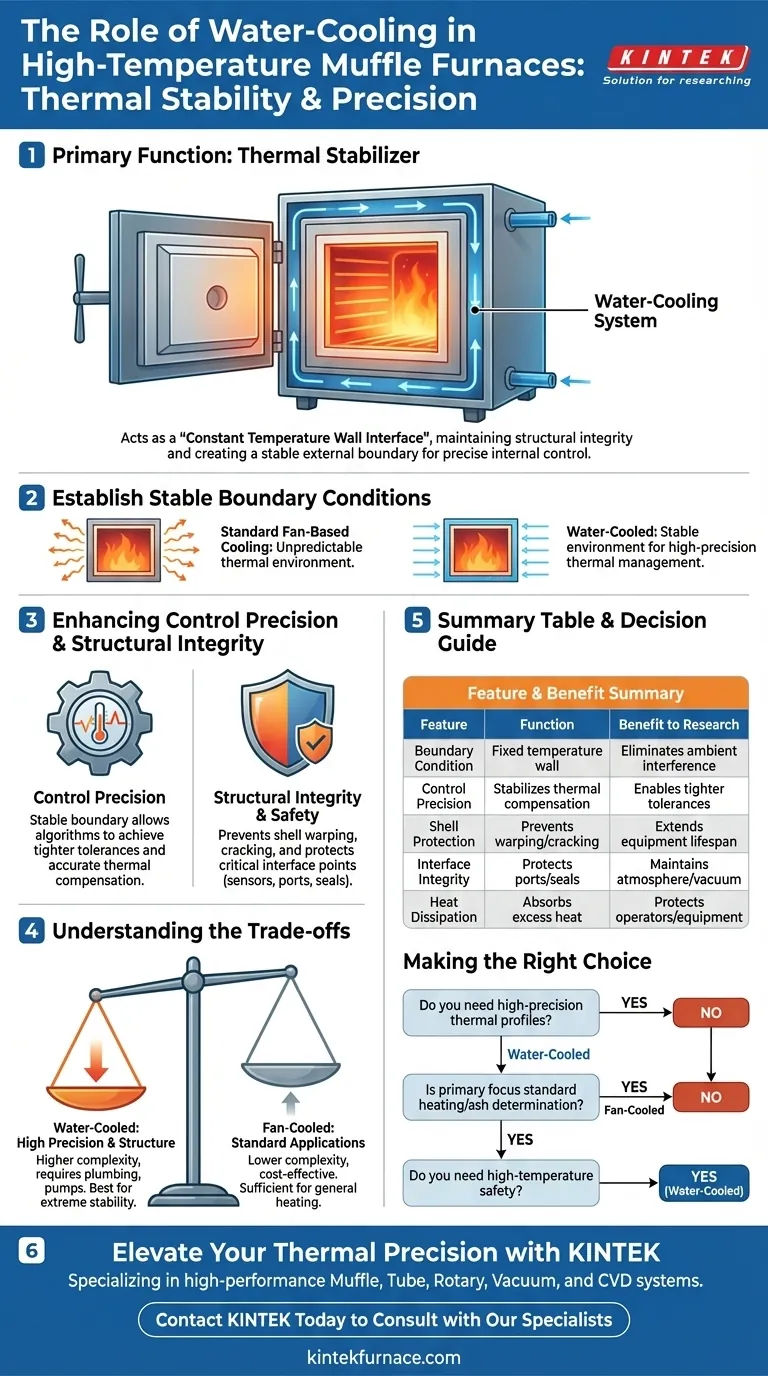
In high-precision muffle furnaces, a water-cooling system functions primarily as a thermal stabilizer. It acts as a "constant temperature wall interface" that maintains the structural integrity of the furnace shell and critical connection points. Beyond mere safety, this cooling layer creates a stable external boundary condition, which is essential for the internal control system to achieve accurate thermal compensation.
Core Takeaway While standard laboratory furnaces often rely on simple exhaust fans, high-precision units utilize water cooling to establish a fixed thermal boundary. This prevents shell deformation and provides the consistent baseline required for ultra-precise internal temperature regulation.
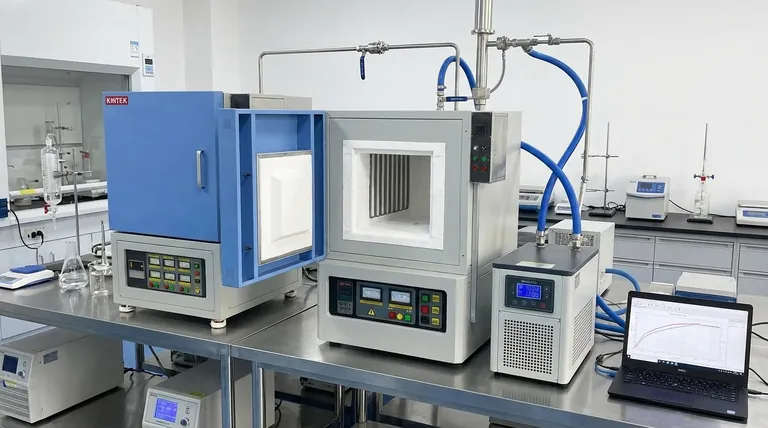
The Role of the Constant Temperature Wall
Establishing Stable Boundary Conditions
High-temperature operations create massive thermal gradients. The water-cooling system creates a consistent "wall" around the furnace chamber.
By keeping the external boundary at a fixed temperature, the system eliminates variables caused by fluctuating ambient conditions. This stability is the foundation for high-precision thermal management.
Enhancing Control Precision
Internal temperature control systems rely on algorithms to manage heat flow. These algorithms perform better when the external environment is predictable.
The water-cooling system assists the controller by stabilizing the environment against which it must compensate. This allows for tighter tolerances and more accurate thermal compensation during complex heating cycles.
Structural Integrity and Safety
Protecting the Furnace Shell
The immense heat generated inside a muffle furnace can compromise the outer casing. The primary physical role of the water-cooling system is to preserve the furnace shell.
By absorbing and removing excess heat, it prevents the casing from warping, cracking, or degrading over time. This ensures the unit remains mechanically sound even during prolonged high-temperature use.
Managing Specific Interfaces
Furnaces have critical interface points, such as ports for sensors, gas lines, or viewports. These areas are often more sensitive to thermal expansion than the main body.
Water cooling creates a protective thermal barrier around these specific interfaces. This prevents seal failure and maintains vacuum or atmosphere integrity within the muffle.
Understanding the Trade-offs
Complexity vs. Necessity
It is important to note that not all muffle furnaces require this level of thermal management. As noted in standard laboratory contexts, many units operate effectively with simple fan-based exhaust systems.
Water cooling adds complexity, requiring plumbing, pumps, and potential leak maintenance. It is a feature specifically designed for applications where structural rigidity and extremely precise temperature control outweigh the added operational overhead.
Making the Right Choice for Your Application
To determine if a water-cooled system is necessary for your specific requirements, consider the following:
- If your primary focus is high-precision thermal profiles: You likely need a water-cooled unit to ensure the control algorithms have a stable boundary condition for accurate compensation.
- If your primary focus is standard ash determination or general heating: A standard laboratory unit with fan-based cooling is typically sufficient and more cost-effective.
- If your primary focus is high-temperature safety: Water cooling provides the highest level of protection for the furnace shell and the operator by keeping external surface temperatures low.
The value of a water-cooling system lies not just in cooling, but in the rigorous control and stability it brings to high-temperature environments.
Summary Table:
| Feature | Function in Water-Cooled Muffle Furnaces | Benefit to Research/Production |
|---|---|---|
| Boundary Condition | Establishes a fixed temperature wall | Eliminates ambient temperature interference |
| Control Precision | Stabilizes thermal compensation environment | Enables tighter tolerances for complex cycles |
| Shell Protection | Prevents casing warping and cracking | Extends equipment lifespan and ensures safety |
| Interface Integrity | Protects sensor ports and gas line seals | Maintains atmosphere and vacuum stability |
| Heat Dissipation | Absorbs and removes excess external heat | Protects operators and sensitive lab equipment |
Elevate Your Thermal Precision with KINTEK
Don’t let fluctuating boundary conditions compromise your high-precision research. At KINTEK, we specialize in engineering high-performance Muffle, Tube, Rotary, Vacuum, and CVD systems designed to meet the most rigorous laboratory standards. Whether you need a water-cooled furnace for ultra-stable thermal profiles or a custom-built solution for unique industrial applications, our expert R&D and manufacturing teams are here to deliver.
Ready to optimize your high-temperature processes? Contact KINTEK Today to Consult with Our Specialists
Visual Guide
References
- Yuchen Wang, Haisheng Fang. Research and optimization of temperature uniformity of high-precision muffle furnace. DOI: 10.1088/1742-6596/3009/1/012076
This article is also based on technical information from Kintek Furnace Knowledge Base .
Related Products
- 1700℃ High Temperature Muffle Oven Furnace for Laboratory
- 1800℃ High Temperature Muffle Oven Furnace for Laboratory
- 1200℃ Muffle Oven Furnace for Laboratory
- 1400℃ Muffle Oven Furnace for Laboratory
- High Temperature Muffle Oven Furnace for Laboratory Debinding and Pre Sintering
People Also Ask
- What is the primary function of a high-temperature laboratory muffle furnace in chemical synthesis? Achieve Precision.
- How does a high-temperature laboratory muffle furnace affect material properties? Transform Anodic Oxide Films Fast
- What role does a muffle furnace play in BCZY712 electrolyte powder production? Achieve Perfect Phase Purity
- How does a muffle furnace impact Ni/MgAl2O4 catalysts? Optimize Stability and Catalytic Performance
- What is the role of a high-temperature muffle furnace in guava leaf carbonization? Master Precise Pyrolysis Control
















